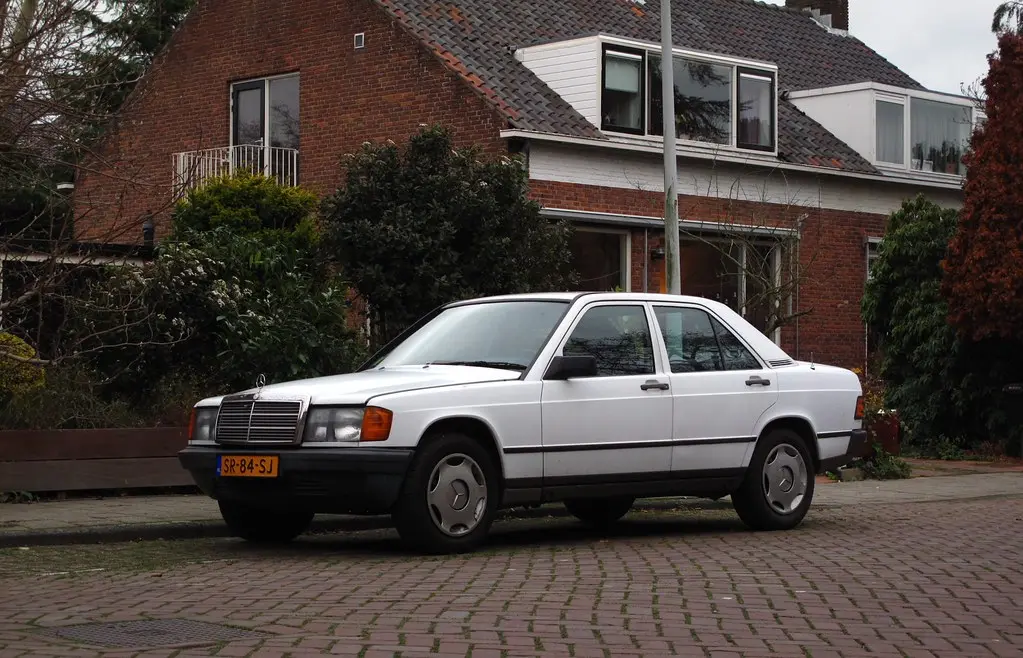
Mercedes-Benz

Mercedes-Benz 190

Mercedes-Benz 190
Photo: Rutger van der Maar / Wikimedia Commons · CC BY 2.0

The official data lists 36 versions of the Mercedes-Benz 190 (1984–2010), in the European Union and the United States. Each market publishes its own figures, measured on its own test procedure.

At a glance

Years in the data
1984–2010
Markets
European Union, United States
Engines
2.0 L to 2.6 L
Fuels
Diesel, Petrol
Lowest consumption (United States)
7.8 L/100 km (EPA)
New registrations in the EU
10

What is the Mercedes-Benz 190?

The 190 is a compact four-door saloon that brought Mercedes-Benz into a smaller class of passenger cars. Its crisp, wedge-shaped design set it apart, while a specially developed rear suspension helped define its engineering. The W201 sat below the brand’s larger saloons and began the model line that later became the C-Class.

It suited drivers looking for a more compact Mercedes-Benz saloon for everyday use. The W201’s mix of a smaller footprint and traditional saloon practicality gave the marque a new place in the passenger-car range.

W201 generation and engines

The W201 appears in US figures from 1984 to 1993, with petrol and diesel engines from 2.0 L to 2.6 L. The 190 E used petrol injection, while the 190 D brought diesel power to the range. A 16-valve 190 E added a sportier version to the line.

In EU registration figures, a single 2.0 L diesel version appears in 2010. That entry is separate from the W201’s US model years.

How economical is the Mercedes-Benz 190?

In the United States, the best combined EPA rating is 30 MPG. The lowest listed consumption is 7.8 L/100 km under the EPA procedure. EPA results use a different test method from European WLTP or NEDC figures, so the ratings are not directly interchangeable.

In EU registration figures, the listed 2.0 L diesel appears in 2010.

Where was the 190 sold?

US figures cover 1984 to 1993 and include petrol and diesel versions. The EU registration entry is for a 2.0 L diesel in 2010.

Questions and answers

What generation is the Mercedes-Benz 190?

The 190 is the W201 generation, shown in the US figures from 1984 to 1993.

What engines were available in the US?

The US range included petrol and diesel engines from 2.0 L to 2.6 L.

What is its best EPA fuel economy figure?

The best combined EPA rating listed is 30 MPG.

190 W201 (1984–1993)

Mercedes-Benz 190 W201
Photo: Rutger van der Maar / Wikimedia Commons · CC BY 2.0

Model codes: W201 · Sold in: United States · References: en.wikipedia.org, media.mercedes-benz.com

United States 35 versions

Model years sold in the USA, from the EPA and the Department of Energy (fueleconomy.gov). MPG on the EPA test; litres per 100 km = 235.215 ÷ MPG.

Years and versionEngineFuelGearboxDriveConsumption (combined)CO₂
1991–1993(FFS)2.3 LPetrol5-speed manualRear-wheel drive21 MPG (11.2 L/100 km) EPA263 g/km
1992–1993(FFS)2.3 LPetrol4-speed automaticRear-wheel drive20 MPG (11.8 L/100 km) EPA276 g/km
1990–1993(FFS)2.6 LPetrol5-speed manualRear-wheel drive20 MPG (11.8 L/100 km) EPA276 g/km
1992–1993(FFS)2.6 LPetrol4-speed automaticRear-wheel drive20 MPG (11.8 L/100 km) EPA276 g/km
1991(FFS)2.0 LPetrol4-speed manualRear-wheel drive20 MPG (11.8 L/100 km) EPA276 g/km
1991(GUZZLER), EMS2.0 LPetrol4-speed automaticRear-wheel drive17 MPG (13.8 L/100 km) EPA325 g/km
1991(FFS)2.3 LPetrol4-speed automaticRear-wheel drive21 MPG (11.2 L/100 km) EPA263 g/km
1991(FFS)2.6 LPetrol4-speed automaticRear-wheel drive19 MPG (12.4 L/100 km) EPA291 g/km
1990(FFS)2.6 LPetrol4-speed automaticRear-wheel drive18 MPG (13.1 L/100 km) EPA307 g/km
1989(NO-CAT)2.5 LDiesel4-speed automaticRear-wheel drive27 MPG (8.7 L/100 km) EPA234 g/km
1989(FFS)2.6 LPetrol4-speed automaticRear-wheel drive19 MPG (12.4 L/100 km) EPA291 g/km
1989(FFS)2.6 LPetrol5-speed manualRear-wheel drive20 MPG (11.8 L/100 km) EPA276 g/km
1986–1988(16-VALVE) (FFS) (MPFI) · (FFS)2.3 LPetrol4-speed automaticRear-wheel drive20 MPG (11.8 L/100 km) EPA276 g/km
1987–1988(FFS)2.3 LPetrol5-speed manualRear-wheel drive21 MPG (11.2 L/100 km) EPA263 g/km
1986–1988(MPFI) (NO-CAT) · (NO-CAT)2.5 LDiesel4-speed automaticRear-wheel drive28 MPG (8.4 L/100 km) EPA226 g/km
1988(FFS)2.6 LPetrol4-speed automaticRear-wheel drive19 MPG (12.4 L/100 km) EPA291 g/km
1988(FFS)2.6 LPetrol5-speed manualRear-wheel drive19 MPG (12.4 L/100 km) EPA291 g/km
1987(FFS)2.3 LPetrol4-speed automaticRear-wheel drive19 MPG (12.4 L/100 km) EPA291 g/km
1987(FFS)2.3 LPetrol5-speed manualRear-wheel drive19 MPG (12.4 L/100 km) EPA291 g/km
1987(NO-CAT)2.5 LDiesel5-speed manualRear-wheel drive28 MPG (8.4 L/100 km) EPA226 g/km
1987(DSL,TRBO) (NO-CAT)2.5 LDiesel4-speed automaticRear-wheel drive26 MPG (9.0 L/100 km) EPA243 g/km
1987(FFS)2.6 LPetrol4-speed automaticRear-wheel drive18 MPG (13.1 L/100 km) EPA307 g/km
1985–1986(FFS) · (FFS) (MPFI)2.3 LPetrol5-speed manualRear-wheel drive20 MPG (11.8 L/100 km) EPA276 g/km
1986(FFS) (MPFI)2.3 LPetrol4-speed automaticRear-wheel drive19 MPG (12.4 L/100 km) EPA291 g/km
1986(16-VALVE) (FFS) (MPFI)2.3 LPetrol5-speed manualRear-wheel drive19 MPG (12.4 L/100 km) EPA291 g/km
1986(MPFI) (NO-CAT)2.5 LDiesel5-speed manualRear-wheel drive28 MPG (8.4 L/100 km) EPA226 g/km
19852.2 LDiesel4-speed automaticRear-wheel drive27 MPG (8.7 L/100 km) EPA234 g/km
19852.2 LDiesel5-speed manualRear-wheel drive30 MPG (7.8 L/100 km) EPA211 g/km
1985(FFS)2.3 LPetrol4-speed automaticRear-wheel drive18 MPG (13.1 L/100 km) EPA307 g/km
1984(DIESEL)2.2 LDiesel4-speed automatic–29 MPG (8.1 L/100 km) EPA218 g/km
1984(DIESEL) · (DIESEL) CA model2.2 LDiesel4-speed automatic–28 MPG (8.4 L/100 km) EPA226 g/km
1984(DIESEL) · (DIESEL) CA model2.2 LDiesel5-speed manual–30 MPG (7.8 L/100 km) EPA211 g/km
1984(DIESEL)2.2 LDiesel5-speed manual–30 MPG (7.8 L/100 km) EPA211 g/km
1984(FFS) · (FFS) CA model2.3 LPetrol4-speed automatic–20 MPG (11.8 L/100 km) EPA276 g/km
1984(FFS) · (FFS) CA model2.3 LPetrol5-speed manual–21 MPG (11.2 L/100 km) EPA263 g/km

Versions outside these generations

European Union 1 version

New cars registered in the EU (plus Norway and Iceland), from the European Environment Agency. Figures on the NEDC procedure until 2020 and on WLTP from 2021; versions are grouped by engine and power, with their number of registrations.

Years and versionEngineFuelCO₂EU registrations
20102.0 LDiesel156 g/km10

Official figures are measured on standard test procedures and differ between markets. Your consumption depends on how, where and in what conditions you drive.