Mazda

Mazda B3000

Mazda B3000
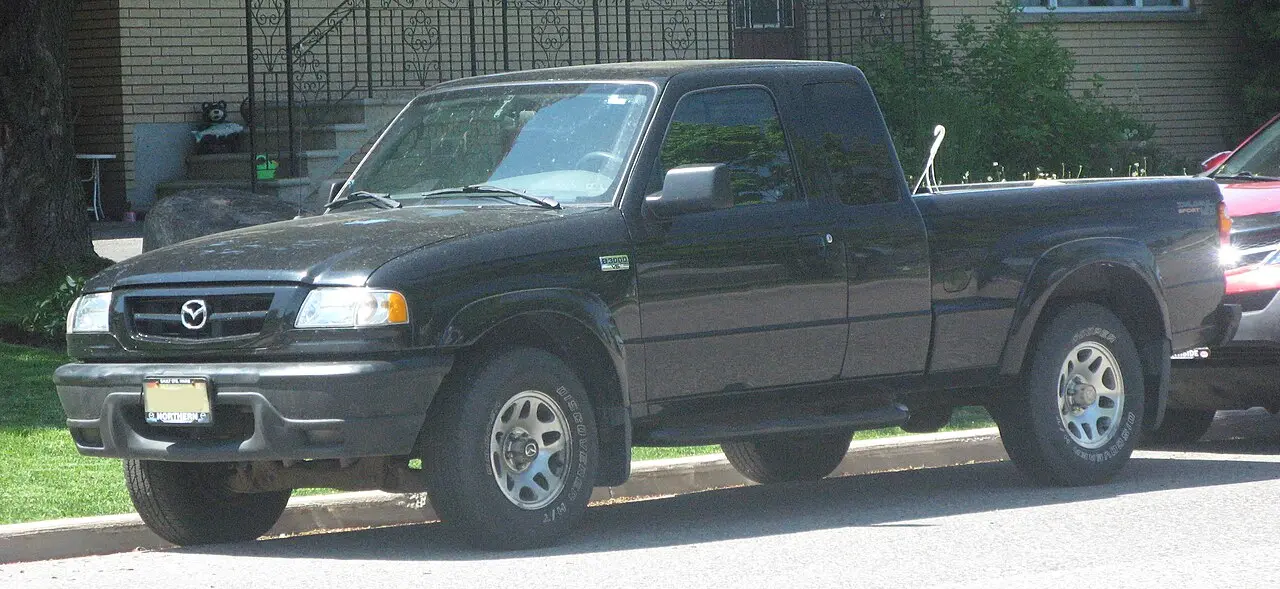
Photo: SsmIntrigue / Wikimedia Commons · CC BY-SA 4.0

The official data lists 55 versions of the Mazda B3000 (1995–2008), in the United States and Canada. Each market publishes its own figures, measured on its own test procedure.

At a glance

Years in the data
1995–2008
Markets
United States, Canada
Engines
3.0 L
Fuels
Petrol, Flex fuel (E85)
Lowest consumption (Canada)
12.5 L/100 km (5-cycle)
Lowest consumption (United States)
13.1 L/100 km (EPA)

What is the Mazda B3000?

The Mazda B3000 is a pickup from the B-Series, Mazda’s truck line. Its open load bed makes it suited to carrying bulky items, while the cabin serves everyday travel. The B3000 name refers to its 3.0-litre engine.

Mazda B3000 generation

The B3000 belongs to the fifth generation of Mazda’s B-Series, code UN, which ran from 1999 to 2008. This generation was sold in North America and shared its basic truck architecture with the Ford Ranger, while using Mazda-specific styling. Mazda’s pickup history reaches back to the Proceed truck, introduced in 1965.

Engines and fuel consumption

The B3000 has a 3.0-litre petrol engine, and some versions can use E85 flex fuel.

US EPA figures cover 1999–2008 models. The lowest listed consumption is 13.1 L/100 km, and the best combined rating is 18 MPG. Canadian NRCan figures cover 1995–2008 models, with a lowest listed consumption of 12.5 L/100 km on the 5-cycle test. EPA and Canadian 5-cycle results use different procedures, so they are not directly comparable.

Where was the Mazda B3000 sold?

The B3000 was sold in the United States and Canada. The market years differ, while the fifth-generation B-Series ran from 1999 to 2008.

Questions and answers

What body style is the Mazda B3000?

It is a pickup truck with an open load bed.

What engine does the B3000 use?

It has a 3.0-litre petrol engine, with E85 flex-fuel capability in some versions.

What is its lowest listed consumption?

The lowest US figure is 13.1 L/100 km on EPA figures; Canada’s lowest is 12.5 L/100 km on the 5-cycle test.

Where was the B3000 sold?

It was sold in the United States and Canada.

B3000 B-Series fifth generation (1999–2008)

Mazda B3000 B-Series fifth generation
Photo: SsmIntrigue / Wikimedia Commons · CC BY-SA 4.0

Model codes: UN · Sold in: United States and Canada · References: en.wikipedia.org, jdpower.com

United States 23 versions

Model years sold in the USA, from the EPA and the Department of Energy (fueleconomy.gov). MPG on the EPA test; litres per 100 km = 235.215 ÷ MPG.

Years and versionEngineFuelGearboxDriveConsumption (combined)CO₂
2004–20083.0 LPetrol5-speed manualRear-wheel drive18 MPG (13.1 L/100 km) EPA307 g/km
2007–2008CLKUP3.0 LPetrol5-speed automaticRear-wheel drive17 MPG (13.8 L/100 km) EPA325 g/km
2006CLKUP3.0 LPetrol5-speed automaticRear-wheel drive17 MPG (13.8 L/100 km) EPA325 g/km
2004–2005CLKUP3.0 LPetrol5-speed automaticRear-wheel drive18 MPG (13.1 L/100 km) EPA307 g/km
2001–2003FLEX-FUEL, CLKUP3.0 LFlex fuel (E85)5-speed automaticRear-wheel drive17 MPG (13.8 L/100 km) EPA325 g/km
2002–20033.0 LPetrol5-speed manualRear-wheel drive18 MPG (13.1 L/100 km) EPA307 g/km
2003CLKUP3.0 LPetrol5-speed automaticRear-wheel drive17 MPG (13.8 L/100 km) EPA325 g/km
2003CLKUP3.0 LPetrol5-speed automaticFour- or all-wheel drive16 MPG (14.7 L/100 km) EPA345 g/km
20033.0 LPetrol5-speed manualFour- or all-wheel drive17 MPG (13.8 L/100 km) EPA325 g/km
20023.0 LPetrol5-speed manualFour- or all-wheel drive17 MPG (13.8 L/100 km) EPA325 g/km
2001–2002CLKUP3.0 LPetrol5-speed automaticRear-wheel drive17 MPG (13.8 L/100 km) EPA325 g/km
2002CLKUP3.0 LPetrol5-speed automaticFour- or all-wheel drive16 MPG (14.7 L/100 km) EPA345 g/km
20013.0 LPetrol5-speed manualRear-wheel drive17 MPG (13.8 L/100 km) EPA325 g/km
2001CLKUP3.0 LPetrol5-speed automaticFour- or all-wheel drive15 MPG (15.7 L/100 km) EPA368 g/km
20013.0 LPetrol5-speed manualFour- or all-wheel drive16 MPG (14.7 L/100 km) EPA345 g/km
2000FLEX-FUEL, CLKUP3.0 LFlex fuel (E85)4-speed automaticRear-wheel drive17 MPG (13.8 L/100 km) EPA325 g/km
2000FLEX-FUEL3.0 LFlex fuel (E85)5-speed manualRear-wheel drive18 MPG (13.1 L/100 km) EPA307 g/km
2000FLEX-FUEL, CLKUP3.0 LFlex fuel (E85)4-speed automaticFour- or all-wheel drive15 MPG (15.7 L/100 km) EPA368 g/km
2000FLEX-FUEL3.0 LFlex fuel (E85)5-speed manualFour- or all-wheel drive17 MPG (13.8 L/100 km) EPA325 g/km
1999FFV, CLKUP3.0 LPetrol4-speed automaticRear-wheel drive17 MPG (13.8 L/100 km) EPA325 g/km
1999FFV3.0 LPetrol5-speed manualRear-wheel drive18 MPG (13.1 L/100 km) EPA307 g/km
1999FFV, CLKUP3.0 LPetrol4-speed automaticFour- or all-wheel drive15 MPG (15.7 L/100 km) EPA368 g/km
1999FFV3.0 LPetrol5-speed manualFour- or all-wheel drive17 MPG (13.8 L/100 km) EPA325 g/km

Canada 20 versions

Model years sold in Canada, from Natural Resources Canada fuel consumption ratings (5-cycle test).

Years and versionEngineFuelGearboxConsumption (combined)CO₂
2008Pickup truck: Small3.0 LPetrol5-speed automatic14.1 L/100 km 5-cycle324 g/km
2008Pickup truck: Small3.0 LPetrol5-speed manual13.2 L/100 km 5-cycle304 g/km
2007Pickup truck: Standard3.0 LPetrol5-speed automatic14.3 L/100 km 5-cycle329 g/km
2007Pickup truck: Standard3.0 LPetrol5-speed manual13.1 L/100 km 5-cycle301 g/km
2006Pickup truck: Standard3.0 LPetrol5-speed manual13.1 L/100 km 5-cycle301 g/km
2006Pickup truck: Standard3.0 LPetrol5-speed automatic13.8 L/100 km 5-cycle317 g/km
2005Pickup truck: Standard3.0 LPetrol5-speed automatic13.3 L/100 km 5-cycle306 g/km
2005Pickup truck: Standard3.0 LPetrol5-speed manual13.1 L/100 km 5-cycle301 g/km
2004Pickup truck: Standard3.0 LPetrol5-speed automatic13.5 L/100 km 5-cycle311 g/km
2004Pickup truck: Standard3.0 LPetrol5-speed manual13.1 L/100 km 5-cycle301 g/km
2003Pickup truck: Standard3.0 LPetrol5-speed automatic13.9 L/100 km 5-cycle320 g/km
2003Pickup truck: Standard3.0 LFlex fuel (E85)5-speed automatic18.3 L/100 km 5-cycle293 g/km
2003Pickup truck: Standard3.0 LPetrol5-speed manual12.8 L/100 km 5-cycle294 g/km
2002Pickup truck: Standard3.0 LPetrol5-speed automatic13.7 L/100 km 5-cycle315 g/km
2002Pickup truck: Standard3.0 LPetrol5-speed manual13.0 L/100 km 5-cycle299 g/km
2001Pickup truck: Standard3.0 LPetrol5-speed automatic14.2 L/100 km 5-cycle327 g/km
2001Pickup truck: Standard3.0 LPetrol5-speed manual13.5 L/100 km 5-cycle311 g/km
1999–2000Pickup truck: Standard3.0 LPetrol5-speed manual14.0 L/100 km 5-cycle322 g/km
1999Pickup truck: Standard3.0 LPetrol4-speed automatic14.7 L/100 km 5-cycle338 g/km
1999Pickup truck: Standard3.0 LPetrol5-speed manual13.9 L/100 km 5-cycle320 g/km

Versions outside these generations

Canada 12 versions

Model years sold in Canada, from Natural Resources Canada fuel consumption ratings (5-cycle test).

Years and versionEngineFuelGearboxConsumption (combined)CO₂
1998–2000Pickup truck: Standard3.0 LPetrol4-speed automatic13.6 L/100 km 5-cycle313 g/km
1998Pickup truck: Standard3.0 LPetrol5-speed manual13.6 L/100 km 5-cycle313 g/km
1997Pickup truck: Standard3.0 LPetrol4-speed automatic13.5 L/100 km 5-cycle311 g/km
1997Pickup truck: Standard3.0 LPetrol5-speed manual12.9 L/100 km 5-cycle297 g/km
1997Pickup truck: Standard3.0 LPetrol4-speed automatic15.1 L/100 km 5-cycle347 g/km
1997Pickup truck: Standard3.0 LPetrol5-speed manual13.9 L/100 km 5-cycle320 g/km
1996Pickup truck: Standard3.0 LPetrol4-speed automatic12.9 L/100 km 5-cycle297 g/km
1996Pickup truck: Standard3.0 LPetrol5-speed manual12.5 L/100 km 5-cycle288 g/km
1996Pickup truck: Standard3.0 LPetrol4-speed automatic13.4 L/100 km 5-cycle308 g/km
1996Pickup truck: Standard3.0 LPetrol5-speed manual12.9 L/100 km 5-cycle297 g/km
1995Pickup truck: Standard3.0 LPetrol4-speed automatic13.0 L/100 km 5-cycle299 g/km
1995Pickup truck: Standard3.0 LPetrol5-speed manual12.9 L/100 km 5-cycle297 g/km

Official figures are measured on standard test procedures and differ between markets. Your consumption depends on how, where and in what conditions you drive.