Maserati

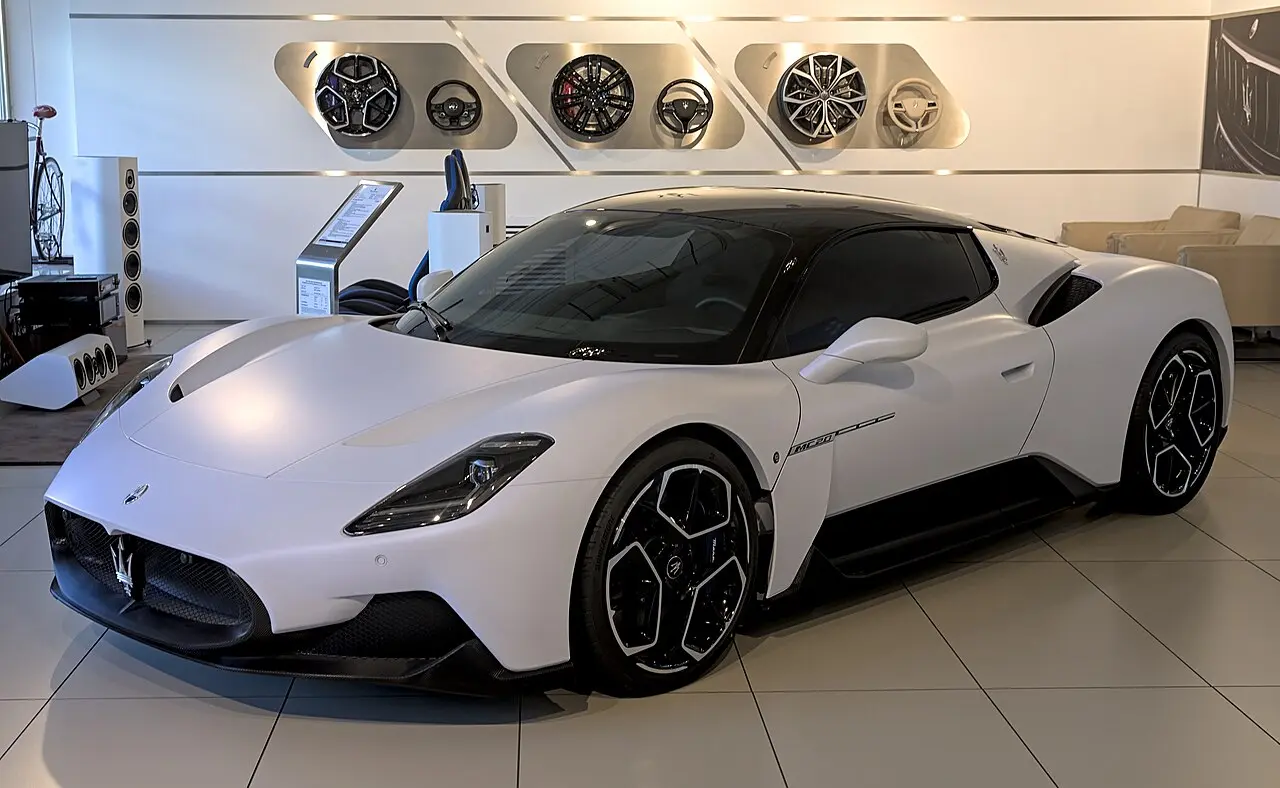
Maserati MC20

Maserati MC20
Photo: Alexander Migl / Wikimedia Commons · CC BY-SA 4.0

The official data lists 8 versions of the Maserati MC20 (2021–2025), in the European Union, the United States, and Canada. Each market publishes its own figures, measured on its own test procedure.

At a glance

Years in the data
2021–2025
Markets
European Union, United States, Canada
Engines
3.0 L to 3.0 L
Power
463 kW (630 PS)
Fuels
Petrol
Lowest consumption (European Union)
11.5 L/100 km (WLTP)
Lowest consumption (Canada)
12.8 L/100 km (5-cycle)
Lowest consumption (United States)
13.1 L/100 km (EPA)
New registrations in the EU
777

What is the Maserati MC20?

The MC20 is a mid-engined, two-seat sports car with a low coupé body and a petrol V6. It sits at the sporting end of Maserati’s range. Its carbon-fibre monocoque was a first for the marque, and its sculpted shape gives the engine and aerodynamic bodywork room to take centre stage.

Maserati developed the MC20 around its Nettuno engine, designed in Modena. The engine’s pre-chamber combustion system draws on Formula 1 technology.

Engines and power

The MC20 has a 3.0 L petrol engine producing 463 kW (630 PS). That specification is listed in the European Union, the United States and Canada. With its engine behind the cabin and space for two, the MC20 is built around a focused sports-car experience.

How economical is the Maserati MC20?

The lowest listed official consumption is 11.5 L/100 km on the European Union’s WLTP test. The United States EPA rating is 13.1 L/100 km, or 18 MPG combined. In Canada, the NRCan five-cycle figure is 12.8 L/100 km. These results use different test procedures—WLTP in Europe, EPA in the United States and the five-cycle test in Canada—so they are best read within their respective markets.

There were 777 MC20 registrations in the European Union from 2021 to 2025.

Where was the MC20 sold?

Official figures list the MC20 in the European Union, the United States and Canada. Its listed years are 2021–2025 in the EU and 2022–2025 in both North American markets. Each market’s line-up is petrol-only, with a 3.0 L engine producing 463 kW (630 PS).

Questions and answers

What engine does the Maserati MC20 have?

It has a 3.0 L petrol engine producing 463 kW (630 PS).

How much fuel does the MC20 use?

The lowest listed figures are 11.5 L/100 km WLTP in the EU, 13.1 L/100 km EPA in the US and 12.8 L/100 km on Canada’s NRCan five-cycle test.

When was the MC20 sold in the EU?

Its EU registration years are 2021–2025.

MC20 MC20 (2021–2025)

Maserati MC20 MC20
Photo: Alexander Migl / Wikimedia Commons · CC BY-SA 4.0

Model codes: M240 · References: maserati.com, en.wikipedia.org

European Union 4 versions

New cars registered in the EU (plus Norway and Iceland), from the European Environment Agency. Figures on the NEDC procedure until 2020 and on WLTP from 2021; versions are grouped by engine and power, with their number of registrations.

Years and versionEnginePowerFuelConsumption (combined)CO₂EU registrations
20253.0 L463 kW (630 PS)Petrol11.6 L/100 km WLTP263 g/km79
20243.0 L463 kW (630 PS)Petrol11.6 L/100 km WLTP263 g/km126
20233.0 L463 kW (630 PS)Petrol11.6 L/100 km WLTP263 g/km248
2021–20223.0 L463 kW (630 PS)Petrol11.5 L/100 km WLTP261 g/km324

United States 2 versions

Model years sold in the USA, from the EPA and the Department of Energy (fueleconomy.gov). MPG on the EPA test; litres per 100 km = 235.215 ÷ MPG.

Years and versionEngineFuelGearboxDriveConsumption (combined)CO₂
2022–2025SIDI & PFI3.0 LPetrol8-speed automaticRear-wheel drive18 MPG (13.1 L/100 km) EPA295 g/km
2023–2025SIDI & PFI3.0 LPetrol8-speed automaticRear-wheel drive18 MPG (13.1 L/100 km) EPA300 g/km

Canada 2 versions

Model years sold in Canada, from Natural Resources Canada fuel consumption ratings (5-cycle test).

Years and versionEngineFuelGearboxConsumption (combined)CO₂
2023–2025Two-seater3.0 LPetrol8-speed automatic12.8 L/100 km 5-cycle299 g/km
2022–2024Two-seater3.0 LPetrol8-speed automatic12.8 L/100 km 5-cycle295 g/km

Official figures are measured on standard test procedures and differ between markets. Your consumption depends on how, where and in what conditions you drive.