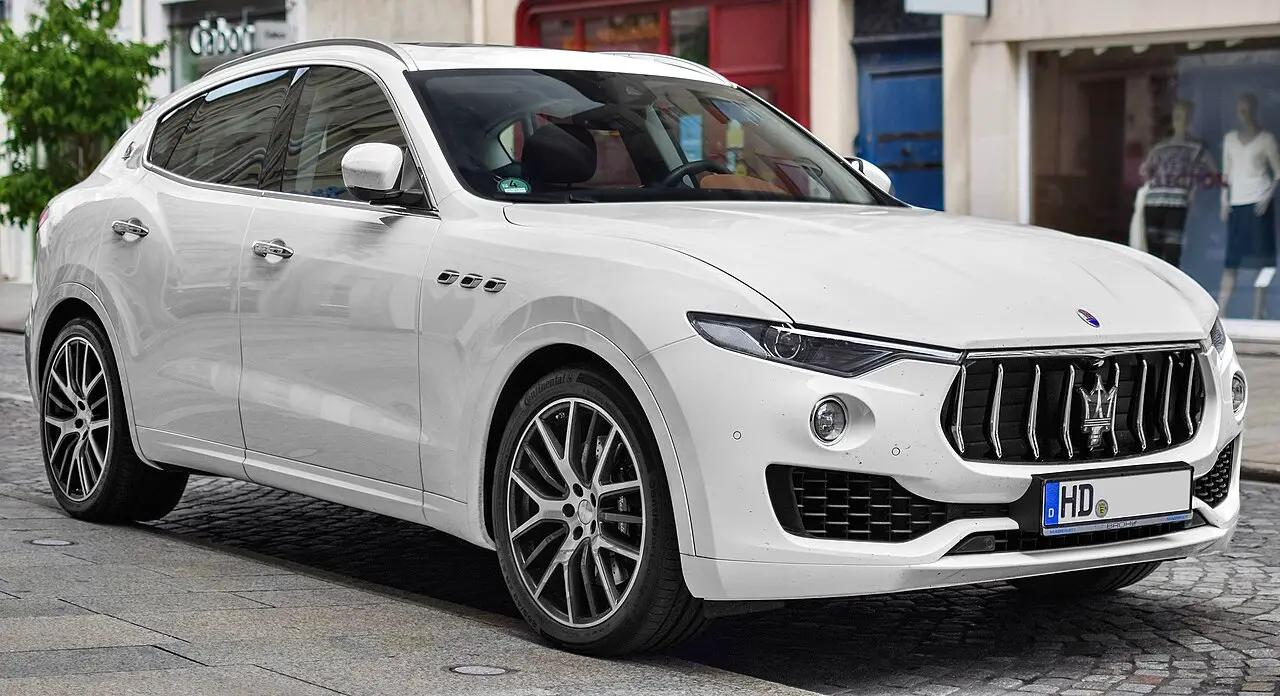
The official data lists 76 versions of the Maserati Levante (2016–2026), in the European Union, the United Kingdom, the United States, and Canada. Each market publishes its own figures, measured on its own test procedure.
At a glance
Years in the data
2016–2026
Markets
European Union, United Kingdom, United States, Canada
Engines
2.0 L to 3.8 L
Power
184 kW (250 PS) to 427 kW (581 PS)
Fuels
Petrol, Hybrid, Diesel
Lowest consumption (United Kingdom)
7.2 L/100 km (NEDC)
Lowest consumption (European Union)
8.0 L/100 km (WLTP)
Lowest consumption (United States)
13.1 L/100 km (EPA)
New registrations in the EU
38,725
What is the Maserati Levante?
The Levante is Maserati’s first SUV, introduced in 2016. It brought the marque’s Italian design and performance focus to a taller body style, with the elevated seating and flexible layout associated with an SUV. It joined a range that had included saloons and sports cars.
The Levante generation (M161) has been built since 2016. Petrol and diesel versions appear in European and UK figures, while the overall EU listings also include hybrid and other fuel classifications. The model extended Maserati’s range into an SUV format.
Engines and power
In EU figures, Levante engines range from 2.0 to 3.8 litres, with power from 184 kW (250 PS) to 474 kW (644 PS). Listed fuel types include petrol, hybrid, diesel and other. These are overall range figures; individual versions varied.
The 3.0-litre diesel producing 202 kW (275 PS) featured prominently in EU registrations. UK listings cover 3.0-litre petrol and diesel models, with power from 189 kW (257 PS) to 316 kW (430 PS). US and Canadian listings cover petrol engines from 3.0 to 3.8 litres.
Fuel consumption
The lowest listed EU consumption is 8 L/100 km on the WLTP test. The UK low is 7.2 L/100 km on NEDC. WLTP and NEDC are different European test procedures, so their results are not directly interchangeable.
The lowest listed US figure is 13.1 L/100 km, with an EPA rating of 18 MPG combined. Canada’s lowest is 13.2 L/100 km on NRCan’s 5-cycle test. EPA and Canadian 5-cycle procedures also differ from European tests.
Where was the Levante sold?
The Levante appears in official figures for the European Union, the UK, the United States and Canada. EU figures span 2016–2025; UK figures span 2017–2026; and US and Canadian figures span 2017 onward. The periods vary by market.
EU registrations total 38,725 Levantes. The model brought Maserati’s design and performance focus to an SUV, adding a taller and more flexible body style to the range.
Questions and answers
Was the Levante Maserati’s first SUV?
Yes. Introduced in 2016, the Levante was Maserati’s first SUV.
What generation is the Levante?
The Levante generation (M161) has been built since 2016.
What is the Levante’s lowest listed consumption?
The lowest figure is 7.2 L/100 km on NEDC in the UK listings.
Did the Levante have a diesel engine?
Yes. Diesel versions appear in EU and UK figures. The 3.0-litre, 202 kW (275 PS) version featured prominently in EU registrations.
New cars registered in the EU (plus Norway and Iceland), from the European Environment Agency. Figures on the NEDC procedure until 2020 and on WLTP from 2021; versions are grouped by engine and power, with their number of registrations.
Years and version
Engine
Power
Fuel
Consumption (combined)
CO₂
EU registrations
2025
3.0 L
316 kW (430 PS)
Petrol
12.2 L/100 km WLTP
277 g/km
58
2025
3.8 L
427 kW (581 PS)
Petrol
14.5 L/100 km WLTP
328 g/km
32
2023–2024
2.0 L
243 kW (330 PS)
Hybrid
10.0 L/100 km WLTP
227 g/km
471
2023–2024
3.0 L
316 kW (430 PS)
Petrol
12.2 L/100 km WLTP
277 g/km
226
2023–2024
3.8 L
427 kW (581 PS)
Petrol
14.5 L/100 km WLTP
327 g/km
163
2024
3.0 L
257 kW (349 PS)
Petrol
12.8 L/100 km WLTP
289 g/km
18
2023
3.0 L
257 kW (349 PS)
Petrol
13.0 L/100 km WLTP
292 g/km
23
2022
2.0 L
243 kW (330 PS)
Hybrid
10.0 L/100 km WLTP
228 g/km
990
2022
3.0 L
316 kW (430 PS)
Petrol
12.2 L/100 km WLTP
280 g/km
210
2022
3.0 L
257 kW (349 PS)
Petrol
12.2 L/100 km WLTP
293 g/km
145
2022
3.8 L
427 kW (581 PS)
Petrol
14.4 L/100 km WLTP
328 g/km
131
2022
2.0 L
243 kW (330 PS)
Petrol
9.8 L/100 km WLTP
228 g/km
34
2021
3.0 L
257 kW (349 PS)
Petrol
11.5 L/100 km WLTP
291 g/km
1,251
2021
3.0 L
316 kW (430 PS)
Petrol
12.2 L/100 km WLTP
291 g/km
593
2021
2.0 L
243 kW (330 PS)
Hybrid
10.3 L/100 km WLTP
233 g/km
545
2021
3.0 L
184 kW (250 PS)
Diesel
8.0 L/100 km WLTP
248 g/km
424
2021
3.0 L
202 kW (275 PS)
Diesel
8.2 L/100 km WLTP
248 g/km
392
2021
3.8 L
427 kW (581 PS)
Petrol
14.6 L/100 km WLTP
346 g/km
355
2021
3.8 L
390 kW (530 PS)
Petrol
15.0 L/100 km WLTP
352 g/km
70
2021
2.0 L
243 kW (330 PS)
Petrol
10.5 L/100 km WLTP
234 g/km
30
2020
3.0 L
257 kW (349 PS)
Petrol
–
260 g/km
1,369
2020
3.0 L
184 kW (250 PS)
Diesel
–
211 g/km
950
2020
3.0 L
202 kW (275 PS)
Diesel
–
212 g/km
792
2020
3.0 L
316 kW (430 PS)
Petrol
–
263 g/km
409
2019–2020
3.8 L
427 kW (581 PS)
Petrol
–
301 g/km
378
2019–2020
3.8 L
427 kW (581 PS)
Petrol
–
302 g/km
94
2020
3.8 L
390 kW (530 PS)
Petrol
–
300 g/km
81
2020
3.0 L
27 kW (37 PS)
Petrol
–
259 g/km
12
2019
3.0 L
257 kW (349 PS)
Petrol
–
268 g/km
1,869
2019
3.0 L
202 kW (275 PS)
Diesel
–
213 g/km
1,634
2019
3.0 L
184 kW (250 PS)
Diesel
–
215 g/km
1,273
2019
3.0 L
316 kW (430 PS)
Petrol
–
270 g/km
815
2019
3.8 L
390 kW (530 PS)
Petrol
–
299 g/km
24
2018
3.0 L
202 kW (275 PS)
Diesel
–
209 g/km
3,442
2018
3.0 L
316 kW (430 PS)
Petrol
–
259 g/km
1,860
2018
3.0 L
184 kW (250 PS)
Diesel
–
198 g/km
1,706
2018
3.0 L
257 kW (349 PS)
Petrol
–
257 g/km
992
2017
3.0 L
202 kW (275 PS)
Diesel
–
191 g/km
6,293
2017
3.0 L
316 kW (430 PS)
Petrol
–
253 g/km
2,151
2017
3.0 L
184 kW (250 PS)
Other fuel
–
189 g/km
1,726
2017
3.0 L
257 kW (349 PS)
Petrol
–
249 g/km
155
2017
3.0 L
303 kW (412 PS)
Diesel
–
189 g/km
71
2017
3.0 L
474 kW (644 PS)
Petrol
–
253 g/km
58
2016
3.0 L
202 kW (275 PS)
Diesel
–
191 g/km
2,554
2016
3.0 L
316 kW (430 PS)
Petrol
–
253 g/km
1,134
2016
3.0 L
184 kW (250 PS)
Diesel
–
189 g/km
700
2016
2.9 L
316 kW (430 PS)
Petrol
–
253 g/km
22
United Kingdom 12 versions
New cars on sale in the UK, from the Vehicle Certification Agency. NEDC figures until 2018 and WLTP figures after; years are the editions a version appeared in.
Years and version
Engine
Power
Fuel
Gearbox
Consumption (combined)
CO₂
2025–2026350 hp Essence · 350 hp GranLusso · 350 hp GranSport
3.0 L
257 kW (349 PS)
Petrol
8-speed automatic
13.4 L/100 km WLTP
303 g/km
2025–2026430 hp GranLusso · 430 hp GranSport
3.0 L
316 kW (430 PS)
Petrol
8-speed automatic
13.3 L/100 km WLTP
301 g/km
2024350 hp Essence · 350 hp GranLusso · 350 hp GranSport
3.0 L
189 kW (257 PS)
Petrol
8-speed automatic
13.4 L/100 km WLTP
303 g/km
2024430 hp GranLusso · 430 hp GranSport
3.0 L
232 kW (315 PS)
Petrol
8-speed automatic
13.3 L/100 km WLTP
301 g/km
2020–2023350 hp Essence · 350 hp GranLusso · 350 hp GranSport
3.0 L
257 kW (349 PS)
Petrol
8-speed automatic
13.4 L/100 km WLTP
303 g/km
2020–2023430 hp Essence
3.0 L
316 kW (430 PS)
Petrol
8-speed automatic
12.6 L/100 km WLTP
286 g/km
2020–2023430 hp GranLusso · 430 hp GranSport
3.0 L
316 kW (430 PS)
Petrol
8-speed automatic
13.3 L/100 km WLTP
301 g/km
2020–2023275 hp Essence · 275 hp GranLusso · 275 hp GranSport
3.0 L
202 kW (275 PS)
Diesel
8-speed automatic
9.4 L/100 km WLTP
245 g/km
2019350 hp Essence · 350 hp GranLusso · 350 hp GranSport
3.0 L
257 kW (349 PS)
Petrol
8-speed automatic
12.6 L/100 km WLTP
–
2019430 hp Essence · 430 hp GranLusso · 430 hp GranSport
3.0 L
316 kW (430 PS)
Petrol
8-speed automatic
12.6 L/100 km WLTP
–
2019275 hp Essence · 275 hp GranLusso · 275 hp GranSport
3.0 L
202 kW (275 PS)
Diesel
8-speed automatic
9.4 L/100 km WLTP
–
2017–2018Levante Diesel · 3.0 V6 Turbo Diesel
3.0 L
–
Diesel
8-speed automatic
7.2 L/100 km NEDC
189 g/km
United States 7 versions
Model years sold in the USA, from the EPA and the Department of Energy (fueleconomy.gov). MPG on the EPA test; litres per 100 km = 235.215 ÷ MPG.
Years and version
Engine
Fuel
Gearbox
Drive
Consumption (combined)
CO₂
2021–2024SIDI
3.0 L
Petrol
8-speed automatic
All-wheel drive
18 MPG (13.1 L/100 km) EPA
308 g/km
2021–2024SIDI
3.8 L
Petrol
8-speed automatic
All-wheel drive
16 MPG (14.7 L/100 km) EPA
349 g/km
2019–2020SIDI
3.0 L
Petrol
8-speed automatic
All-wheel drive
17 MPG (13.8 L/100 km) EPA
324 g/km
2019–2020SIDI
3.8 L
Petrol
8-speed automatic
All-wheel drive
15 MPG (15.7 L/100 km) EPA
360 g/km
2019SIDI
3.0 L
Petrol
8-speed automatic
All-wheel drive
17 MPG (13.8 L/100 km) EPA
331 g/km
2017–2018SIDI
3.0 L
Petrol
8-speed automatic
All-wheel drive
16 MPG (14.7 L/100 km) EPA
346 g/km
2017–2018SIDI
3.0 L
Petrol
8-speed automatic
All-wheel drive
16 MPG (14.7 L/100 km) EPA
341 g/km
Canada 10 versions
Model years sold in Canada, from Natural Resources Canada fuel consumption ratings (5-cycle test).
Years and version
Engine
Fuel
Gearbox
Consumption (combined)
CO₂
2021–2024Sport utility vehicle: Standard
3.0 L
Petrol
8-speed automatic
13.2 L/100 km 5-cycle
308 g/km
2021–2024Sport utility vehicle: Standard
3.8 L
Petrol
8-speed automatic
15.0 L/100 km 5-cycle
349 g/km
2019–2020Sport utility vehicle: Standard
3.0 L
Petrol
8-speed automatic
13.7 L/100 km 5-cycle
324 g/km
2020Sport utility vehicle: Standard
3.8 L
Petrol
8-speed automatic
15.3 L/100 km 5-cycle
360 g/km
2019Sport utility vehicle: Standard
3.0 L
Petrol
8-speed automatic
14.0 L/100 km 5-cycle
330 g/km
2019Sport utility vehicle: Standard
3.8 L
Petrol
8-speed automatic
15.3 L/100 km 5-cycle
360 g/km
2018Sport utility vehicle: Standard
3.0 L
Petrol
8-speed automatic
14.4 L/100 km 5-cycle
340 g/km
2018Sport utility vehicle: Standard
3.0 L
Petrol
8-speed automatic
14.7 L/100 km 5-cycle
346 g/km
2017Sport utility vehicle: Standard
3.0 L
Petrol
8-speed automatic
14.7 L/100 km 5-cycle
340 g/km
2017Sport utility vehicle: Standard
3.0 L
Petrol
8-speed automatic
14.7 L/100 km 5-cycle
346 g/km
Official figures are measured on standard test procedures and differ between markets. Your consumption depends on how, where and in what conditions you drive.