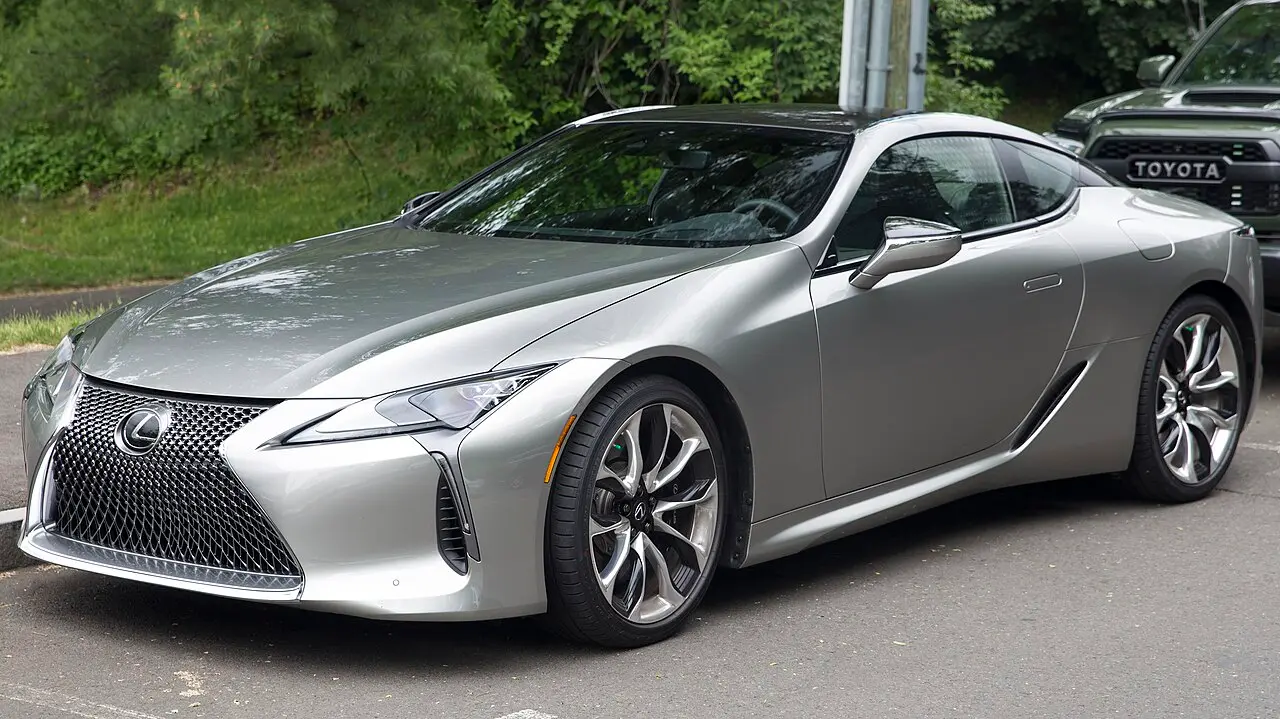
The official data lists 49 versions of the Lexus LC (2017–2026), in the European Union, the United Kingdom, the United States, and Canada. Each market publishes its own figures, measured on its own test procedure.
At a glance
Years in the data
2017–2026
Markets
European Union, United Kingdom, United States, Canada
Engines
3.5 L to 5.0 L
Power
220 kW (299 PS) to 527 kW (717 PS)
Fuels
Petrol, Hybrid
Lowest consumption (United Kingdom)
6.4 L/100 km (NEDC)
Lowest consumption (European Union)
7.8 L/100 km (WLTP)
Lowest consumption (United States)
7.8 L/100 km (EPA)
New registrations in the EU
4,712
What is the Lexus LC?
The Lexus LC is a luxury grand touring coupe and a flagship two-door in the Lexus range. Its low roof and long bonnet echo the LF-LC concept that inspired the production car. The LC also introduced Lexus’s GA-L platform, developed for front-engine, rear-wheel-drive models. Its design and grand touring character give it a different role from the brand’s everyday sedans and SUVs.
Generations, engines and power
The LC’s first generation, code Z100, began in 2017. EU versions include petrol and hybrid power, with engines from 3.5 to 5.0 litres. EU output ranges from 220 kW (299 PS) to 527 kW (717 PS); UK versions range from 264 kW (359 PS) to 341 kW (464 PS). US listings include petrol and hybrid versions with engines from 3.5 to 5.0 litres, while Canadian listings show petrol engines in the same size range.
How economical is the Lexus LC?
The lowest official EU consumption figure is 7.8 L/100 km on the WLTP test. The UK minimum is 6.4 L/100 km under NEDC. The USA’s lowest figure is 7.8 L/100 km under EPA testing, with a best combined rating of 30 MPG; Canada’s lowest is 8 L/100 km on the NRCan five-cycle test. WLTP, NEDC, EPA and Canada’s five-cycle procedure differ, so these ratings are best understood within each market.
Where was the Lexus LC sold?
Official EU registration figures record 4,712 LCs from 2017 to 2025. UK VCA figures cover 2017–2023; US EPA and Canadian NRCan listings cover 2018–2026. Lexus introduced the LC as a flagship coupe, inspired by its LF-LC concept.
Questions and answers
How many generations of Lexus LC are there?
There is one generation, the Z100, which began in 2017.
Does the Lexus LC have a hybrid version?
Yes. Hybrid versions appear in the EU, UK and US listings.
What is the lowest official LC consumption figure in the EU?
New cars registered in the EU (plus Norway and Iceland), from the European Environment Agency. Figures on the NEDC procedure until 2020 and on WLTP from 2021; versions are grouped by engine and power, with their number of registrations.
Years and version
Engine
Power
Fuel
Consumption (combined)
CO₂
EU registrations
2025
5.0 L
341 kW (464 PS)
Petrol
11.6 L/100 km WLTP
270 g/km
10
2024
5.0 L
341 kW (464 PS)
Petrol
11.7 L/100 km WLTP
271 g/km
417
2024
3.5 L
220 kW (299 PS)
Hybrid
8.1 L/100 km WLTP
184 g/km
21
2023
5.0 L
341 kW (464 PS)
Petrol
11.7 L/100 km WLTP
269 g/km
224
2023
3.5 L
220 kW (299 PS)
Hybrid
8.1 L/100 km WLTP
182 g/km
30
2022
5.0 L
341 kW (464 PS)
Petrol
11.7 L/100 km WLTP
271 g/km
169
2022
3.5 L
220 kW (299 PS)
Hybrid
7.7 L/100 km WLTP
184 g/km
37
2021
5.0 L
341 kW (464 PS)
Petrol
11.7 L/100 km WLTP
272 g/km
544
2021
3.5 L
220 kW (299 PS)
Hybrid
7.8 L/100 km WLTP
184 g/km
83
2020
5.0 L
341 kW (464 PS)
Petrol
–
275 g/km
348
2020
3.5 L
220 kW (299 PS)
Hybrid
–
154 g/km
134
2019
5.0 L
341 kW (464 PS)
Petrol
–
265 g/km
314
2019
3.5 L
220 kW (299 PS)
Hybrid
–
149 g/km
263
2019
3.5 L
220 kW (299 PS)
Petrol
–
151 g/km
54
2019
5.0 L
351 kW (477 PS)
Petrol
–
266 g/km
18
2018
3.5 L
220 kW (299 PS)
Petrol
–
148 g/km
648
2018
5.0 L
351 kW (477 PS)
Petrol
–
261 g/km
467
2018
5.0 L
341 kW (464 PS)
Petrol
–
265 g/km
21
2017
3.5 L
220 kW (299 PS)
Petrol
–
147 g/km
470
2017
5.0 L
351 kW (477 PS)
Petrol
–
266 g/km
336
2017
5.0 L
527 kW (717 PS)
Petrol
–
265 g/km
72
2017
3.5 L
330 kW (449 PS)
Petrol
–
147 g/km
32
United Kingdom 12 versions
New cars on sale in the UK, from the Vehicle Certification Agency. NEDC figures until 2018 and WLTP figures after; years are the editions a version appeared in.
Years and version
Engine
Power
Fuel
Gearbox
Consumption (combined)
CO₂
2020–202320"& 21" (RWD) LC · 21" (RWD) Limited Edition · 21" (RWD) Sport Pack and 4 more trims
3.5 L
264 kW (359 PS)
Hybrid
Continuously variable (CVT)
8.1 L/100 km WLTP
184 g/km
2020–202320 & 21" (RWD) LC · 21" (RWD) Limited Edition · 21" (RWD) Sport Pack and 5 more trims
5.0 L
341 kW (464 PS)
Petrol
10-speed automatic
11.6 L/100 km WLTP
262 g/km
2020–202320"& 21" (RWD) LC Convertible · 21" (RWD) Regatta Edition · 21" (RWD) Sport Plus Pack and 3 more trims
5.0 L
341 kW (464 PS)
Petrol
10-speed automatic
11.7 L/100 km WLTP
275 g/km
2019500h 20" & 21" wheels · 20"&21" (RWD) 20"&21" (RWD) · 20"&21" (RWD) LC and 22 more trims
3.5 L
264 kW (359 PS)
Hybrid
Continuously variable (CVT)
8.1 L/100 km WLTP
–
2019500 with 20" & 21" wheels · 20 & 21" (RWD) LC · 21 & 21" (RWD) LC HUD and 22 more trims
5.0 L
341 kW (464 PS)
Petrol
10-speed automatic
11.6 L/100 km WLTP
–
2017–2018LC 500h
3.5 L
–
Hybrid
Continuously variable (CVT)
6.4 L/100 km NEDC
145 g/km
2017–2018LC 500h Sport Pack · LC 500h Sport Plus Pack
3.5 L
–
Hybrid
Continuously variable (CVT)
6.5 L/100 km NEDC
148 g/km
2018LC 500h · Sport · Sport + and 1 more trim
3.5 L
–
Hybrid
Continuously variable (CVT)
42.8 L/100 km NEDC
150 g/km
2017–2018LC 500
5.0 L
–
Petrol
10-speed automatic
11.5 L/100 km NEDC
263 g/km
2017–2018LC 500 Sport Pack · LC 500 Sport Plus Pack
5.0 L
–
Petrol
10-speed automatic
11.6 L/100 km NEDC
267 g/km
2018LC 500 · Sport · Limited Edition
5.0 L
–
Petrol
Continuously variable (CVT)
24.4 L/100 km NEDC
265 g/km
2018Sport +
5.0 L
–
Hybrid
Continuously variable (CVT)
24.4 L/100 km NEDC
265 g/km
United States 8 versions
Model years sold in the USA, from the EPA and the Department of Energy (fueleconomy.gov). MPG on the EPA test; litres per 100 km = 235.215 ÷ MPG.
Years and version
Engine
Fuel
Gearbox
Drive
Consumption (combined)
CO₂
2021–2026SIDI & PFI
5.0 L
Petrol
10-speed automatic
Rear-wheel drive
18 MPG (13.1 L/100 km) EPA
304 g/km
2024–2026SIDI & PFI
5.0 L
Petrol
10-speed automatic
Rear-wheel drive
18 MPG (13.1 L/100 km) EPA
299 g/km
2023–2025SIDI & PFI; Hybrid
3.5 L
Hybrid
Continuously variable (CVT)
Rear-wheel drive
29 MPG (8.1 L/100 km) EPA
189 g/km
2019–2023SIDI & PFI
5.0 L
Petrol
10-speed automatic
Rear-wheel drive
19 MPG (12.4 L/100 km) EPA
294 g/km
2021–2022SIDI & PFI; Hybrid
3.5 L
Hybrid
Continuously variable (CVT)
Rear-wheel drive
29 MPG (8.1 L/100 km) EPA
188 g/km
2019–2020SIDI & PFI; Hybrid
3.5 L
Hybrid
Continuously variable (CVT)
Rear-wheel drive
30 MPG (7.8 L/100 km) EPA
185 g/km
2018SIDI & PFI
3.5 L
Hybrid
Continuously variable (CVT)
Rear-wheel drive
30 MPG (7.8 L/100 km) EPA
187 g/km
2018SIDI & PFI
5.0 L
Petrol
10-speed automatic
Rear-wheel drive
19 MPG (12.4 L/100 km) EPA
285 g/km
Canada 7 versions
Model years sold in Canada, from Natural Resources Canada fuel consumption ratings (5-cycle test).
Years and version
Engine
Fuel
Gearbox
Consumption (combined)
CO₂
2021–2026Minicompact
5.0 L
Petrol
10-speed automatic
13.0 L/100 km 5-cycle
304 g/km
2024–2026Subcompact
5.0 L
Petrol
10-speed automatic
12.7 L/100 km 5-cycle
299 g/km
2019–2025Subcompact
3.5 L
Petrol
Continuously variable (CVT)
8.1 L/100 km 5-cycle
189 g/km
2021–2023Subcompact
5.0 L
Petrol
10-speed automatic
12.6 L/100 km 5-cycle
294 g/km
2019–2020Subcompact
5.0 L
Petrol
10-speed automatic
12.6 L/100 km 5-cycle
294 g/km
2018Subcompact
3.5 L
Petrol
Continuously variable (CVT)
8.0 L/100 km 5-cycle
187 g/km
2018Subcompact
5.0 L
Petrol
10-speed automatic
12.2 L/100 km 5-cycle
286 g/km
Official figures are measured on standard test procedures and differ between markets. Your consumption depends on how, where and in what conditions you drive.