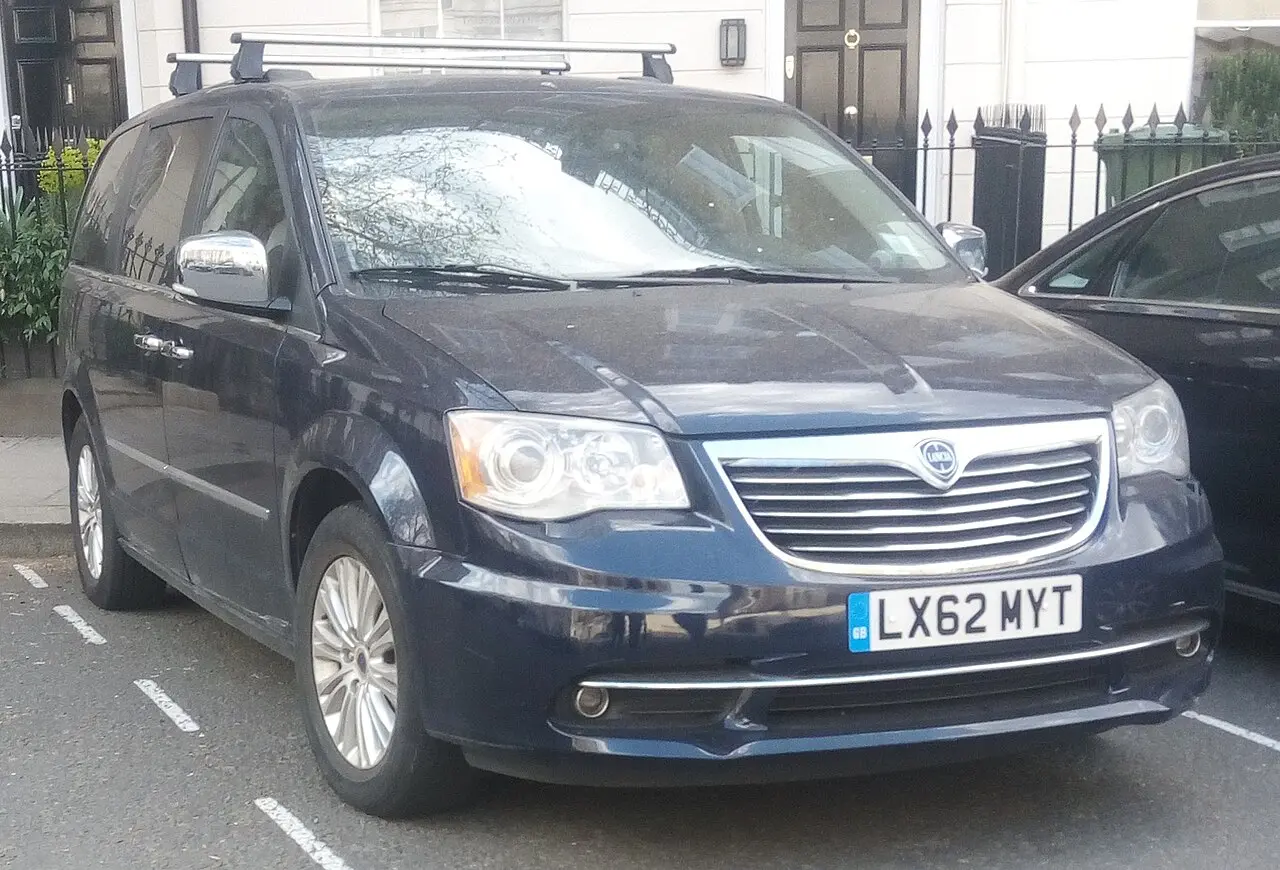
Lancia

Lancia Voyager

Lancia Voyager
Photo: Calreyn88 / Wikimedia Commons · CC BY-SA 4.0

The official data lists 34 versions of the Lancia Voyager (2011–2016), in the European Union and France. Each market publishes its own figures, measured on its own test procedure.

At a glance

Years in the data
2011–2016
Markets
European Union, France
Engines
2.8 L to 3.6 L
Power
120 kW (163 PS) to 208 kW (283 PS)
Fuels
Diesel, Petrol
Lowest consumption (France)
7.9 L/100 km (NEDC)
New registrations in the EU
26,922

What is the Lancia Voyager?

The Lancia Voyager is a large MPV designed around passenger space and long journeys. It brought the Chrysler Grand Voyager to Lancia’s European range during the two marques’ partnership, with Lancia styling and trim.

The fifth-generation Voyager, known as V, was sold from 2011 to 2015. Its tall body and sliding side doors made room for passengers and helped with access in tight parking spaces.

Engines and power

EU registration figures cover Voyager versions from 2011 to 2016, with engines from 2.8 to 3.6 litres and power from 120 kW (163 PS) to 208 kW (283 PS). The range included diesel and petrol versions, as well as versions classified as other fuel. The 2.8-litre diesel featured among the leading EU registrations at both 120 kW (163 PS) and 130 kW (177 PS).

Fuel consumption and CO₂

In France, ADEME lists the Voyager from 2012 to 2015. Its lowest listed consumption is 7.9 L/100 km on the NEDC test. European test figures can use NEDC or WLTP, and results from the two procedures are not directly comparable.

Where was the Voyager sold?

The Voyager appears in EU registration figures from 2011 to 2016 and in French ADEME listings from 2012 to 2015. It gave Lancia’s European range a large, Chrysler-derived people carrier during the partnership era.

Questions and answers

What type of car is the Lancia Voyager?

It is a large MPV, or people carrier, designed around passenger space and family travel.

Which Voyager generation is covered?

The Lancia Voyager V, sold from 2011 to 2015.

What was the lowest listed fuel consumption in France?

ADEME lists 7.9 L/100 km on the NEDC test.

What engines and power were available in EU registration figures?

Engines ranged from 2.8 to 3.6 litres, with power from 120 kW (163 PS) to 208 kW (283 PS).

Voyager V (2011–2015)

Lancia Voyager V
Photo: Calreyn88 / Wikimedia Commons · CC BY-SA 4.0

Model codes: RT · Sold in: European Union and France · References: media.stellantis.com, rac.co.uk

European Union 24 versions

New cars registered in the EU (plus Norway and Iceland), from the European Environment Agency. Figures on the NEDC procedure until 2020 and on WLTP from 2021; versions are grouped by engine and power, with their number of registrations.

Years and versionEnginePowerFuelCO₂EU registrations
20152.8 L130 kW (177 PS)Diesel207 g/km2,842
2014–20152.8 L131 kW (178 PS)Diesel207 g/km1,682
20152.8 L130 kW (177 PS)Diesel207 g/km770
20153.6 L208 kW (283 PS)Petrol249 g/km144
20142.8 L130 kW (177 PS)Diesel207 g/km2,513
20142.8 L130 kW (177 PS)Diesel207 g/km1,526
20143.6 L208 kW (283 PS)Petrol251 g/km508
20142.8 L120 kW (163 PS)Diesel207 g/km71
20142.8 L120 kW (163 PS)Diesel207 g/km53
2013–20142.8 L131 kW (178 PS)Diesel207 g/km50
2012–20132.8 L131 kW (178 PS)Diesel207 g/km2,189
20132.8 L120 kW (163 PS)Diesel207 g/km1,477
20132.8 L130 kW (177 PS)Diesel208 g/km1,043
20132.8 L120 kW (163 PS)Diesel210 g/km627
20133.6 L208 kW (283 PS)Petrol252 g/km497
20132.8 L–Other fuel207 g/km364
20132.8 L130 kW (177 PS)Diesel207 g/km185
20122.8 L120 kW (163 PS)Diesel207 g/km5,023
20122.8 L120 kW (163 PS)Diesel205 g/km2,298
20123.6 L208 kW (283 PS)Petrol252 g/km754
20122.8 L130 kW (177 PS)Diesel207 g/km16
20112.8 L120 kW (163 PS)Diesel207 g/km1,325
20112.8 L120 kW (163 PS)Diesel207 g/km748
20113.6 L208 kW (283 PS)Petrol252 g/km80

France 9 versions

New cars on sale in France, from ADEME Car Labelling. NEDC figures until 2015, WLTP figures in the current catalogue.

Years and versionEnginePowerFuelGearboxConsumption (combined)CO₂
2015Voyager 2.8 Multijet II (163ch)–120 kW (163 PS)Diesel6-speed automatic7.9 L/100 km NEDC207 g/km
2015Voyager 2.8 Multijet II (178ch)–131 kW (178 PS)Diesel6-speed automatic7.9 L/100 km NEDC207 g/km
2015Voyager 3.6 V6 (283ch)–208 kW (283 PS)Petrol6-speed automatic10.8 L/100 km NEDC252 g/km
2014Voyager 2.8 Multijet II (163ch)–120 kW (163 PS)Diesel6-speed automatic7.9 L/100 km NEDC207 g/km
2014Voyager 2.8 Multijet II (178ch)–131 kW (178 PS)Diesel6-speed automatic7.9 L/100 km NEDC207 g/km
2014Voyager 3.6 V6 (283ch)–208 kW (283 PS)Petrol6-speed automatic10.8 L/100 km NEDC252 g/km
2012–2013Voyager 2.8 Multijet II (163 ch) · Voyager 2.8 Multijet II (163ch)–120 kW (163 PS)Diesel6-speed automatic7.9 L/100 km NEDC207 g/km
2013Voyager 2.8 Multijet II (178ch)–131 kW (178 PS)Diesel6-speed automatic7.9 L/100 km NEDC207 g/km
2012–2013Voyager 3.6 V6 (283 ch) · Voyager 3.6 V6 (283ch)–208 kW (283 PS)Petrol6-speed automatic10.8 L/100 km NEDC252 g/km

Versions outside these generations

European Union 1 version

New cars registered in the EU (plus Norway and Iceland), from the European Environment Agency. Figures on the NEDC procedure until 2020 and on WLTP from 2021; versions are grouped by engine and power, with their number of registrations.

Years and versionEnginePowerFuelCO₂EU registrations
20162.8 L130 kW (177 PS)Diesel209 g/km137

Official figures are measured on standard test procedures and differ between markets. Your consumption depends on how, where and in what conditions you drive.