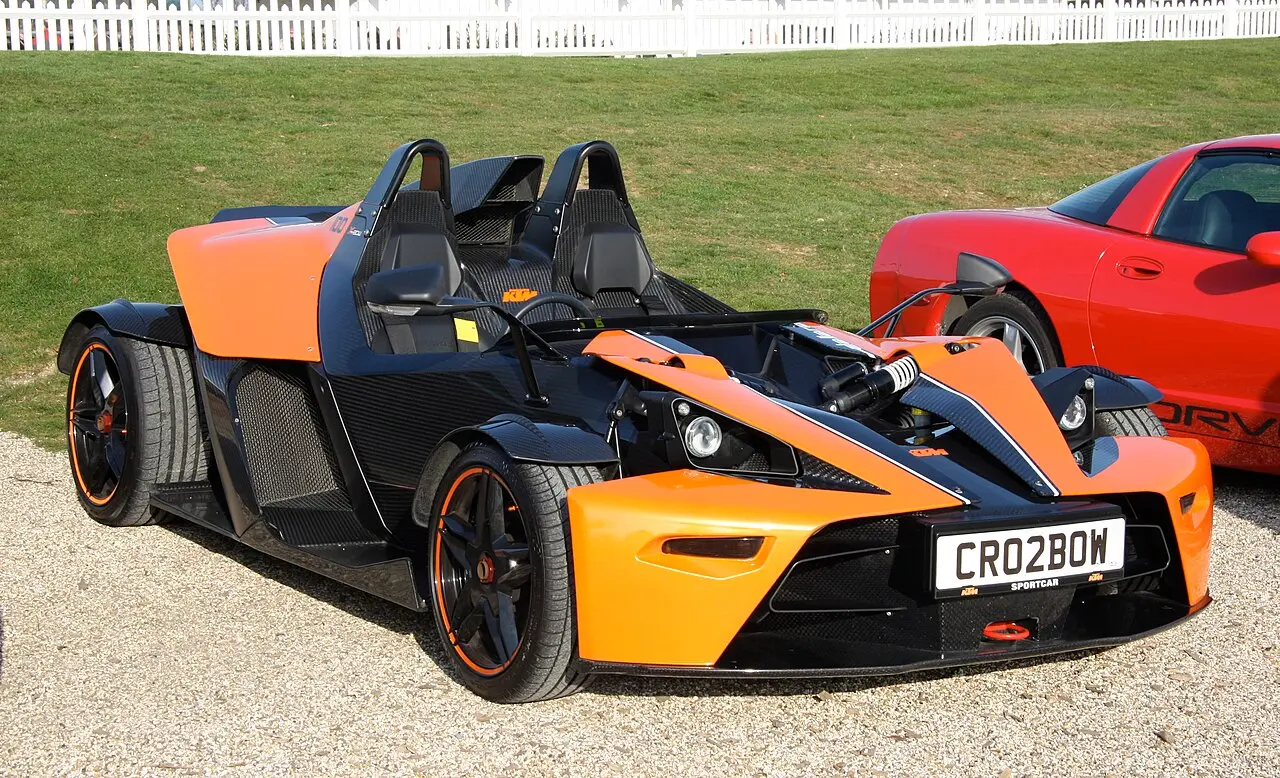
What is the KTM X-Bow?
The KTM X-Bow is a two-seat sports car with an open cockpit and a carbon-fibre monocoque. Its stripped-back layout gives it a race-car feel, while its small footprint and focused design set it apart from conventional road cars. The X-Bow is KTM’s first four-wheeled vehicle, extending the Austrian maker’s motorcycle identity into sports cars.
KTM presented the production X-Bow in 2008, developed with Dallara, Audi and KISKA. The original open design has since been joined by more enclosed road versions and track-focused models, while retaining the carbon-fibre structure and compact sports-car character.
Engines and power
Across the European Union registration range, the X-Bow is listed with petrol engines from 2.0 to 2.5 litres. Official power spans 177 kW (241 PS) to 368 kW (500 PS). The range includes both 2.0-litre and 2.5-litre versions, with the latter reaching the top listed output.
How economical is the KTM X-Bow?
The lowest listed official consumption in the EU is 9.1 L/100 km on the WLTP test. The EU range comprises petrol versions, with 760 registrations recorded from 2010 through 2025.
Consumption results differ by test procedure: Europe uses WLTP and, for some older figures, NEDC; the USA uses EPA ratings, while Canada uses a 5-cycle test. Those methods make figures from different markets difficult to compare directly.
Where was the KTM X-Bow sold?
The X-Bow appears in European Union registration figures from 2010 through 2025, with 20 versions listed. The most registered entry was a 2.0-litre petrol model rated at 220 kW (299 PS), with 110 registrations in 2018. Other leading entries were a 2.0-litre petrol version from 2010, with 106 registrations, and a 2.5-litre petrol version rated at 368 kW (500 PS), with 79 registrations from 2023 through 2025.
Questions and answers
Is the KTM X-Bow a two-seat sports car?
Yes. It has two seats, an open cockpit and a carbon-fibre monocoque, with a pared-back layout inspired by racing cars.
What engines were available in the X-Bow?
The EU range lists petrol engines from 2.0 to 2.5 litres, with official power from 177 kW (241 PS) to 368 kW (500 PS).
What is the X-Bow's official fuel consumption?
Its lowest listed EU figure is 9.1 L/100 km on the WLTP test.
How many KTM X-Bows were registered in the EU?
Official EU registration figures record 760 from 2010 through 2025.