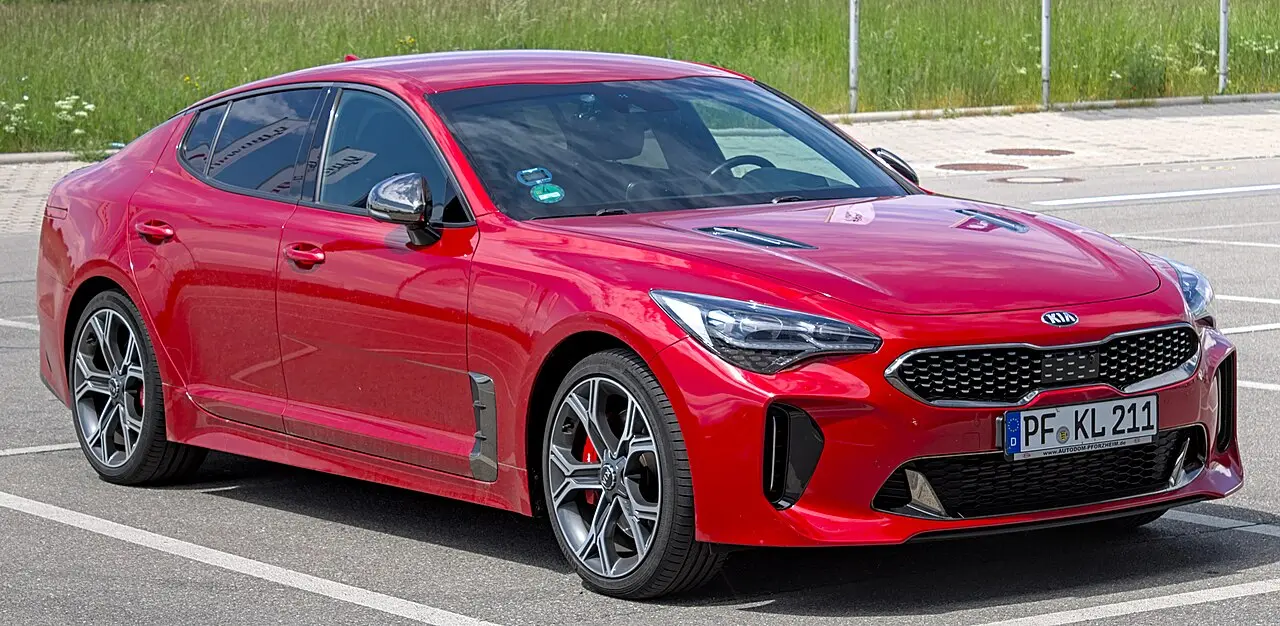
The official data lists 54 versions of the Kia Stinger (2017–2024), in the European Union, the United Kingdom, the United States, and Canada. Each market publishes its own figures, measured on its own test procedure.
At a glance
Years in the data
2017–2024
Markets
European Union, United Kingdom, United States, Canada
Engines
2.0 L to 3.3 L
Power
147 kW (200 PS) to 408 kW (555 PS)
Fuels
Petrol, Diesel
Lowest consumption (United Kingdom)
5.8 L/100 km (NEDC)
Lowest consumption (European Union)
8.1 L/100 km (WLTP)
Lowest consumption (United States)
9.4 L/100 km (EPA)
New registrations in the EU
22,016
What is the Kia Stinger?
The Stinger is a five-seat fastback sports sedan, with a roomy cabin and a rear hatch beneath its sloping roof. It brought Kia into grand touring territory, alongside the brand’s more practical models. Kia introduced it in 2017; the first generation, known by the code CK, ran from 2017 to 2023.
Its long bonnet and sweeping roof give it a distinctive profile. The Stinger drew on Kia’s GT concept and was designed as a performance-focused car for comfortable longer journeys.
Generations, engines and power
The Stinger had one generation, the CK, sold from 2017 to 2023. Engine choices ranged from 2.0 to 3.3 litres, with petrol and diesel versions in the EU and UK. In the EU, power ranged from 147 kW (200 PS) to 408 kW (555 PS); in the UK, it reached 366 kW (498 PS). US and Canadian versions had petrol engines from 2.0 to 3.3 litres.
The 3.3-litre petrol versions were prominent in EU registrations. The most registered listed variants produced 269 kW (366 PS) and 272 kW (370 PS).
How economical is the Kia Stinger?
Official consumption figures depend on the market and test procedure. UK VCA figures include a low of 5.8 L/100 km on the NEDC test, while the EU low is 8.1 L/100 km on WLTP. In the United States, the EPA figure is 9.4 L/100 km, or 25 MPG combined; Canada’s NRCan 5-cycle figure is 9.7 L/100 km. These ratings are not directly comparable: Europe uses WLTP or the older NEDC procedure, the US uses EPA testing, and Canada uses a 5-cycle test.
EU registrations cover 2017–2024 and total 22,016 cars. UK VCA figures span 2018–2024, while US EPA and Canadian NRCan figures span 2018–2023.
Where was the Kia Stinger sold?
The Stinger was sold in the European Union, the United Kingdom, the United States and Canada. EU and UK versions used petrol or diesel; North American versions used petrol.
Questions and answers
How many generations of Kia Stinger were there?
One: the CK first generation, sold from 2017 to 2023.
What engines did the Stinger have?
Engine sizes ranged from 2.0 to 3.3 litres, with petrol and diesel versions in Europe and the UK.
What is the Stinger’s lowest official fuel consumption figure?
The lowest listed figure is 5.8 L/100 km in UK VCA NEDC figures. The EU WLTP low is 8.1 L/100 km.
Was the Stinger sold in North America?
Yes. US EPA and Canadian NRCan figures span 2018–2023 and cover petrol versions.
New cars registered in the EU (plus Norway and Iceland), from the European Environment Agency. Figures on the NEDC procedure until 2020 and on WLTP from 2021; versions are grouped by engine and power, with their number of registrations.
Years and version
Engine
Power
Fuel
Consumption (combined)
CO₂
EU registrations
2023–2024
3.3 L
269 kW (366 PS)
Petrol
10.9 L/100 km WLTP
247 g/km
922
2022
3.3 L
269 kW (366 PS)
Petrol
10.7 L/100 km WLTP
247 g/km
609
2021
3.3 L
269 kW (366 PS)
Petrol
10.7 L/100 km WLTP
247 g/km
1,722
2021
2.0 L
180 kW (245 PS)
Petrol
8.1 L/100 km WLTP
196 g/km
92
2021
2.2 L
147 kW (200 PS)
Diesel
6.6 L/100 km WLTP
184 g/km
18
2020
3.3 L
269 kW (366 PS)
Petrol
–
240 g/km
1,607
2020
2.0 L
180 kW (245 PS)
Petrol
–
185 g/km
678
2020
2.2 L
147 kW (200 PS)
Diesel
–
163 g/km
204
2019
3.3 L
269 kW (366 PS)
Petrol
–
240 g/km
3,450
2019
2.0 L
180 kW (245 PS)
Petrol
–
188 g/km
1,696
2019
2.2 L
147 kW (200 PS)
Diesel
–
162 g/km
1,456
2019
3.3 L
272 kW (370 PS)
Petrol
–
242 g/km
142
2019
2.0 L
188 kW (256 PS)
Petrol
–
189 g/km
106
2018
3.3 L
272 kW (370 PS)
Petrol
–
244 g/km
3,260
2018
2.2 L
147 kW (200 PS)
Diesel
–
160 g/km
1,674
2018
2.0 L
188 kW (256 PS)
Petrol
–
187 g/km
1,616
2018
3.3 L
269 kW (366 PS)
Petrol
–
240 g/km
480
2018
2.0 L
180 kW (245 PS)
Petrol
–
188 g/km
110
2018
3.3 L
272 kW (370 PS)
Petrol
–
244 g/km
10
2017
3.3 L
272 kW (370 PS)
Petrol
–
244 g/km
1,376
2017
2.2 L
147 kW (200 PS)
Diesel
–
154 g/km
390
2017
2.0 L
282 kW (383 PS)
Diesel
–
190 g/km
162
2017
3.3 L
408 kW (555 PS)
Petrol
–
244 g/km
126
2017
2.0 L
188 kW (256 PS)
Petrol
–
189 g/km
110
United Kingdom 13 versions
New cars on sale in the UK, from the Vehicle Certification Agency. NEDC figures until 2018 and WLTP figures after; years are the editions a version appeared in.
Years and version
Engine
Power
Fuel
Gearbox
Consumption (combined)
CO₂
2020–2023Blue Edition 2.0 T-GDi 242bhp 8-speed auto ISG
2.0 L
180 kW (245 PS)
Petrol
8-speed automatic
9.7 L/100 km WLTP
221 g/km
2020–2023GT-Line 2.0 T-GDi 242bhp 8-speed auto ISG · GT-Line S 2.0 T-GDi 242bhp 8-speed auto ISG
2.0 L
180 kW (245 PS)
Petrol
8-speed automatic
9.6 L/100 km WLTP
215 g/km
2020–2023GT-Line 2.2 CRDi 197bhp 8-speed auto ISG · GT-Line S 2.2 CRDi 197bhp 8-speed auto ISG
2.2 L
147 kW (200 PS)
Diesel
8-speed automatic
6.9 L/100 km WLTP
179 g/km
2020–2023GT S 3.3 T-GDi 361bhp 8-speed auto ISG
3.3 L
269 kW (366 PS)
Petrol
8-speed automatic
10.2 L/100 km WLTP
233 g/km
2019Blue Edition 2.0 T-GDi 242bhp 8-speed auto ISG
2.0 L
180 kW (245 PS)
Petrol
8-speed automatic
9.7 L/100 km WLTP
–
2019GT-Line 2.0 T-GDi 242bhp 8-speed auto ISG · GT-Line S 2.0 T-GDi 242bhp 8-speed auto ISG
2.0 L
180 kW (245 PS)
Petrol
8-speed automatic
9.6 L/100 km WLTP
–
2019GT-Line 2.2 CRDi 197bhp 8-speed auto ISG · GT-Line S 2.2 CRDi 197bhp 8-speed auto ISG
Model years sold in the USA, from the EPA and the Department of Energy (fueleconomy.gov). MPG on the EPA test; litres per 100 km = 235.215 ÷ MPG.
Years and version
Engine
Fuel
Gearbox
Drive
Consumption (combined)
CO₂
2022–2023SIDI & PFI
2.5 L
Petrol
8-speed automatic
All-wheel drive
24 MPG (9.8 L/100 km) EPA
236 g/km
2022–2023SIDI & PFI
2.5 L
Petrol
8-speed automatic
Rear-wheel drive
25 MPG (9.4 L/100 km) EPA
221 g/km
2022–2023SIDI
3.3 L
Petrol
8-speed automatic
All-wheel drive
20 MPG (11.8 L/100 km) EPA
280 g/km
2022–2023SIDI
3.3 L
Petrol
8-speed automatic
Rear-wheel drive
20 MPG (11.8 L/100 km) EPA
272 g/km
2018–2021SIDI
2.0 L
Petrol
8-speed automatic
All-wheel drive
24 MPG (9.8 L/100 km) EPA
229 g/km
2018–2021SIDI
2.0 L
Petrol
8-speed automatic
Rear-wheel drive
25 MPG (9.4 L/100 km) EPA
227 g/km
2018–2021SIDI
3.3 L
Petrol
8-speed automatic
Rear-wheel drive
20 MPG (11.8 L/100 km) EPA
277 g/km
2020–2021SIDI
3.3 L
Petrol
8-speed automatic
All-wheel drive
20 MPG (11.8 L/100 km) EPA
279 g/km
2018–2019SIDI
3.3 L
Petrol
8-speed automatic
All-wheel drive
20 MPG (11.8 L/100 km) EPA
277 g/km
Canada 4 versions
Model years sold in Canada, from Natural Resources Canada fuel consumption ratings (5-cycle test).
Years and version
Engine
Fuel
Gearbox
Consumption (combined)
CO₂
2022–2023Mid-size
3.3 L
Petrol
8-speed automatic
11.9 L/100 km 5-cycle
280 g/km
2019–2021Mid-size
3.3 L
Petrol
8-speed automatic
11.8 L/100 km 5-cycle
279 g/km
2019Mid-size
2.0 L
Petrol
8-speed automatic
9.7 L/100 km 5-cycle
229 g/km
2018Mid-size
3.3 L
Petrol
8-speed automatic
11.3 L/100 km 5-cycle
265 g/km
Versions outside these generations
United Kingdom 4 versions
New cars on sale in the UK, from the Vehicle Certification Agency. NEDC figures until 2018 and WLTP figures after; years are the editions a version appeared in.
Years and version
Engine
Power
Fuel
Gearbox
Consumption (combined)
CO₂
2024GT-Line 2.0 T-GDi 242bhp 8-speed auto ISG · GT-Line S 2.0 T-GDi 242bhp 8-speed auto ISG
2.0 L
245 kW (333 PS)
Petrol
8-speed automatic
9.6 L/100 km WLTP
215 g/km
2024Blue Edition 2.0 T-GDi 242bhp 8-speed auto ISG
2.0 L
245 kW (333 PS)
Petrol
8-speed automatic
9.7 L/100 km WLTP
221 g/km
2024GT-Line 2.2 CRDi 197bhp 8-speed auto ISG · GT-Line S 2.2 CRDi 197bhp 8-speed auto ISG
2.2 L
200 kW (272 PS)
Diesel
8-speed automatic
6.9 L/100 km WLTP
179 g/km
2024GT S 3.3 T-GDi 361bhp 8-speed auto ISG
3.3 L
366 kW (498 PS)
Petrol
8-speed automatic
10.2 L/100 km WLTP
233 g/km
Official figures are measured on standard test procedures and differ between markets. Your consumption depends on how, where and in what conditions you drive.