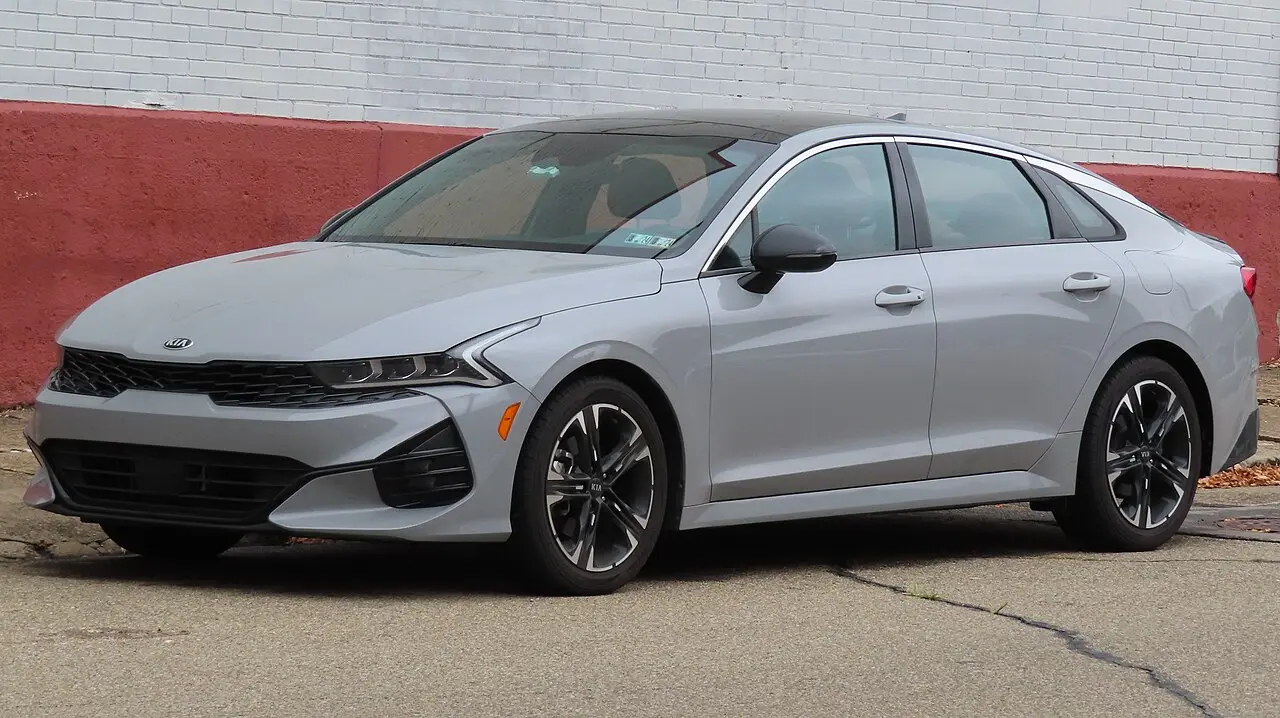
What kind of car is the Kia K5?
The Kia K5 is a mid-size four-door sedan in the passenger-car side of Kia’s range. In the United States, the K5 name replaced Optima for this generation. Kia gave it a lower, wider design and introduced it on the N3 platform.
The fifth-generation K5, code DL3, began in 2021 and is listed in the United States and Canada. Kia’s US launch introduced turbocharged engines, an eight-speed automatic transmission and available all-wheel drive.
Engines and power
The US and Canadian listings cover petrol engines from 1.6 to 2.5 litres. Power varies by version. In the United States, Kia offered a turbocharged range with an eight-speed automatic transmission; some versions also had an eight-speed dual-clutch transmission. All-wheel drive was available with the 1.6-litre engine.
How economical is the Kia K5?
The lowest listed US consumption is 7.4 L/100 km, and the best combined EPA rating is 32 MPG. Canada’s lowest listed figure is 8.2 L/100 km on the NRCan 5-cycle test. These procedures differ: EPA ratings apply in the United States, NRCan’s 5-cycle figures in Canada, and European figures use WLTP or NEDC.
US listings run from 2021 through 2027, while Canadian listings run from 2021 through 2024. The listed engine sizes in both markets range from 1.6 to 2.5 litres.
Where was the Kia K5 sold?
The K5 is listed in the United States and Canada. Its fifth generation brought the K5 name to the US mid-size sedan role previously associated with the Optima. It remains one of Kia’s larger passenger cars alongside the brand’s SUV lineup.
Questions and answers
Which K5 generation is listed?
The K5 is the fifth generation, designated DL3, and its listed years begin in 2021.
What engine sizes are listed for the Kia K5?
The US and Canadian listings cover petrol engines from 1.6 to 2.5 litres.
What is the K5’s best listed US fuel economy?
Its best combined EPA rating is 32 MPG, with the lowest listed consumption at 7.4 L/100 km.
How do the US and Canadian K5 consumption figures differ?
The lowest listed figure is 7.4 L/100 km under EPA testing in the US and 8.2 L/100 km under NRCan’s 5-cycle procedure in Canada.