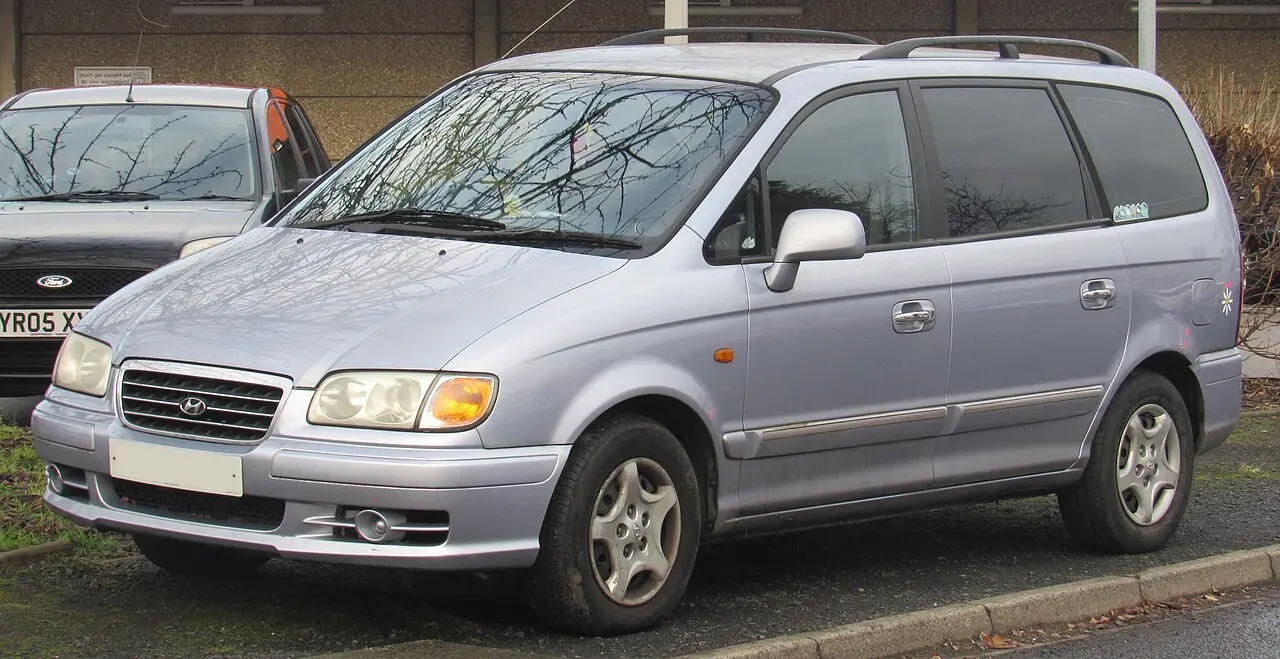
Hyundai

Hyundai Trajet

Hyundai Trajet
Photo: Vauxford / Wikimedia Commons · CC BY-SA 4.0

The official data lists 12 versions of the Hyundai Trajet (2000–2010), in the European Union and the United Kingdom. Each market publishes its own figures, measured on its own test procedure.

At a glance

Years in the data
2000–2010
Markets
European Union, United Kingdom
Engines
2.0 L to 2.7 L
Fuels
Petrol, Diesel
Lowest consumption (United Kingdom)
7.2 L/100 km (NEDC)
New registrations in the EU
18

What kind of car is the Hyundai Trajet?

The Hyundai Trajet is a multi-purpose vehicle with a tall, spacious body and room for family passengers and their luggage. It joined Hyundai’s range as the company added more practical people carriers alongside its saloons and hatchbacks.

Generations and engines

The first-generation Trajet, code FO, was sold in the UK from 2000 to 2007. UK versions used petrol or diesel engines ranging from 2.0 L to 2.7 L. A 2.0 L petrol version also appears in EU registration figures for 2010.

How economical is the Hyundai Trajet?

The lowest listed UK fuel consumption is 7.2 L/100 km on the NEDC test. EU registration figures show 18 petrol Trajets registered in 2010.

Where was the Hyundai Trajet sold?

The Trajet appears in UK VCA figures from 2000 to 2007 and EU registration figures for 2010.

Questions and answers

When was the Hyundai Trajet sold in the UK?

UK VCA figures cover the first-generation Trajet from 2000 to 2007.

What engines did the Trajet have?

The UK range included petrol and diesel engines from 2.0 L to 2.7 L.

What is the Trajet’s lowest listed fuel consumption?

The lowest listed UK figure is 7.2 L/100 km on the NEDC test.

Trajet first generation (2000–2007)

Hyundai Trajet first generation
Photo: Vauxford / Wikimedia Commons · CC BY-SA 4.0

Model codes: FO · Sold in: United Kingdom · References: en.wikipedia.org, autocentrum.pl

United Kingdom 11 versions

New cars on sale in the UK, from the Vehicle Certification Agency. NEDC figures until 2018 and WLTP figures after; years are the editions a version appeared in.

Years and versionEngineFuelGearboxConsumption (combined)CO₂
2006–20072.0l DOHC2.0 LPetrol5-speed manual8.7 L/100 km NEDC208 g/km
2006–20072.0l DOHC2.0 LPetrol4-speed automatic9.6 L/100 km NEDC230 g/km
20062.0l CRTD2.0 LDiesel5-speed manual7.2 L/100 km NEDC192 g/km
20062.0l CRTD2.0 LDiesel4-speed automatic8.4 L/100 km NEDC224 g/km
2001–20042.0 Turbo Diesel · 2.0l Turbo Diesel · 2.0l CRTD2.0 LDiesel5-speed manual7.2 L/100 km NEDC192 g/km
2001–20042.0 Turbo Diesel · 2.0l Turbo Diesel · 2.0l CRTD2.0 LDiesel4-speed automatic8.4 L/100 km NEDC224 g/km
2001–20042.0 DOHC · 2.0 DOHC · 2.0l DOHC2.0 LPetrol5-speed manual9.3 L/100 km NEDC223 g/km
2001–20042.0 DOHC · 2.0 DOHC · 2.0l DOHC2.0 LPetrol4-speed automatic10.3 L/100 km NEDC247 g/km
2000–20042.7 DOHC · 2.7 V6 DOHC · 2.7 V6 DOHC and 1 more trim2.7 LPetrol4-speed automatic11.3 L/100 km NEDC271 g/km
20002.0 DOHC2.0 LPetrol5-speed manual9.3 L/100 km NEDC223 g/km
20002.0 DOHC2.0 LPetrol4-speed automatic10.3 L/100 km NEDC247 g/km

Versions outside these generations

European Union 1 version

New cars registered in the EU (plus Norway and Iceland), from the European Environment Agency. Figures on the NEDC procedure until 2020 and on WLTP from 2021; versions are grouped by engine and power, with their number of registrations.

Years and versionEngineFuelCO₂EU registrations
20102.0 LPetrol208 g/km18

Official figures are measured on standard test procedures and differ between markets. Your consumption depends on how, where and in what conditions you drive.