Hyundai

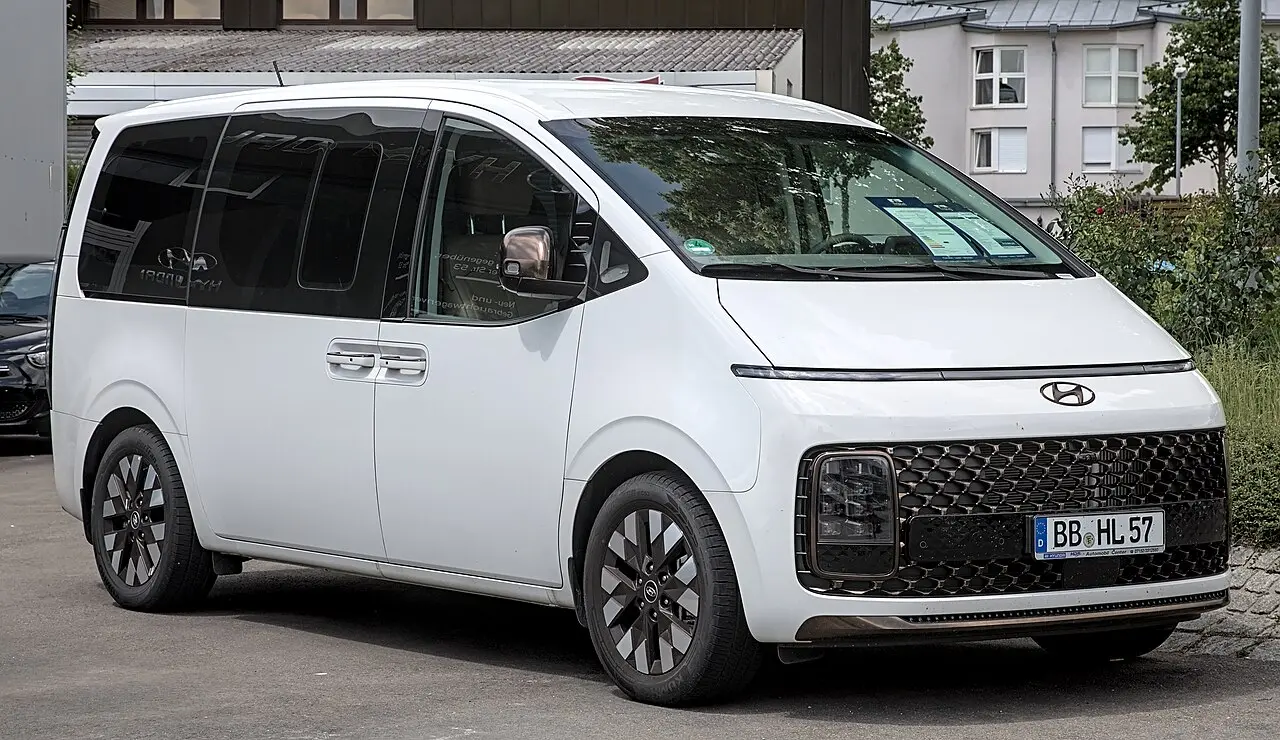
Hyundai Staria

Hyundai Staria
Photo: Alexander Migl / Wikimedia Commons · CC BY-SA 4.0

The official data lists 11 versions of the Hyundai Staria (2021–2025), in the European Union. Each market publishes its own figures, measured on its own test procedure.

At a glance

Years in the data
2021–2025
Markets
European Union
Engines
1.6 L to 2.2 L
Power
117 kW (159 PS) to 130 kW (177 PS)
Fuels
Hybrid, Plug-in hybrid, Petrol, Diesel
Lowest consumption (European Union)
5.8 L/100 km (WLTP)
Plug-in hybrid, weighted (European Union)
7.6 L/100 km (WLTP)
New registrations in the EU
14,112

What is the Hyundai Staria?

The Staria is a multi-purpose vehicle (MPV) with a spacious cabin designed to carry people and luggage. Hyundai’s “Inside-Out” design approach starts with the cabin and shapes the exterior around its sense of space and openness.

The first generation arrived in 2021. In Hyundai’s line-up, the Staria fills the people-carrier role, with conventional and electrified powertrains.

Engines and power

EU versions span 1.6- to 2.2-litre engines, with power from 117 kW (159 PS) to 130 kW (177 PS). Listed fuels include hybrid, plug-in hybrid, petrol and diesel. The 2.2-litre diesel with 130 kW (177 PS) was the most registered configuration in each of 2022, 2023 and 2024.

How economical is the Hyundai Staria?

The lowest stated WLTP consumption for petrol, diesel and hybrid versions is 5.8 L/100 km. The plug-in hybrid’s lowest stated figure is 7.6 L/100 km WLTP, an official weighted value that assumes some driving is electric.

Where was it sold?

The Staria recorded 14,112 European Economic Area registrations from 2021 to 2025 across 11 versions.

Questions and answers

When did the Staria first go on sale?

Its first generation began in 2021; EU registration figures run through 2025.

What is the Staria’s most common EU engine?

The 2.2-litre diesel with 130 kW (177 PS) was the most registered configuration in 2022, 2023 and 2024.

What is its lowest stated fuel consumption?

For petrol, diesel and hybrid versions, it is 5.8 L/100 km WLTP. The plug-in hybrid’s lowest stated weighted figure is 7.6 L/100 km WLTP.

Staria first generation (since 2021)

Hyundai Staria first generation
Photo: Alexander Migl / Wikimedia Commons · CC BY-SA 4.0

Sold in: European Union · References: hyundai.news

European Union 11 versions

New cars registered in the EU (plus Norway and Iceland), from the European Environment Agency. Figures on the NEDC procedure until 2020 and on WLTP from 2021; versions are grouped by engine and power, with their number of registrations.

Years and versionEnginePowerFuelConsumption (combined)CO₂EU registrations
20251.6 L118 kW (160 PS)Hybrid7.6 L/100 km WLTP172 g/km2,131
20251.6 L117 kW (159 PS)Hybrid7.6 L/100 km WLTP172 g/km1,337
20251.6 L118 kW (160 PS)Plug-in hybrid7.6 L/100 km WLTP172 g/km71
20251.6 L–Petrol5.8 L/100 km WLTP171 g/km66
20252.2 L130 kW (177 PS)Diesel8.5 L/100 km WLTP222 g/km23
20242.2 L130 kW (177 PS)Diesel8.6 L/100 km WLTP226 g/km2,983
20241.6 L118 kW (160 PS)Hybrid7.6 L/100 km WLTP172 g/km350
20241.6 L117 kW (159 PS)Hybrid7.6 L/100 km WLTP172 g/km93
20232.2 L130 kW (177 PS)Diesel8.6 L/100 km WLTP226 g/km4,164
20222.2 L130 kW (177 PS)Diesel8.7 L/100 km WLTP227 g/km2,154
20212.2 L130 kW (177 PS)Diesel8.6 L/100 km WLTP227 g/km740

Official figures are measured on standard test procedures and differ between markets. Your consumption depends on how, where and in what conditions you drive.