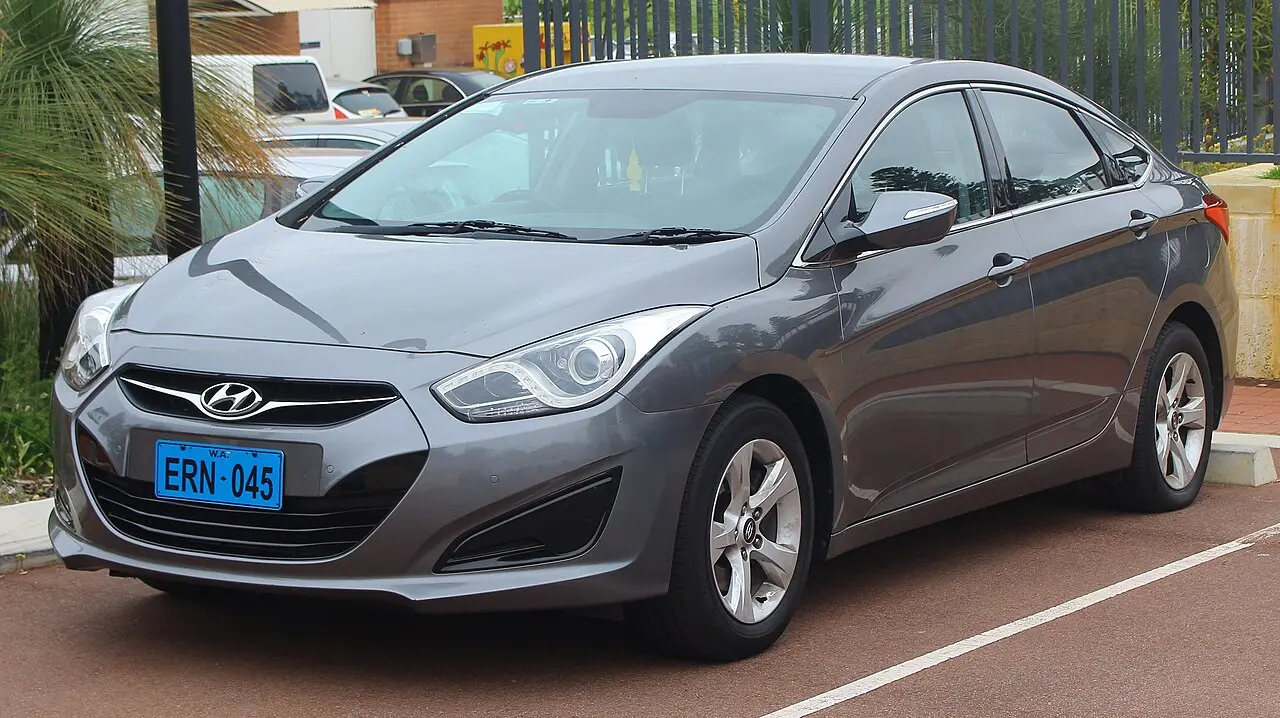
The official data lists 142 versions of the Hyundai i40 (2011–2020), in the European Union, the United Kingdom, and France. Each market publishes its own figures, measured on its own test procedure.
At a glance
Years in the data
2011–2020
Markets
European Union, United Kingdom, France
Engines
1.6 L to 2.0 L
Power
85 kW (116 PS) to 149 kW (203 PS)
Fuels
Diesel, Petrol, LPG, Hybrid
Lowest consumption (France)
4.2 L/100 km (NEDC)
Lowest consumption (United Kingdom)
4.2 L/100 km (NEDC)
New registrations in the EU
318,616
What is the Hyundai i40?
The Hyundai i40 is a family car developed for Europe and offered as a saloon and an estate, which Hyundai called the Wagon. The estate has a longer roof and a more flexible load space, while the saloon has a traditional four-door shape.
Hyundai introduced the i40 in 2011, following development at its European research facilities. It sat in the mid-size part of the company’s range and was based on the Sonata platform.
Generations and body styles
The i40 had one generation, the first generation (2011–2019), with the code VF. The Wagon arrived before the saloon. Updates refreshed the car during its life, while both body styles remained available for drivers choosing between an estate and a saloon.
Engines and power
Across EU registrations, engines ranged from 1.6 L to 2.0 L and power from 85 kW (116 PS) to 156 kW (212 PS). Petrol, diesel, LPG, hybrid and other entries appear in the EU range. The most registered configuration in the EU figures was a 1.7 L diesel producing 100 kW (136 PS).
UK figures show engines from 1.6 L to 1.7 L and power from 85 kW (116 PS) to 104 kW (141 PS). France’s recorded power range was also 85 kW (116 PS) to 104 kW (141 PS).
Fuel consumption
The lowest stated official consumption is 4.2 L/100 km on the NEDC test, for both UK and French versions. NEDC is a standardised laboratory test, so real-world consumption can differ.
Questions and answers
Was the Hyundai i40 available as an estate?
Yes. Hyundai sold it as a Wagon estate as well as a four-door saloon.
What was the i40’s generation?
It had one generation, the first generation (2011–2019), identified by the code VF.
What is the lowest stated i40 fuel consumption?
The lowest stated figure is 4.2 L/100 km on the NEDC test, in UK and French market figures.
Model codes: VF · Sold in: European Union, United Kingdom, and France · References: en.wikipedia.org, hyundai.com
European Union 67 versions
New cars registered in the EU (plus Norway and Iceland), from the European Environment Agency. Figures on the NEDC procedure until 2020 and on WLTP from 2021; versions are grouped by engine and power, with their number of registrations.
Years and version
Engine
Power
Fuel
CO₂
EU registrations
2019
1.6 L
100 kW (136 PS)
Diesel
120 g/km
3,646
2019
1.6 L
99 kW (135 PS)
Petrol
148 g/km
1,114
2019
1.6 L
85 kW (116 PS)
Diesel
117 g/km
702
2019
1.7 L
104 kW (141 PS)
Diesel
122 g/km
168
2019
1.7 L
85 kW (116 PS)
Diesel
115 g/km
74
2019
2.0 L
121 kW (165 PS)
Petrol
174 g/km
32
2018
1.7 L
104 kW (141 PS)
Diesel
123 g/km
9,758
2018
1.6 L
99 kW (135 PS)
Petrol
141 g/km
2,820
2018
1.7 L
85 kW (116 PS)
Diesel
114 g/km
2,606
2018
2.0 L
121 kW (165 PS)
Petrol
173 g/km
1,876
2018
1.6 L
100 kW (136 PS)
Diesel
121 g/km
516
2018
1.6 L
85 kW (116 PS)
Diesel
115 g/km
62
2017
1.7 L
104 kW (141 PS)
Diesel
127 g/km
20,630
2017
1.6 L
99 kW (135 PS)
Petrol
142 g/km
3,078
2017
1.7 L
85 kW (116 PS)
Diesel
114 g/km
2,368
2017
1.7 L
156 kW (212 PS)
Diesel
126 g/km
1,300
2017
2.0 L
121 kW (165 PS)
Petrol
174 g/km
1,218
2017
2.0 L
182 kW (247 PS)
Petrol
172 g/km
200
2017
1.7 L
128 kW (174 PS)
Diesel
119 g/km
106
2017
1.6 L
149 kW (203 PS)
Petrol
148 g/km
54
2017
1.7 L
100 kW (136 PS)
Diesel
131 g/km
14
2016
1.7 L
104 kW (141 PS)
Diesel
126 g/km
32,026
2016
1.6 L
99 kW (135 PS)
Petrol
144 g/km
3,482
2016
1.7 L
85 kW (116 PS)
Diesel
115 g/km
3,030
2016
2.0 L
121 kW (165 PS)
Petrol
173 g/km
1,110
2016
1.7 L
100 kW (136 PS)
Diesel
142 g/km
118
2016
2.0 L
121 kW (165 PS)
LPG
176 g/km
38
2015
1.7 L
100 kW (136 PS)
Diesel
142 g/km
29,110
2015
1.7 L
104 kW (141 PS)
Diesel
125 g/km
10,030
2015
1.7 L
85 kW (116 PS)
Diesel
118 g/km
5,394
2015
1.6 L
99 kW (135 PS)
Petrol
146 g/km
3,944
2015
2.0 L
121 kW (165 PS)
Petrol
173 g/km
520
2015
2.0 L
130 kW (177 PS)
Petrol
172 g/km
300
2015
2.0 L
131 kW (178 PS)
Petrol
175 g/km
106
2015
1.7 L
85 kW (116 PS)
Hybrid
113 g/km
52
2015
2.0 L
130 kW (177 PS)
Diesel
159 g/km
10
2014
1.7 L
100 kW (136 PS)
Diesel
140 g/km
36,500
2014
1.6 L
99 kW (135 PS)
Petrol
147 g/km
5,940
2014
1.7 L
85 kW (116 PS)
Diesel
120 g/km
5,128
2014
2.0 L
131 kW (178 PS)
Petrol
169 g/km
574
2014
2.0 L
130 kW (177 PS)
Petrol
171 g/km
486
2014
–
–
Diesel
143 g/km
10
2014
2.0 L
131 kW (178 PS)
Diesel
162 g/km
10
2013
1.7 L
100 kW (136 PS)
Diesel
139 g/km
33,734
2013
1.6 L
99 kW (135 PS)
Petrol
147 g/km
8,336
2013
1.7 L
85 kW (116 PS)
Diesel
121 g/km
7,740
2013
1.7 L
–
Other fuel
127 g/km
4,532
2013
2.0 L
130 kW (177 PS)
Petrol
171 g/km
1,172
2013
2.0 L
131 kW (178 PS)
Petrol
171 g/km
846
2013
1.6 L
–
Other fuel
149 g/km
118
2013
–
–
Diesel
131 g/km
24
2013
–
–
Petrol
169 g/km
24
2013
2.0 L
131 kW (178 PS)
Petrol
176 g/km
16
2012
1.7 L
100 kW (136 PS)
Diesel
141 g/km
35,909
2012
1.7 L
85 kW (116 PS)
Diesel
123 g/km
9,749
2012
1.6 L
99 kW (135 PS)
Petrol
147 g/km
6,644
2012
2.0 L
130 kW (177 PS)
Petrol
172 g/km
2,725
2012
2.0 L
131 kW (178 PS)
Petrol
171 g/km
578
2012
–
–
Diesel
135 g/km
228
2012
–
–
Petrol
156 g/km
102
2011
1.7 L
100 kW (136 PS)
Diesel
139 g/km
10,314
2011
1.7 L
85 kW (116 PS)
Diesel
117 g/km
1,868
2011
2.0 L
130 kW (177 PS)
Petrol
171 g/km
1,662
2011
1.6 L
99 kW (135 PS)
Petrol
148 g/km
1,488
2011
–
–
Petrol
157 g/km
18
2011
–
–
Diesel
130 g/km
16
2011
1.8 L
–
Petrol
134 g/km
10
United Kingdom 42 versions
New cars on sale in the UK, from the Vehicle Certification Agency. NEDC figures until 2018 and WLTP figures after; years are the editions a version appeared in.
New cars registered in the EU (plus Norway and Iceland), from the European Environment Agency. Figures on the NEDC procedure until 2020 and on WLTP from 2021; versions are grouped by engine and power, with their number of registrations.
Years and version
Engine
Power
Fuel
CO₂
EU registrations
2020
1.6 L
100 kW (136 PS)
Diesel
118 g/km
315
2020
1.6 L
99 kW (135 PS)
Petrol
145 g/km
112
2020
1.6 L
85 kW (116 PS)
Diesel
118 g/km
76
Official figures are measured on standard test procedures and differ between markets. Your consumption depends on how, where and in what conditions you drive.