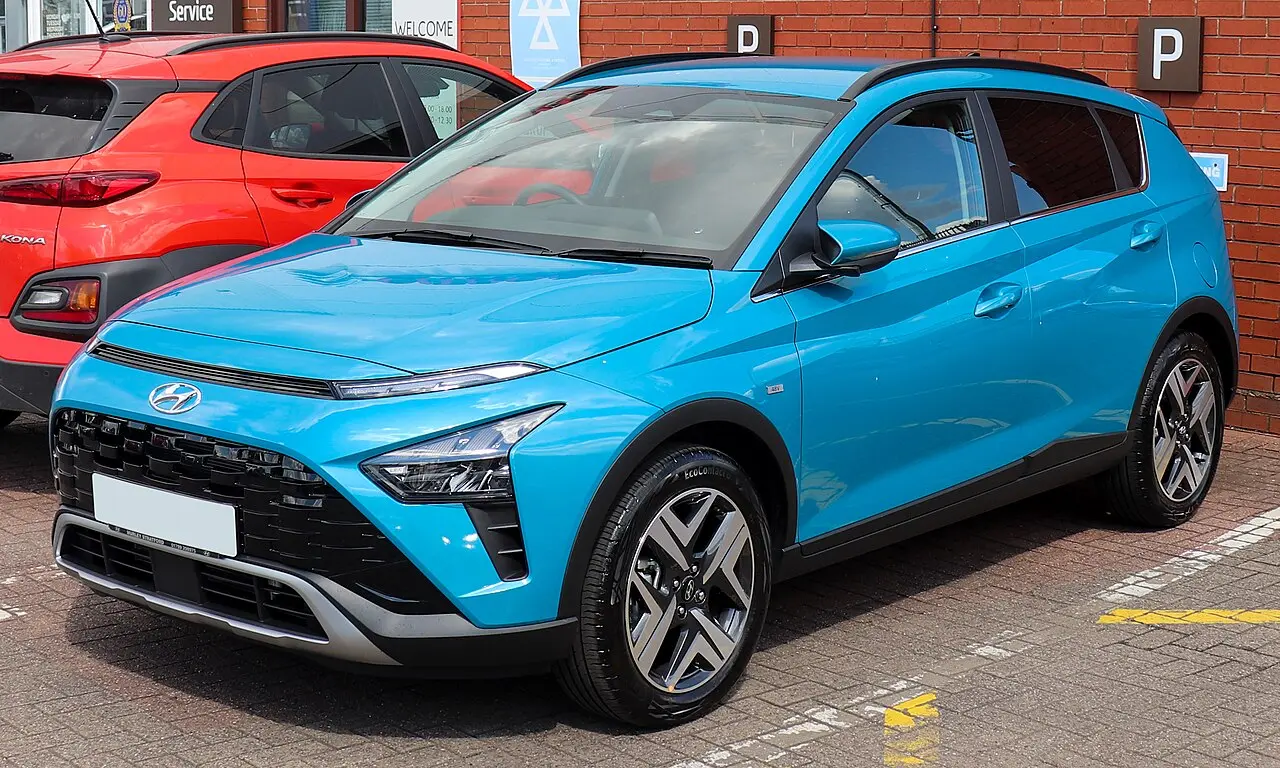
What is the Hyundai Bayon?
The Hyundai Bayon is a compact crossover SUV designed for Europe. Its compact exterior and roomy interior give it a practical shape for city streets and everyday journeys. It sits at the compact end of Hyundai’s SUV range, with sharp lines and angular details in keeping with the brand’s design language.
The first generation began in 2021 and continues today. Hyundai introduced the Bayon as a Europe-focused crossover, with petrol, hybrid and LPG fuel types listed in the EU range.
Engines and power
EU versions use engines from 1.0 to 1.2 litres, with recorded power from 57 kW (77 PS) to 88 kW (120 PS). The 1.0-litre petrol version rated at 74 kW (101 PS) was among the most registered EU choices. UK listings show 1.0-litre engines with power from 66 kW (90 PS) to 120 kW (163 PS), and include petrol and hybrid versions.
How economical is the Hyundai Bayon?
The lowest listed EU fuel consumption is 4.5 L/100 km on the WLTP test. The UK low is 5.2 L/100 km, also under WLTP. These are the lowest listed figures for petrol, diesel or hybrid versions. Test procedures differ between markets, so WLTP results are not directly equivalent to US EPA or Canadian 5-cycle figures.
Where was the Bayon sold?
EU registration figures cover 2021 to 2025, with 126,001 cars registered. UK listings cover 2021 to 2026. The listed fuel types differ by market: the EU range includes petrol, hybrid and LPG, while the UK range includes petrol and hybrid.
Questions and answers
When did the Hyundai Bayon go on sale?
Its first generation began in 2021. EU registration figures cover 2021 to 2025, and UK listings cover 2021 to 2026.
What engines does the Bayon have?
The EU range lists 1.0- to 1.2-litre engines and petrol, hybrid and LPG fuel types. UK listings show 1.0-litre petrol and hybrid versions.
What is the Bayon’s lowest listed fuel consumption?
The EU low is 4.5 L/100 km WLTP; the UK low is 5.2 L/100 km WLTP.