Honda

Honda Element

Honda Element
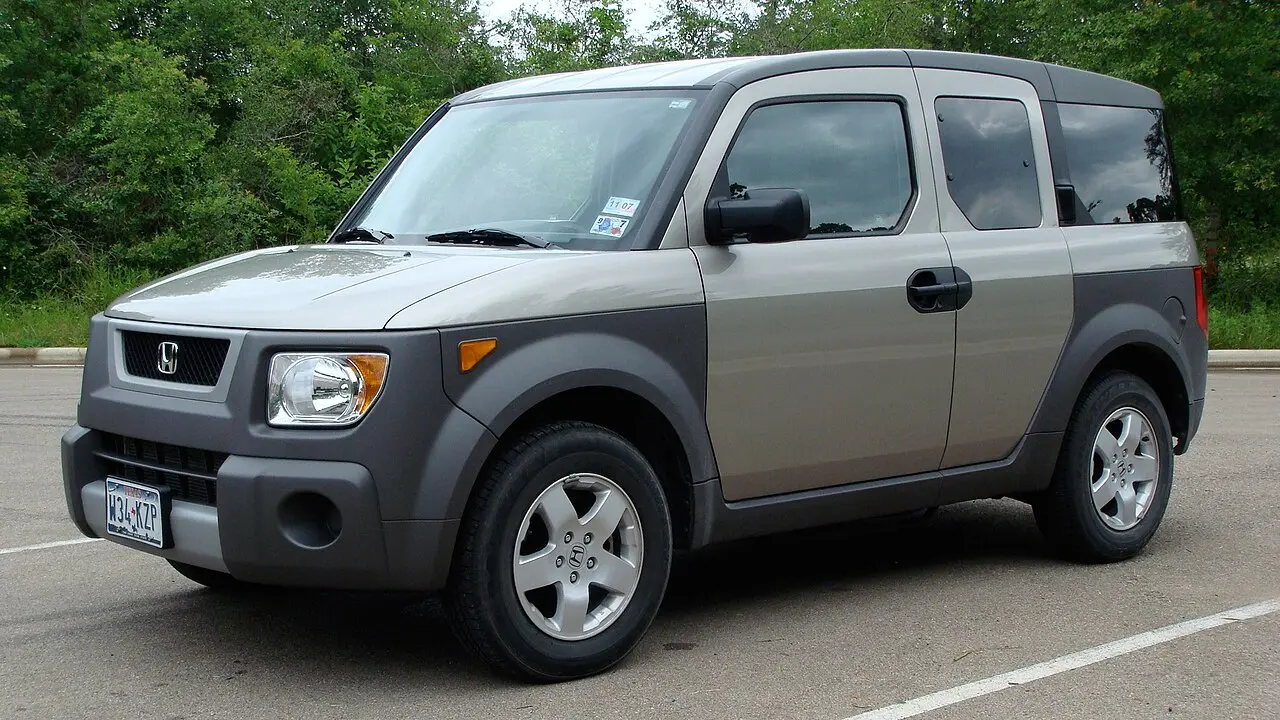
Photo: phototram / Wikimedia Commons · CC BY 2.0

The official data lists 26 versions of the Honda Element (2003–2011), in the United States and Canada. Each market publishes its own figures, measured on its own test procedure.

At a glance

Years in the data
2003–2011
Markets
United States, Canada
Engines
2.4 L
Fuels
Petrol
Lowest consumption (United States)
10.7 L/100 km (EPA)
Lowest consumption (Canada)
10.9 L/100 km (5-cycle)

What is the Honda Element?

The Honda Element is a boxy SUV designed around practical access and flexible cargo carrying. Its rear-hinged side doors open alongside the front doors, creating a broad opening into the cabin. Honda also offered water-resistant seat fabric, a useful touch for carrying gear or pets. The Element’s listed North American model years run from 2003 to 2011.

Honda Element generation

The first-generation Element, codes YH1 and YH2, ran from 2003 to 2011. Its rear-hinged side doors open with the front doors, making it easier to load bulky items. The durable interior and adaptable cargo space give the Element a distinctive place among Honda’s SUVs.

Engine and fuel consumption

Every listed version uses a 2.4 L petrol engine. In the United States, the best combined EPA rating is 22 MPG, with a lowest listed consumption of 10.7 L/100 km. Canada’s lowest listed figure is 10.9 L/100 km on the NRCan 5-cycle test. The EPA and Canadian 5-cycle procedures differ, so results are best read within their own markets.

Where was the Element sold?

The Element is listed in the United States and Canada, with model years from 2003 to 2011 in both countries. The listed versions use petrol.

Questions and answers

What kind of vehicle is the Honda Element?

It is a boxy SUV designed around accessible, flexible cargo space.

What years was the Element sold?

The model years run from 2003 to 2011 in both the United States and Canada.

What engine does the Element use?

The listed versions use a 2.4 L petrol engine.

What is the Element’s best combined EPA fuel economy?

The best combined EPA rating is 22 MPG.

Element First generation (2003–2011)

Honda Element First generation
Photo: phototram / Wikimedia Commons · CC BY 2.0

Model codes: YH1, YH2 · Sold in: United States and Canada · References: en.wikipedia.org

United States 14 versions

Model years sold in the USA, from the EPA and the Department of Energy (fueleconomy.gov). MPG on the EPA test; litres per 100 km = 235.215 ÷ MPG.

Years and versionEngineFuelGearboxDriveConsumption (combined)CO₂
2010–20112.4 LPetrol5-speed automaticAll-wheel drive21 MPG (11.2 L/100 km) EPA263 g/km
20112.4 LPetrol5-speed automaticFront-wheel drive22 MPG (10.7 L/100 km) EPA251 g/km
20112.4 LPetrol5-speed manualAll-wheel drive20 MPG (11.8 L/100 km) EPA276 g/km
2007–2010CLKUP2.4 LPetrol5-speed automaticFront-wheel drive22 MPG (10.7 L/100 km) EPA251 g/km
2007–20102.4 LPetrol5-speed manualFront-wheel drive20 MPG (11.8 L/100 km) EPA276 g/km
20102.4 LPetrol5-speed manualAll-wheel drive20 MPG (11.8 L/100 km) EPA276 g/km
2007–2009CLKUP2.4 LPetrol5-speed automaticFour- or all-wheel drive21 MPG (11.2 L/100 km) EPA263 g/km
2007–20092.4 LPetrol5-speed manualFour- or all-wheel drive20 MPG (11.8 L/100 km) EPA276 g/km
2003–2006CLKUP2.4 LPetrol4-speed automaticFour- or all-wheel drive20 MPG (11.8 L/100 km) EPA276 g/km
2003–20062.4 LPetrol5-speed manualFour- or all-wheel drive20 MPG (11.8 L/100 km) EPA276 g/km
2005–2006CLKUP2.4 LPetrol4-speed automaticFront-wheel drive21 MPG (11.2 L/100 km) EPA263 g/km
2005–20062.4 LPetrol5-speed manualFront-wheel drive21 MPG (11.2 L/100 km) EPA263 g/km
2003–2004CLKUP2.4 LPetrol4-speed automaticFront-wheel drive21 MPG (11.2 L/100 km) EPA263 g/km
2003–20042.4 LPetrol5-speed manualFront-wheel drive21 MPG (11.2 L/100 km) EPA263 g/km

Canada 12 versions

Model years sold in Canada, from Natural Resources Canada fuel consumption ratings (5-cycle test).

Years and versionEngineFuelGearboxConsumption (combined)CO₂
2007–2011Sport utility vehicle2.4 LPetrol5-speed automatic10.9 L/100 km 5-cycle251 g/km
2007–2011Sport utility vehicle2.4 LPetrol5-speed automatic11.3 L/100 km 5-cycle260 g/km
2007–2008Sport utility vehicle2.4 LPetrol5-speed manual11.7 L/100 km 5-cycle269 g/km
2006Sport utility vehicle2.4 LPetrol4-speed automatic11.2 L/100 km 5-cycle258 g/km
2006Sport utility vehicle2.4 LPetrol5-speed manual11.4 L/100 km 5-cycle262 g/km
2006Sport utility vehicle2.4 LPetrol4-speed automatic11.6 L/100 km 5-cycle267 g/km
2006Sport utility vehicle2.4 LPetrol5-speed manual11.8 L/100 km 5-cycle271 g/km
2003–2004Sport utility vehicle2.4 LPetrol4-speed automatic10.9 L/100 km 5-cycle251 g/km
2003–2004Sport utility vehicle2.4 LPetrol5-speed manual11.4 L/100 km 5-cycle262 g/km
2003–2004Sport utility vehicle2.4 LPetrol4-speed automatic11.5 L/100 km 5-cycle265 g/km
2004Sport utility vehicle2.4 LPetrol5-speed manual11.9 L/100 km 5-cycle274 g/km

Official figures are measured on standard test procedures and differ between markets. Your consumption depends on how, where and in what conditions you drive.