Ford

Ford Maverick

Ford Maverick
Photo: Elise240SX / Wikimedia Commons · CC BY-SA 4.0

The official data lists 37 versions of the Ford Maverick (2001–2026), in the United Kingdom, the United States, and Canada. Each market publishes its own figures, measured on its own test procedure.

At a glance

Years in the data
2001–2026
Markets
United Kingdom, United States, Canada
Engines
2.0 L to 3.0 L
Fuels
Petrol, Hybrid
Lowest consumption (United States)
6.2 L/100 km (EPA)
Lowest consumption (Canada)
6.2 L/100 km (5-cycle)
Lowest consumption (United Kingdom)
9.6 L/100 km (NEDC)

What is the Ford Maverick?

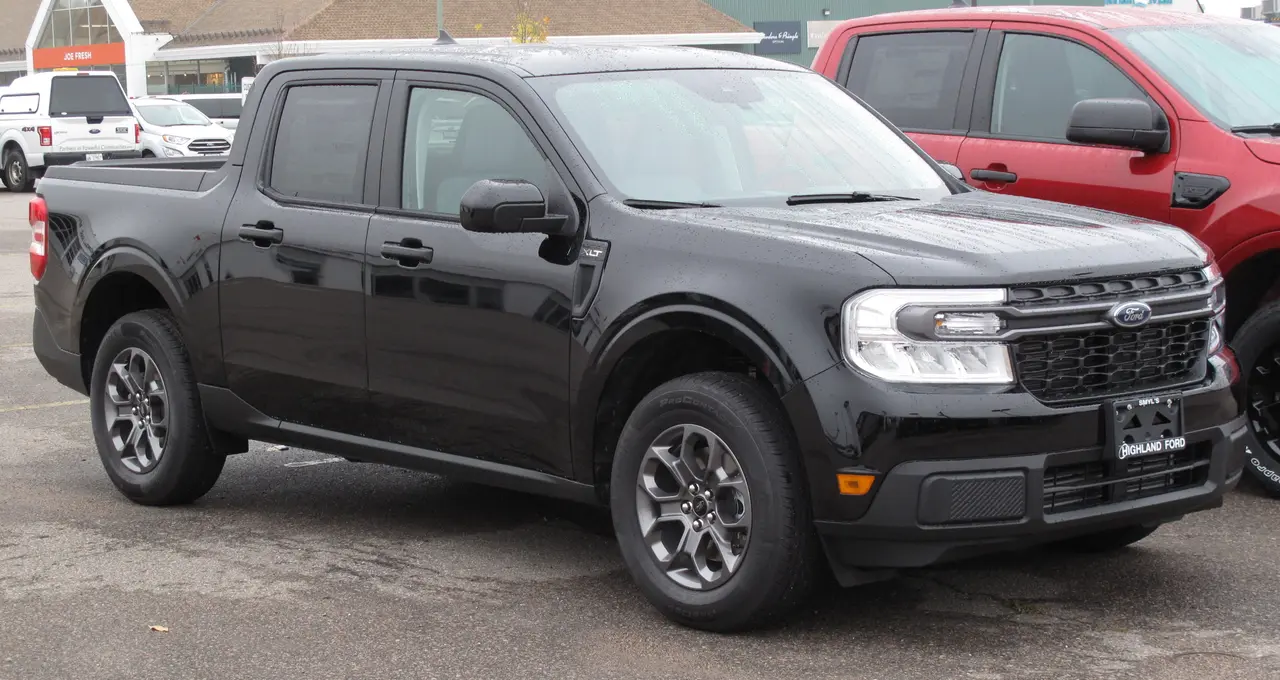
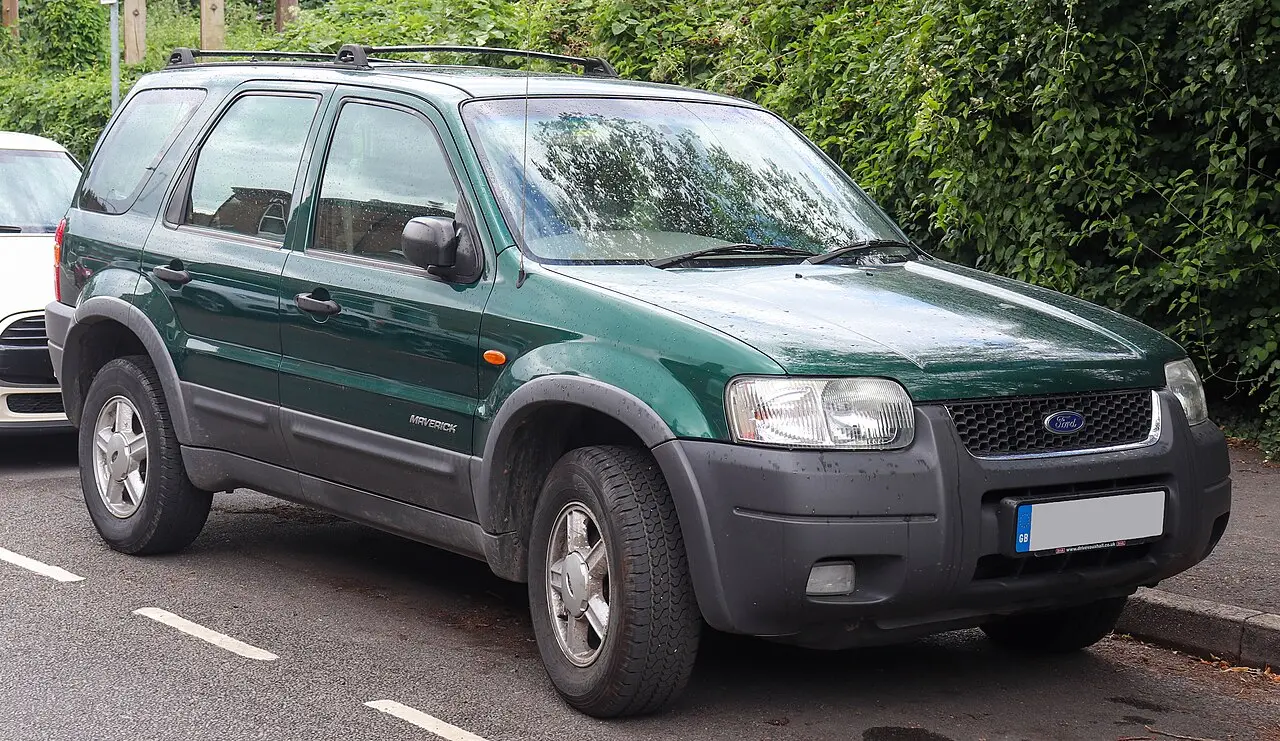
Ford has used the Maverick name for two different vehicles. In the UK, the 2001–2004 Maverick was an SUV. In the United States and Canada, the name returned for a compact pickup introduced for the 2022 model year. Its unibody construction gives it a more car-like design than a traditional truck.

The North American Maverick adds a compact pickup to Ford’s range. Ford introduced the modern model with petrol and hybrid power in the United States, making a hybrid an option from the start.

Generations and engines

The UK Maverick II was sold from 2001 to 2004, with petrol engines ranging from 2.0 L to 3.0 L. The North American pickup is listed as the first generation, beginning in 2022. US engine choices range from 2.0 L to 2.5 L and include petrol and hybrid versions. Canadian listings cover petrol engines in the same displacement range.

The earlier model is an SUV; the modern North American Maverick is a pickup.

How economical is the Ford Maverick?

The lowest listed consumption for the UK model is 9.6 L/100 km on the NEDC test. For the modern pickup, the lowest listed figure is 6.2 L/100 km in both the United States and Canada. The US EPA gives it a best combined rating of 38 MPG. Test procedures differ between markets: Europe uses NEDC here, while the US uses EPA and Canada uses NRCan’s 5-cycle method.

The UK figures cover 2001–2004. US and Canadian figures cover 2022–2026. A hybrid version is listed in the US; the Canadian listings cover petrol versions.

Questions and answers

Is the Ford Maverick an SUV or a pickup?

Both, depending on the market and generation. The UK model from 2001–2004 was an SUV; the North American model introduced in 2022 is a compact pickup.

Does the Ford Maverick have a hybrid version?

A hybrid version is listed for the modern US pickup. The Canadian listings cover petrol versions.

What is the Maverick’s best combined EPA rating?

The best combined EPA rating for the US model is 38 MPG.
Maverick II (2001–2004)

Ford Maverick II
Photo: Vauxford / Wikimedia Commons · CC BY-SA 4.0

Model codes: CD2 · Sold in: United Kingdom · References: adac.de, de.wikipedia.org

Show all 4 versions

Maverick first generation (since 2022)

Ford Maverick first generation
Photo: Elise240SX / Wikimedia Commons · CC BY-SA 4.0

Model codes: C2 · Sold in: United States and Canada · References: en.wikipedia.org, cdn.dealereprocess.org

United States 18 versions

Model years sold in the USA, from the EPA and the Department of Energy (fueleconomy.gov). MPG on the EPA test; litres per 100 km = 235.215 ÷ MPG.

Years and versionEngineFuelGearboxDriveConsumption (combined)CO₂
2025–2026SIDI & PFI2.0 LPetrol8-speed automaticPart-time four-wheel drive25 MPG (9.4 L/100 km) EPA221 g/km
2025–2026SIDI & PFI2.0 LPetrol8-speed automaticFour-wheel drive24 MPG (9.8 L/100 km) EPA230 g/km
2025–2026SIDI & PFI2.0 LPetrol8-speed automaticFour-wheel drive23 MPG (10.2 L/100 km) EPA240 g/km
2026SIDI & PFI2.0 LPetrol8-speed automaticFront-wheel drive26 MPG (9.0 L/100 km) EPA212 g/km
2025–2026Hybrid2.5 LHybridContinuously variable (CVT)Front-wheel drive38 MPG (6.2 L/100 km) EPA145 g/km
2026Hybrid2.5 LHybridContinuously variable (CVT)Part-time four-wheel drive37 MPG (6.4 L/100 km) EPA150 g/km
2026Hybrid2.5 LHybridContinuously variable (CVT)Part-time four-wheel drive36 MPG (6.5 L/100 km) EPA154 g/km
2025Hybrid2.5 LHybridContinuously variable (CVT)Part-time four-wheel drive37 MPG (6.4 L/100 km) EPA149 g/km
2024SIDI2.0 LPetrol8-speed automaticFront-wheel drive26 MPG (9.0 L/100 km) EPA213 g/km
2024SIDI2.0 LPetrol8-speed automaticAll-wheel drive25 MPG (9.4 L/100 km) EPA221 g/km
2023–2024SIDI2.0 LPetrol8-speed automaticAll-wheel drive21 MPG (11.2 L/100 km) EPA257 g/km
2024Hybrid2.5 LHybridContinuously variable (CVT)Front-wheel drive37 MPG (6.4 L/100 km) EPA147 g/km
2023SIDI2.0 LPetrol8-speed automaticFront-wheel drive25 MPG (9.4 L/100 km) EPA221 g/km
2023SIDI2.0 LPetrol8-speed automaticAll-wheel drive24 MPG (9.8 L/100 km) EPA230 g/km
2023Hybrid2.5 LHybridContinuously variable (CVT)Front-wheel drive37 MPG (6.4 L/100 km) EPA149 g/km
2022SIDI2.0 LPetrol8-speed automaticFront-wheel drive26 MPG (9.0 L/100 km) EPA213 g/km
2022SIDI2.0 LPetrol8-speed automaticAll-wheel drive25 MPG (9.4 L/100 km) EPA221 g/km
2022Hybrid2.5 LHybridContinuously variable (CVT)Front-wheel drive37 MPG (6.4 L/100 km) EPA147 g/km

Canada 15 versions

Model years sold in Canada, from Natural Resources Canada fuel consumption ratings (5-cycle test).

Years and versionEngineFuelGearboxConsumption (combined)CO₂
2025–2026Pickup truck: Small2.0 LPetrol8-speed automatic9.4 L/100 km 5-cycle219 g/km
2025–2026Pickup truck: Small2.0 LPetrol8-speed automatic9.7 L/100 km 5-cycle227 g/km
2025–2026Pickup truck: Small2.0 LPetrol8-speed automatic10.1 L/100 km 5-cycle237 g/km
2026Pickup truck: Small2.5 LPetrolContinuously variable (CVT)6.2 L/100 km 5-cycle146 g/km
2026Pickup truck: Small2.5 LPetrolContinuously variable (CVT)6.4 L/100 km 5-cycle150 g/km
2026Pickup truck: Small2.5 LPetrolContinuously variable (CVT)6.6 L/100 km 5-cycle154 g/km
2025Pickup truck: Small2.5 LPetrolContinuously variable (CVT)6.2 L/100 km 5-cycle145 g/km
2025Pickup truck: Small2.5 LPetrolContinuously variable (CVT)6.3 L/100 km 5-cycle148 g/km
2023–2024Pickup truck: Small2.0 LPetrol8-speed automatic11.0 L/100 km 5-cycle257 g/km
2024Pickup truck: Small2.0 LPetrol8-speed automatic9.6 L/100 km 5-cycle225 g/km
2024Pickup truck: Small2.5 LPetrolContinuously variable (CVT)6.3 L/100 km 5-cycle147 g/km
2023Pickup truck: Small2.0 LPetrol8-speed automatic9.8 L/100 km 5-cycle230 g/km
2023Pickup truck: Small2.5 LPetrolContinuously variable (CVT)6.4 L/100 km 5-cycle149 g/km
2022Pickup truck: Small2.0 LPetrol8-speed automatic9.6 L/100 km 5-cycle226 g/km
2022Pickup truck: Small2.5 LPetrolContinuously variable (CVT)6.3 L/100 km 5-cycle147 g/km

Official figures are measured on standard test procedures and differ between markets. Your consumption depends on how, where and in what conditions you drive.