Ford

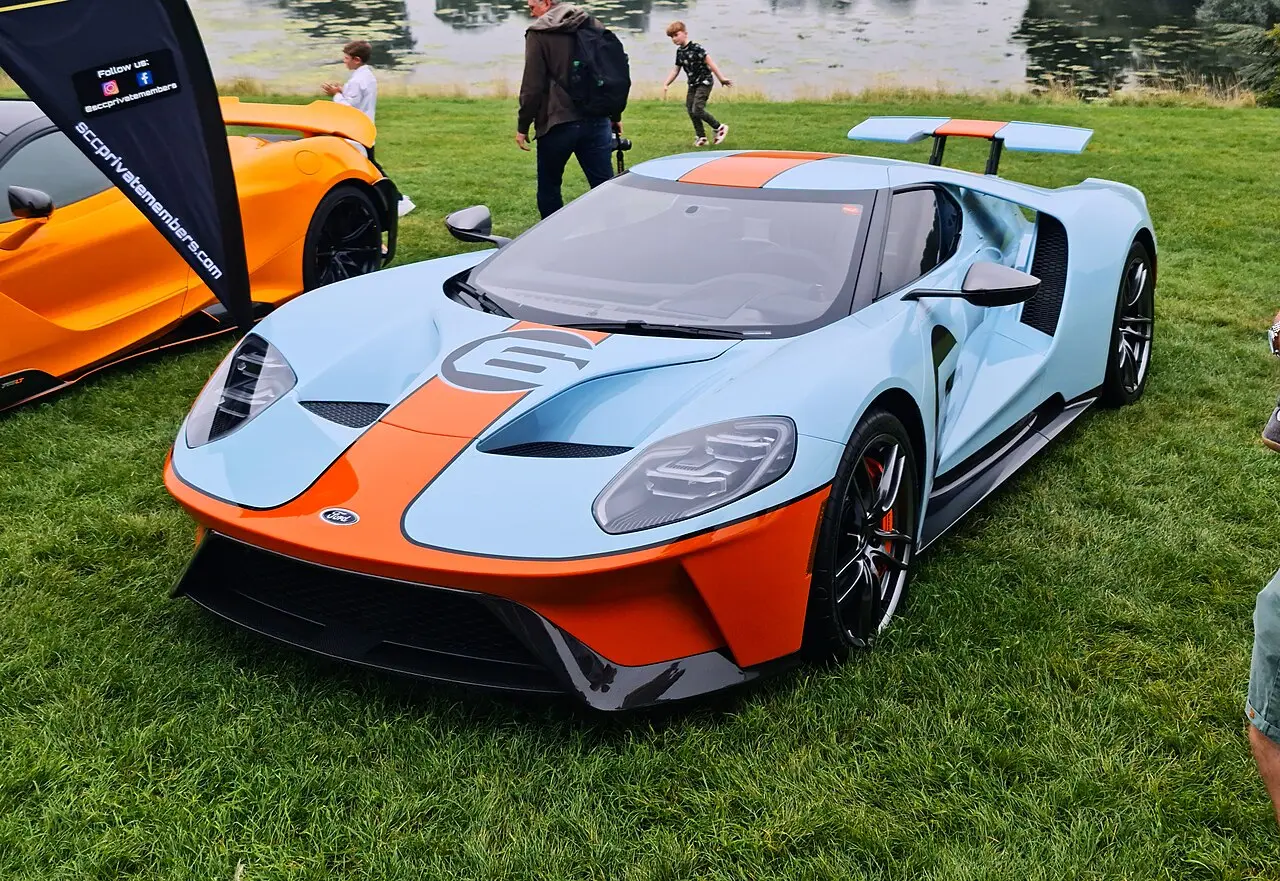
Ford GT

Ford GT
Photo: MrWalkr / Wikimedia Commons · CC BY-SA 4.0

The official data lists 13 versions of the Ford GT (2005–2026), in the European Union, France, the United States, and Canada. Each market publishes its own figures, measured on its own test procedure.

At a glance

Years in the data
2005–2026
Markets
European Union, France, United States, Canada
Engines
3.5 L to 5.4 L
Power
463 kW (630 PS) to 483 kW (657 PS)
Fuels
Petrol
Lowest consumption (European Union)
14.9 L/100 km (WLTP)
Lowest consumption (Canada)
16.6 L/100 km (5-cycle)
Lowest consumption (United States)
16.8 L/100 km (EPA)
New registrations in the EU
217

What is the Ford GT?

The Ford GT is a mid-engined, two-seat supercar shaped for performance. It has a close connection to Ford’s racing history, including the company’s endurance racing programme. The second-generation car uses a carbon-fibre structure and a twin-turbocharged 3.5 L EcoBoost V6.

The model has two generations: the first ran from 2005 to 2006, and the second from 2017 to 2022. The later car brought a new technical approach, with lightweight construction and a body shaped to manage airflow.

Engines and power

EU figures list a 3.5 L petrol engine with outputs from 463 kW (630 PS) to 483 kW (657 PS). US EPA listings span 3.5 L to 5.4 L across the model years covered, while Canadian listings specify a 3.5 L petrol engine. These ranges reflect different generations and markets.

The second-generation GT’s twin-turbo EcoBoost V6 and carbon-fibre structure show how its road car design drew on Ford’s performance and racing work.

How economical is the Ford GT?

EU registration figures list the GT from 2018 to 2024, with a lowest consumption figure of 14.9 L/100 km on the WLTP test. There were 217 EU registrations. US EPA figures cover 2005 to 2022, with a best combined rating of 14 MPG and lowest listed consumption of 16.8 L/100 km. Canadian figures for 2017 to 2022 show 16.6 L/100 km on the NRCan 5-cycle test.

These results use different procedures: WLTP in Europe, EPA in the United States and 5-cycle testing in Canada. The French listing for 2026 specifies a 3.5 L petrol version rated at 463 kW (630 PS).

Where was the Ford GT sold?

The GT’s generation histories include the United States, Canada, the EU, the UK and France. Figures include EU registrations from 2018 to 2024, US EPA listings from 2005 to 2022, Canadian listings from 2017 to 2022 and a French listing for 2026.

Questions and answers

How many Ford GT generations are there?

Two: the first generation ran from 2005 to 2006, and the second from 2017 to 2022.

What engine powers the EU-listed Ford GT?

The EU figures list a 3.5 L petrol engine, with outputs from 463 kW (630 PS) to 483 kW (657 PS).

What is the Ford GT’s EU fuel consumption figure?

The lowest EU figure is 14.9 L/100 km on the WLTP test.

Why do the US and European fuel figures differ?

The United States uses the EPA procedure, while Europe uses WLTP. Canada uses its 5-cycle test.

GT first generation (2005–2006)

Sold in: United States, Canada, European Union, United Kingdom, and France · References: cars.com, en.wikipedia.org

Show 1 version

GT second generation (2017–2022)

Ford GT second generation
Photo: MrWalkr / Wikimedia Commons · CC BY-SA 4.0

Sold in: United States, Canada, European Union, United Kingdom, and France · References: cars.com, media.ford.com

European Union 3 versions

New cars registered in the EU (plus Norway and Iceland), from the European Environment Agency. Figures on the NEDC procedure until 2020 and on WLTP from 2021; versions are grouped by engine and power, with their number of registrations.

Years and versionEnginePowerFuelConsumption (combined)CO₂EU registrations
20223.5 L463 kW (630 PS)Petrol13.7 L/100 km WLTP315 g/km34
20213.5 L463 kW (630 PS)Petrol14.9 L/100 km WLTP316 g/km72
20183.5 L483 kW (657 PS)Petrol–350 g/km62

United States 2 versions

Model years sold in the USA, from the EPA and the Department of Energy (fueleconomy.gov). MPG on the EPA test; litres per 100 km = 235.215 ÷ MPG.

Years and versionEngineFuelGearboxDriveConsumption (combined)CO₂
2020–2022SIDI & PFI3.5 LPetrol7-speed automated manualRear-wheel drive14 MPG (16.8 L/100 km) EPA393 g/km
2017–2019SIDI & PFI3.5 LPetrol7-speed automated manualRear-wheel drive14 MPG (16.8 L/100 km) EPA406 g/km

Canada 5 versions

Model years sold in Canada, from Natural Resources Canada fuel consumption ratings (5-cycle test).

Years and versionEngineFuelGearboxConsumption (combined)CO₂
2022Two-seater3.5 LPetrol7-speed automated manual16.7 L/100 km 5-cycle395 g/km
2020–2021Two-seater3.5 LPetrol7-speed automated manual16.6 L/100 km 5-cycle393 g/km
2019Two-seater3.5 LPetrol7-speed automated manual17.1 L/100 km 5-cycle402 g/km
2018Two-seater3.5 LPetrol7-speed automated manual17.1 L/100 km 5-cycle403 g/km
2017Two-seater3.5 LPetrol7-speed automated manual17.3 L/100 km 5-cycle406 g/km

Versions outside these generations

European Union 1 version

New cars registered in the EU (plus Norway and Iceland), from the European Environment Agency. Figures on the NEDC procedure until 2020 and on WLTP from 2021; versions are grouped by engine and power, with their number of registrations.

Years and versionEnginePowerFuelConsumption (combined)CO₂EU registrations
2023–20243.5 L463 kW (630 PS)Petrol13.7 L/100 km WLTP315 g/km49

France 1 version

New cars on sale in France, from ADEME Car Labelling. NEDC figures until 2015, WLTP figures in the current catalogue.

Years and versionEnginePowerFuelGearbox
2026GT 3.5 EcoBoost BVA73.5 L463 kW (630 PS)Petrol7-speed automatic

Official figures are measured on standard test procedures and differ between markets. Your consumption depends on how, where and in what conditions you drive.