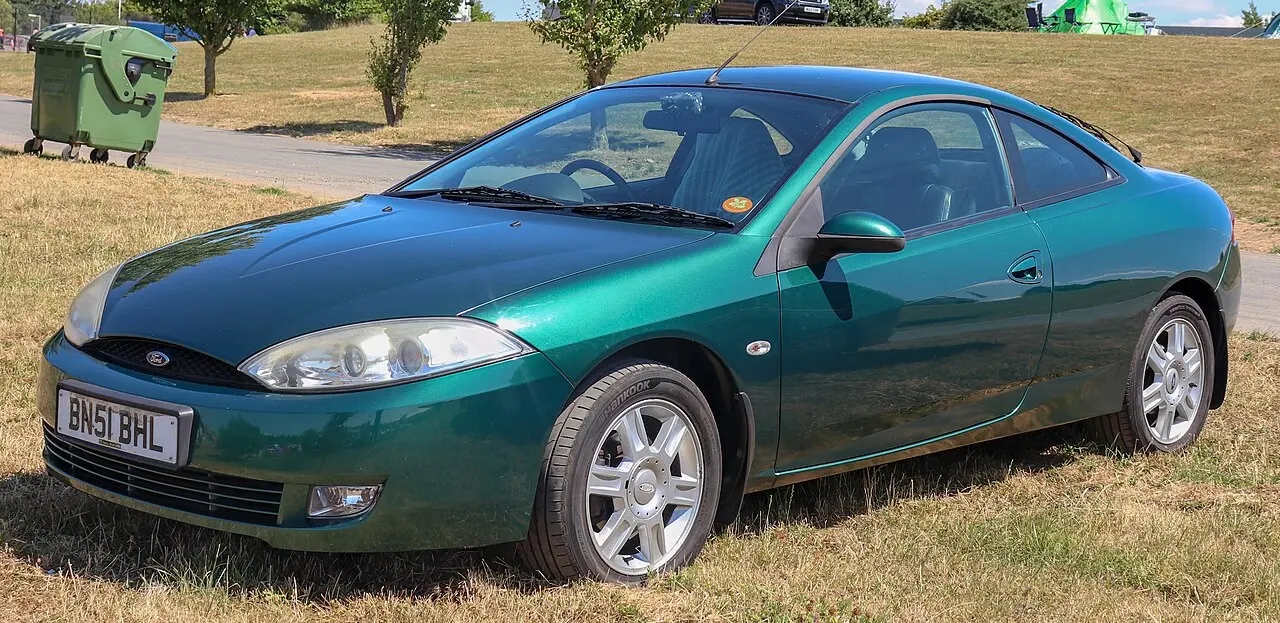
The official data lists 17 versions of the Ford Cougar (2000–2003), in the United Kingdom and Canada. Each market publishes its own figures, measured on its own test procedure.
At a glance
Years in the data
2000–2003
Markets
United Kingdom, Canada
Engines
2.0 L to 2.5 L
Fuels
Petrol
Lowest consumption (United Kingdom)
8.5 L/100 km (NEDC)
Lowest consumption (Canada)
9.5 L/100 km (5-cycle)
What was the Ford Cougar?
The Ford Cougar was a sporty three-door coupé with a liftback tail. Its low roof and sweeping profile set it apart from a conventional family hatchback, while the rear hatch added everyday practicality. It occupied a distinctive spot in Ford’s European range around the turn of the century.
The Cougar had one generation, listed as 1999–2002, and was sold in Europe, the UK and North America. Its crisp lines and sculpted surfaces reflected Ford’s New Edge design style of the era.
Engines and power
UK VCA and Canadian NRCan listings cover petrol engines from 2.0 to 2.5 litres. The range included four-cylinder and V6 engines.
How economical was the Ford Cougar?
The lowest listed consumption is 8.5 L/100 km in the UK under the NEDC procedure. Canada’s lowest listed figure is 9.5 L/100 km under NRCan’s 5-cycle test. Test procedures differ, so the figures are best understood within their own markets.
Where was the Cougar listed?
UK VCA figures cover 2000–2003, while Canadian NRCan figures cover 2000–2002. Its single generation is listed as 1999–2002.
Questions and answers
What body style was the Ford Cougar?
It was a sporty three-door coupé with a liftback tail.
What engines did the Cougar have?
UK and Canadian listings cover petrol engines from 2.0 to 2.5 litres.
What is the lowest listed Cougar fuel consumption?
The UK figure is 8.5 L/100 km under NEDC; Canada’s NRCan 5-cycle figure is 9.5 L/100 km.
When was the Cougar listed?
Its single generation is listed as 1999–2002. UK figures cover 2000–2003, and Canadian figures cover 2000–2002.
Model codes: CDW27 · Sold in: Canada, United States, European Union, and United Kingdom · References: en.wikipedia.org, adac.de
United Kingdom 11 versions
New cars on sale in the UK, from the Vehicle Certification Agency. NEDC figures until 2018 and WLTP figures after; years are the editions a version appeared in.
Years and version
Engine
Fuel
Gearbox
Consumption (combined)
CO₂
2000–20032.0i 16V (16 inch tyre) · 2.0i 16V
2.0 L
Petrol
5-speed manual
8.5 L/100 km NEDC
204 g/km
2000–20032.5i V6 24V
2.5 L
Petrol
4-speed automatic
10.4 L/100 km NEDC
250 g/km
2001–20032.5i V6 24V
2.5 L
Petrol
5-speed manual
9.8 L/100 km NEDC
236 g/km
2000–20012.0i 16V (15 inch tyre)
2.0 L
Petrol
5-speed manual
8.6 L/100 km NEDC
205 g/km
2000–20012.0i 16V (16 inch tyre)
2.0 L
Petrol
5-speed manual
8.5 L/100 km NEDC
202 g/km
20012.5i V6 24V
2.5 L
Petrol
5-speed manual
10.0 L/100 km NEDC
240 g/km
20012.5i V6 24V
2.5 L
Petrol
4-speed automatic
18.5 L/100 km NEDC
257 g/km
2000–20012.5i V6 24V
2.5 L
Petrol
5-speed manual
9.5 L/100 km NEDC
228 g/km
2000–20012.5i V6 24V
2.5 L
Petrol
4-speed automatic
10.0 L/100 km NEDC
240 g/km
20002.0i 16V (15 inch tyre)
2.0 L
Petrol
5-speed manual
8.6 L/100 km NEDC
206 g/km
20002.5i V6 24V · 2.5i V6 24V ST200
2.5 L
Petrol
5-speed manual
10.2 L/100 km NEDC
245 g/km
Canada 6 versions
Model years sold in Canada, from Natural Resources Canada fuel consumption ratings (5-cycle test).
Years and version
Engine
Fuel
Gearbox
Consumption (combined)
CO₂
2001–2002Compact · Subcompact
2.5 L
Petrol
5-speed manual
10.9 L/100 km 5-cycle
251 g/km
2002Subcompact
2.5 L
Petrol
4-speed automatic
11.4 L/100 km 5-cycle
262 g/km
2001Compact
2.5 L
Petrol
4-speed automatic
11.3 L/100 km 5-cycle
260 g/km
2000Compact
2.0 L
Petrol
5-speed manual
9.5 L/100 km 5-cycle
219 g/km
2000Compact
2.5 L
Petrol
4-speed automatic
11.3 L/100 km 5-cycle
260 g/km
2000Compact
2.5 L
Petrol
5-speed manual
11.3 L/100 km 5-cycle
260 g/km
Official figures are measured on standard test procedures and differ between markets. Your consumption depends on how, where and in what conditions you drive.