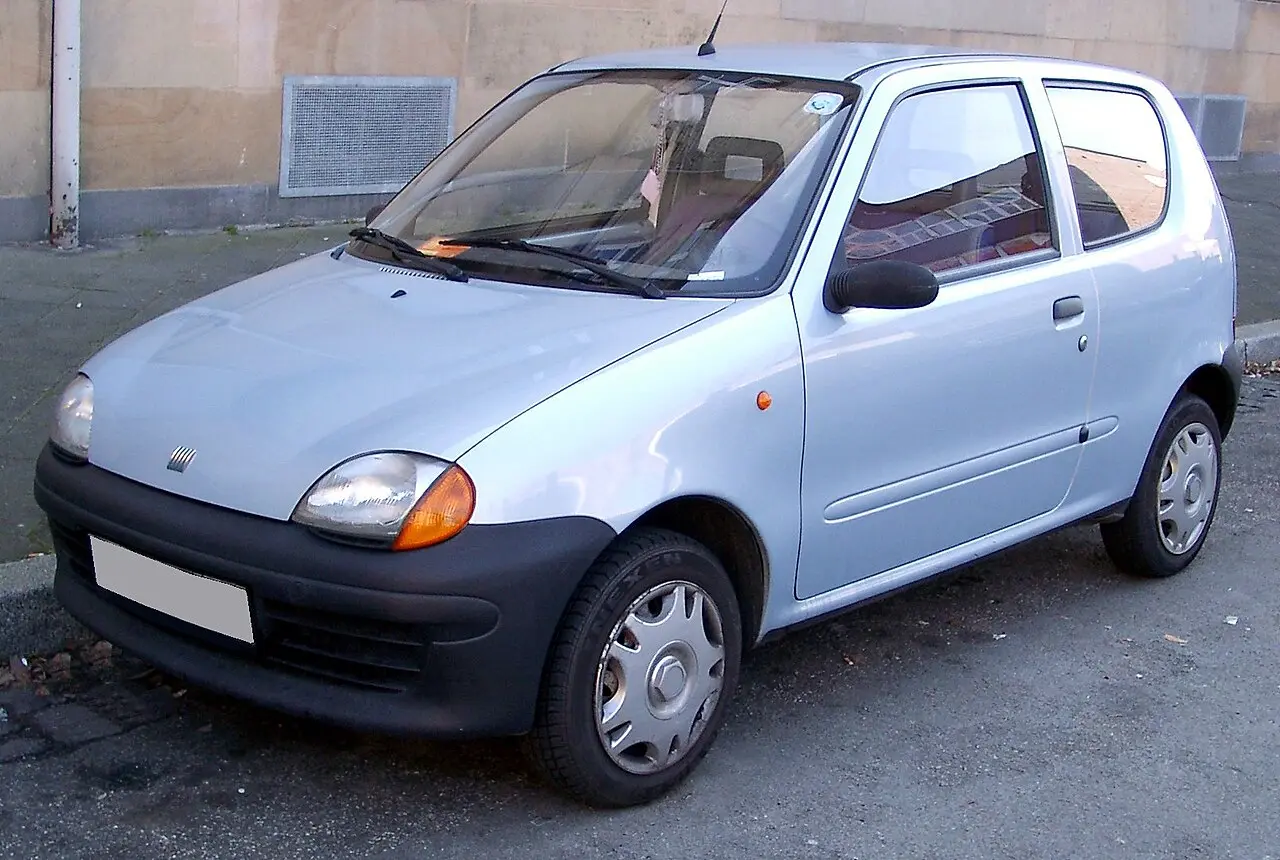
Fiat

Fiat Seicento

Fiat Seicento
Photo: Rudolf Stricker / Wikimedia Commons · CC BY-SA 3.0

The official data lists 11 versions of the Fiat Seicento (2000–2012), in the European Union and the United Kingdom. Each market publishes its own figures, measured on its own test procedure.

At a glance

Years in the data
2000–2012
Markets
European Union, United Kingdom
Engines
0.9 L to 1.1 L
Power
40 kW (54 PS)
Fuels
Petrol, LPG
Lowest consumption (United Kingdom)
6.0 L/100 km (NEDC)
New registrations in the EU
16,953

What is the Fiat Seicento?

The Fiat Seicento was a small city car, following the Cinquecento in Fiat’s line of compact cars. Its modest size and simple format suited everyday trips around town.

Fiat later used the name 600 for the Seicento. The model’s compact proportions kept it at the small-car end of the range.

Generation and design

The Seicento, code 187, ran from 1998 to 2010. It carried on the Cinquecento’s city-car role with an updated body and cabin.

The UK figures cover 2000–2003, while EU registrations span 2010–2012. Registration dates can differ from a model’s production dates.

Engines and power

The EU range used a 1.1-litre engine, with petrol or LPG fuel, rated at 40 kW (54 PS). In the UK, the range covered 0.9- to 1.1-litre petrol engines.

The 1.1-litre petrol entry recorded 16,708 EU registrations in 2010. The same engine and power rating recorded 196 registrations in 2011, while the 1.1-litre LPG entry recorded 24 in 2010.

How economical is the Fiat Seicento?

The lowest UK consumption figure is 6 L/100 km on the NEDC test. NEDC is a European test procedure; results from different procedures and markets are not directly comparable.

The Seicento recorded 16,953 EU registrations across 2010–2012. The UK figures cover 2000–2003.

Questions and answers

What kind of car is the Fiat Seicento?

It is a small city car in Fiat’s line of compact cars.

What engine and power were available for the Seicento?

The EU range used a 1.1-litre engine rated at 40 kW (54 PS), with petrol or LPG fuel.

What is the Seicento’s lowest listed fuel consumption?

The UK figure is 6 L/100 km on the NEDC test.

Seicento Seicento (1998–2010)

Fiat Seicento Seicento
Photo: Rudolf Stricker / Wikimedia Commons · CC BY-SA 3.0

Model codes: 187 · Sold in: European Union and United Kingdom · References: en.wikipedia.org, automobile-catalog.com

European Union 2 versions

New cars registered in the EU (plus Norway and Iceland), from the European Environment Agency. Figures on the NEDC procedure until 2020 and on WLTP from 2021; versions are grouped by engine and power, with their number of registrations.

Years and versionEngineFuelCO₂EU registrations
20101.1 LPetrol140 g/km16,708
20101.1 LLPG139 g/km24

United Kingdom 6 versions

New cars on sale in the UK, from the Vehicle Certification Agency. NEDC figures until 2018 and WLTP figures after; years are the editions a version appeared in.

Years and versionEngineFuelGearboxConsumption (combined)CO₂
2001–2003S/SX · Mia, Active and Sound1.1 LPetrol5-speed manual6.0 L/100 km NEDC143 g/km
2001–2003Sporting and Sporting Abarth1.1 LPetrol5-speed manual6.5 L/100 km NEDC155 g/km
2000–2001Seicento S/SX · S/SX0.9 LPetrol5-speed manual6.1 L/100 km NEDC145 g/km
2000–2001Citymatic0.9 LPetrol5-speed automatic6.1 L/100 km NEDC145 g/km
2000–2001Seicento Sporting · Sporting1.1 LPetrol5-speed manual6.2 L/100 km NEDC148 g/km
2000–2001Seicento Sporting Abarth · Sporting Abarth1.1 LPetrol5-speed manual6.4 L/100 km NEDC151 g/km

Versions outside these generations

European Union 3 versions

New cars registered in the EU (plus Norway and Iceland), from the European Environment Agency. Figures on the NEDC procedure until 2020 and on WLTP from 2021; versions are grouped by engine and power, with their number of registrations.

Years and versionEnginePowerFuelCO₂EU registrations
20121.1 L40 kW (54 PS)Petrol144 g/km11
20111.1 L40 kW (54 PS)Petrol141 g/km196
20111.1 L40 kW (54 PS)LPG139 g/km14

Official figures are measured on standard test procedures and differ between markets. Your consumption depends on how, where and in what conditions you drive.