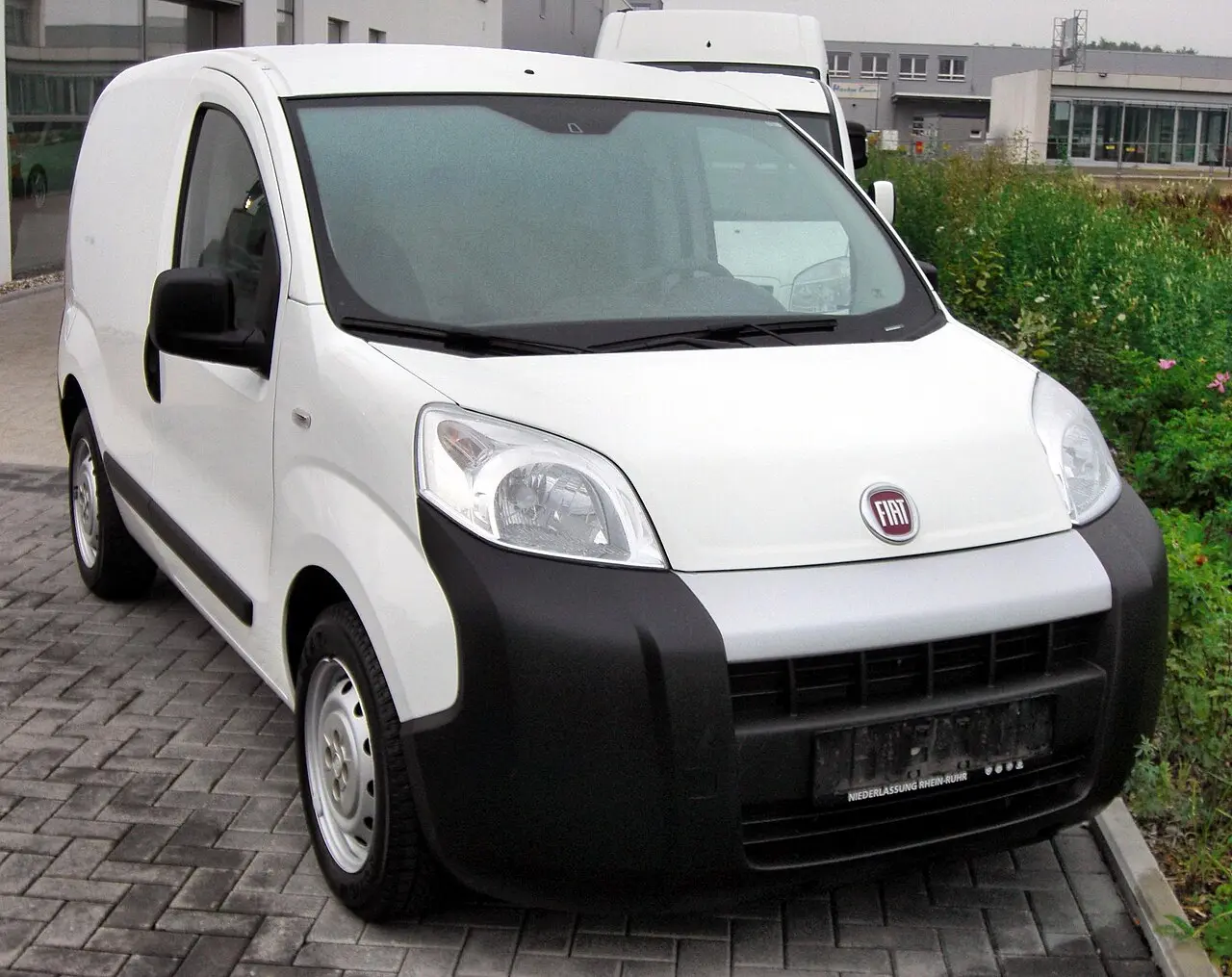
The official data lists 110 versions of the Fiat Fiorino (2009–2020), in the European Union, the United Kingdom, and France. Each market publishes its own figures, measured on its own test procedure.
At a glance
Years in the data
2009–2020
Markets
European Union, United Kingdom, France
Engines
1.2 L to 1.4 L
Power
51 kW (69 PS) to 70 kW (95 PS)
Fuels
Natural gas, Petrol, Diesel
Lowest consumption (France)
4.1 L/100 km (NEDC)
Lowest consumption (United Kingdom)
4.2 L/100 km (NEDC)
New registrations in the EU
19,208
What is the Fiat Fiorino?
The Fiat Fiorino is a compact light commercial van built for carrying goods in city streets and other tight spaces. Its boxy shape makes practical use of its footprint, while a passenger version was sold as the Fiat Qubo.
The third-generation Fiorino, Type 225, brought together a work van and a more passenger-focused format. The Qubo offered the same compact, flexible character for people who needed cabin space as well as an easy-to-manoeuvre vehicle.
Generations and engines
The third-generation Fiorino, Type 225, is listed from 2008 to 2023 across Europe, France and the UK.
European Union versions span 1.2 L to 1.4 L engines and 51 kW (69 PS) to 70 kW (95 PS). Listed fuels include diesel, petrol, natural gas and other classifications. UK listings specify 1.2 L to 1.4 L engines and diesel or petrol. French listings include natural gas, petrol and diesel, with power from 51 kW (69 PS) to 70 kW (95 PS).
How economical is the Fiat Fiorino?
The lowest listed consumption is 4.2 L/100 km in the UK on the NEDC test. France’s lowest listed figure is 4.1 L/100 km, also on NEDC.
Official EU registration figures span 2010–2020 and total 19,208 registrations. Diesel features in the leading listed entries, while petrol and natural gas also appear in the broader EU range.
Where was the Fiat Fiorino sold?
The Fiorino appears in European Union, UK and French listings. The market years are 2010–2020 in the EU, 2009–2014 in the UK, and 2012–2015 in France.
Questions and answers
Is the Fiat Fiorino a car or a van?
It is a compact light commercial van. A passenger version was sold as the Fiat Qubo.
What engines were listed for the Fiorino?
EU entries span 1.2 L to 1.4 L and 51 kW (69 PS) to 70 kW (95 PS). Listed fuels include diesel, petrol, natural gas and other classifications.
What is the Fiat Fiorino’s lowest listed consumption?
France has the lowest listed figure at 4.1 L/100 km on NEDC. The UK listing gives 4.2 L/100 km on the same test procedure.
Which generation is the Fiat Fiorino?
The listings cover the third generation, Fiorino III (Type 225), from 2008 to 2023.
New cars registered in the EU (plus Norway and Iceland), from the European Environment Agency. Figures on the NEDC procedure until 2020 and on WLTP from 2021; versions are grouped by engine and power, with their number of registrations.
Years and version
Engine
Power
Fuel
CO₂
EU registrations
2020
1.2 L
59 kW (80 PS)
Diesel
118 g/km
18
2020
1.4 L
57 kW (77 PS)
Petrol
171 g/km
16
2020
1.2 L
70 kW (95 PS)
Diesel
127 g/km
12
2019
1.2 L
70 kW (95 PS)
Diesel
125 g/km
818
2019
1.4 L
57 kW (77 PS)
Petrol
169 g/km
426
2019
1.2 L
59 kW (80 PS)
Diesel
123 g/km
140
2019
1.4 L
57 kW (77 PS)
Natural gas
145 g/km
46
2018
1.2 L
70 kW (95 PS)
Diesel
116 g/km
372
2018
1.2 L
59 kW (80 PS)
Diesel
116 g/km
246
2018
1.4 L
57 kW (77 PS)
Petrol
163 g/km
116
2018
1.4 L
57 kW (77 PS)
Natural gas
125 g/km
30
2017
1.2 L
70 kW (95 PS)
Diesel
117 g/km
516
2017
1.2 L
59 kW (80 PS)
Diesel
113 g/km
248
2017
1.4 L
57 kW (77 PS)
Other fuel
161 g/km
134
2017
1.4 L
57 kW (77 PS)
Petrol
159 g/km
66
2017
1.4 L
57 kW (77 PS)
Natural gas
127 g/km
46
2016
1.2 L
70 kW (95 PS)
Diesel
112 g/km
384
2016
1.2 L
59 kW (80 PS)
Diesel
111 g/km
264
2016
1.4 L
57 kW (77 PS)
Petrol
161 g/km
126
2016
1.4 L
57 kW (77 PS)
Natural gas
122 g/km
38
2015
1.2 L
55 kW (75 PS)
Diesel
117 g/km
308
2015
1.2 L
70 kW (95 PS)
Diesel
111 g/km
244
2015
1.2 L
59 kW (80 PS)
Diesel
110 g/km
124
2015
1.4 L
57 kW (77 PS)
Petrol
161 g/km
97
2015
1.4 L
57 kW (77 PS)
Natural gas
133 g/km
19
2015
1.4 L
51 kW (69 PS)
Natural gas
119 g/km
18
2014
1.4 L
51 kW (69 PS)
Natural gas
118 g/km
866
2014
1.2 L
55 kW (75 PS)
Diesel
113 g/km
664
2014
1.2 L
70 kW (95 PS)
Diesel
111 g/km
389
2014
1.4 L
54 kW (73 PS)
Petrol
152 g/km
58
2014
1.4 L
57 kW (77 PS)
Natural gas
124 g/km
22
2014
1.4 L
57 kW (77 PS)
Petrol
161 g/km
14
2013
1.2 L
55 kW (75 PS)
Diesel
115 g/km
492
2013
1.2 L
70 kW (95 PS)
Diesel
111 g/km
270
2013
1.4 L
54 kW (73 PS)
Petrol
152 g/km
188
2013
1.4 L
51 kW (69 PS)
Natural gas
116 g/km
56
2013
1.2 L
–
Other fuel
118 g/km
35
2013
1.4 L
57 kW (77 PS)
Natural gas
116 g/km
18
2012
1.2 L
55 kW (75 PS)
Diesel
113 g/km
461
2012
1.4 L
54 kW (73 PS)
Petrol
152 g/km
192
2012
1.2 L
70 kW (95 PS)
Diesel
113 g/km
156
2012
1.4 L
51 kW (69 PS)
Natural gas
114 g/km
81
2012
–
–
Diesel
108 g/km
31
2012
1.4 L
57 kW (77 PS)
Natural gas
115 g/km
11
2011
1.2 L
55 kW (75 PS)
Diesel
114 g/km
1,669
2011
1.2 L
70 kW (95 PS)
Diesel
113 g/km
694
2011
1.4 L
54 kW (73 PS)
Petrol
153 g/km
630
2011
1.4 L
51 kW (69 PS)
Natural gas
115 g/km
67
2011
1.4 L
57 kW (77 PS)
Natural gas
114 g/km
54
2011
–
–
Petrol
–
41
2011
–
–
Diesel
–
25
2010
1.2 L
–
Diesel
115 g/km
5,354
2010
1.4 L
–
Petrol
156 g/km
1,196
2010
1.4 L
–
Natural gas
119 g/km
420
2010
–
–
Petrol
155 g/km
118
2010
–
–
Diesel
115 g/km
64
United Kingdom 13 versions
New cars on sale in the UK, from the Vehicle Certification Agency. NEDC figures until 2018 and WLTP figures after; years are the editions a version appeared in.
Official figures are measured on standard test procedures and differ between markets. Your consumption depends on how, where and in what conditions you drive.