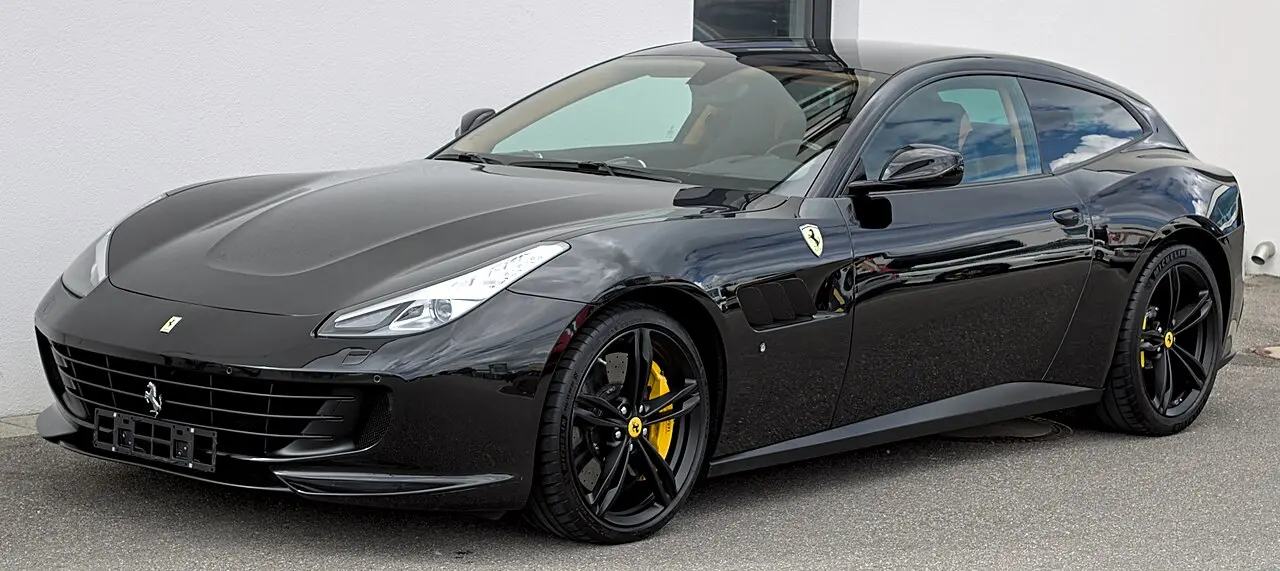
The official data lists 17 versions of the Ferrari GTC4Lusso (2016–2023), in the European Union, the United Kingdom, and the United States. Each market publishes its own figures, measured on its own test procedure.
At a glance
Years in the data
2016–2023
Markets
European Union, United Kingdom, United States
Engines
3.9 L to 6.3 L
Power
449 kW (610 PS) to 507 kW (689 PS)
Fuels
Petrol
Lowest consumption (United Kingdom)
12.9 L/100 km (WLTP)
Lowest consumption (United States)
13.8 L/100 km (EPA)
New registrations in the EU
2,892
What is the Ferrari GTC4Lusso?
The GTC4Lusso is a four-seat grand tourer with a shooting-brake body: a low coupe profile with a rear hatch and room for passengers in the back. It carried forward the four-seat, four-wheel-drive GT layout of the FF, with updated styling and rear-wheel steering on the V12 model.
Generation and engines
The GTC4Lusso had one generation, identified as F151M, sold from 2016 to 2020. EU and UK figures list 3.9-litre and 6.3-litre petrol engines, with power from 449 kW (610 PS) to 507 kW (689 PS). The 6.3-litre version was the most registered in the EU: 738 registrations in 2017.
How economical is the Ferrari GTC4Lusso?
The UK’s lowest listed consumption is 12.9 L/100 km on WLTP. US EPA figures give 13.8 L/100 km, or 17 MPG combined. The EU recorded 2,892 registrations over 2016–2021. US figures cover 2017–2020, while UK figures span 2020–2023.
Test procedures differ: the UK figure uses WLTP and the US figure uses EPA, so they are not direct equivalents.
Where was the Ferrari GTC4Lusso sold?
Official figures list the GTC4Lusso in the European Union, the United Kingdom and the United States. The EU record includes 13 versions; the UK and US records each include two petrol versions.
Questions and answers
How many seats does the GTC4Lusso have?
It is a four-seat grand tourer.
What engines were offered?
The listed petrol engines are 3.9 litres and 6.3 litres, with power from 449 kW (610 PS) to 507 kW (689 PS).
What is its lowest listed consumption?
The lowest figure is 12.9 L/100 km on the UK WLTP test.
New cars registered in the EU (plus Norway and Iceland), from the European Environment Agency. Figures on the NEDC procedure until 2020 and on WLTP from 2021; versions are grouped by engine and power, with their number of registrations.
Years and version
Engine
Power
Fuel
CO₂
EU registrations
2020
6.3 L
507 kW (689 PS)
Petrol
350 g/km
173
2020
3.9 L
449 kW (610 PS)
Petrol
266 g/km
61
2020
6.3 L
585 kW (795 PS)
Petrol
350 g/km
15
2019
6.3 L
507 kW (689 PS)
Petrol
350 g/km
369
2019
3.9 L
449 kW (610 PS)
Petrol
265 g/km
212
2018
6.3 L
507 kW (689 PS)
Petrol
351 g/km
596
2018
3.9 L
449 kW (610 PS)
Petrol
265 g/km
264
2017
6.3 L
507 kW (689 PS)
Petrol
350 g/km
738
2017
3.9 L
449 kW (610 PS)
Petrol
265 g/km
170
2017
6.3 L
761 kW (1,035 PS)
Petrol
350 g/km
14
2016
6.3 L
507 kW (689 PS)
Petrol
350 g/km
220
United Kingdom 2 versions
New cars on sale in the UK, from the Vehicle Certification Agency. NEDC figures until 2018 and WLTP figures after; years are the editions a version appeared in.
Years and version
Engine
Power
Fuel
Gearbox
Consumption (combined)
CO₂
2020–2023Lusso T · GTC4 Lusso T
3.9 L
449 kW (610 PS)
Petrol
7-speed automatic
12.9 L/100 km WLTP
294 g/km
2020–2023Lusso · GTC4 Lusso
6.3 L
507 kW (689 PS)
Petrol
7-speed automatic
16.1 L/100 km WLTP
366 g/km
United States 2 versions
Model years sold in the USA, from the EPA and the Department of Energy (fueleconomy.gov). MPG on the EPA test; litres per 100 km = 235.215 ÷ MPG.
Years and version
Engine
Fuel
Gearbox
Drive
Consumption (combined)
CO₂
2018–2020SIDI; Stop-Start · SIDI
3.9 L
Petrol
7-speed automated manual
Rear-wheel drive
17 MPG (13.8 L/100 km) EPA
326 g/km
2017–2020SIDI; with Stop-Start option · SIDI; Stop-Start · SIDI
6.3 L
Petrol
7-speed automated manual
Part-time four-wheel drive
13 MPG (18.1 L/100 km) EPA
411 g/km
Versions outside these generations
European Union 2 versions
New cars registered in the EU (plus Norway and Iceland), from the European Environment Agency. Figures on the NEDC procedure until 2020 and on WLTP from 2021; versions are grouped by engine and power, with their number of registrations.
Years and version
Engine
Power
Fuel
Consumption (combined)
CO₂
EU registrations
2021
6.3 L
507 kW (689 PS)
Petrol
15.9 L/100 km WLTP
364 g/km
38
2021
3.9 L
449 kW (610 PS)
Petrol
12.8 L/100 km WLTP
265 g/km
22
Official figures are measured on standard test procedures and differ between markets. Your consumption depends on how, where and in what conditions you drive.