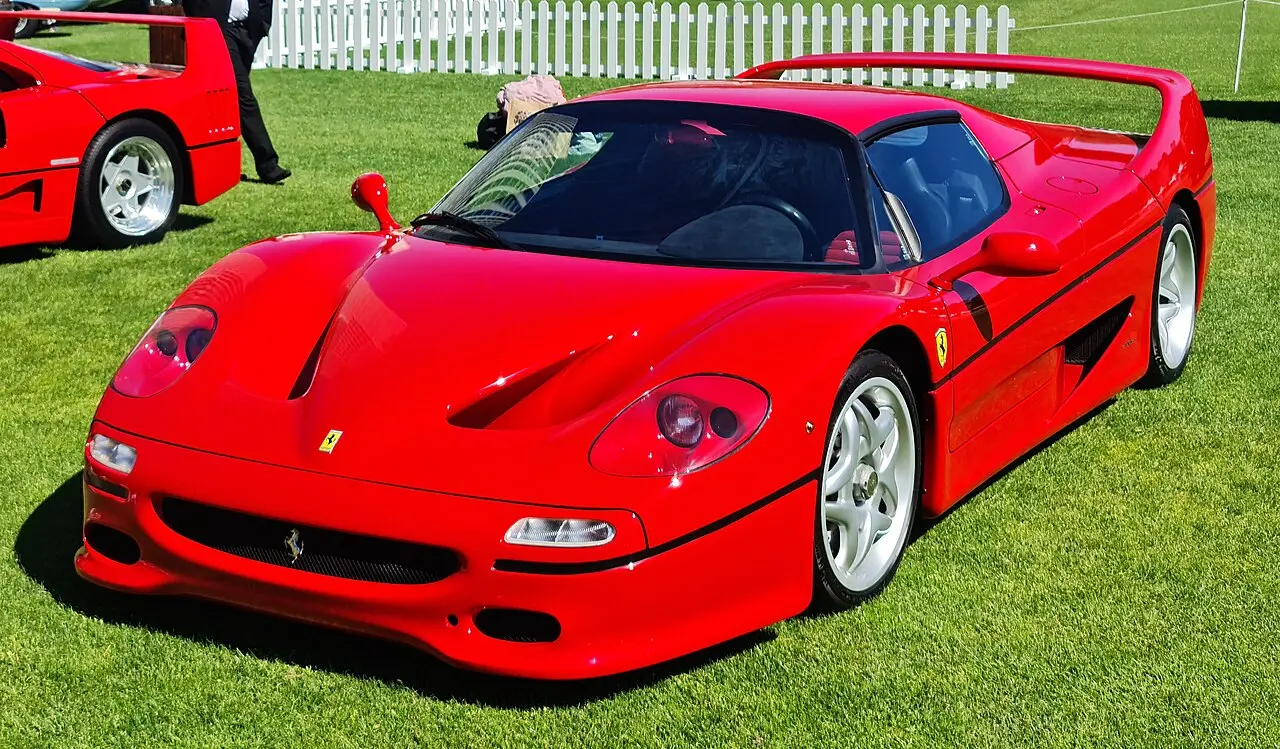
What is the Ferrari F50?
The Ferrari F50 is a two-seat supercar with an open top and a removable hard roof. Ferrari presented it in 1995 as a road car shaped by the company’s Formula One experience. Its carbon-fibre monocoque gives the car a close connection between its racing-inspired engineering and its road-going design.
Engines and power
The F50 has a 4.7-litre petrol engine. Ferrari says its naturally aspirated V12 was derived from a Formula One engine, and it is mounted behind the cabin as a structural part of the chassis. The layout and open cockpit give the F50 a focused, direct character.
How economical is the Ferrari F50?
The US EPA rates the Ferrari F50 at 8 MPG combined, equivalent to 29.4 L/100 km. EPA tests differ from European WLTP and NEDC procedures and Canada’s 5-cycle test, so results from different markets are not directly comparable.
Questions and answers
What kind of car is the Ferrari F50?
It is a two-seat, open-top supercar with a removable hard roof and racing-inspired engineering.
What engine does the Ferrari F50 have?
It has a 4.7-litre petrol V12.
What is the Ferrari F50’s official fuel consumption?
The US EPA figure is 8 MPG combined, or 29.4 L/100 km.
When was the Ferrari F50 sold in the United States?
The US listing is for 1995.