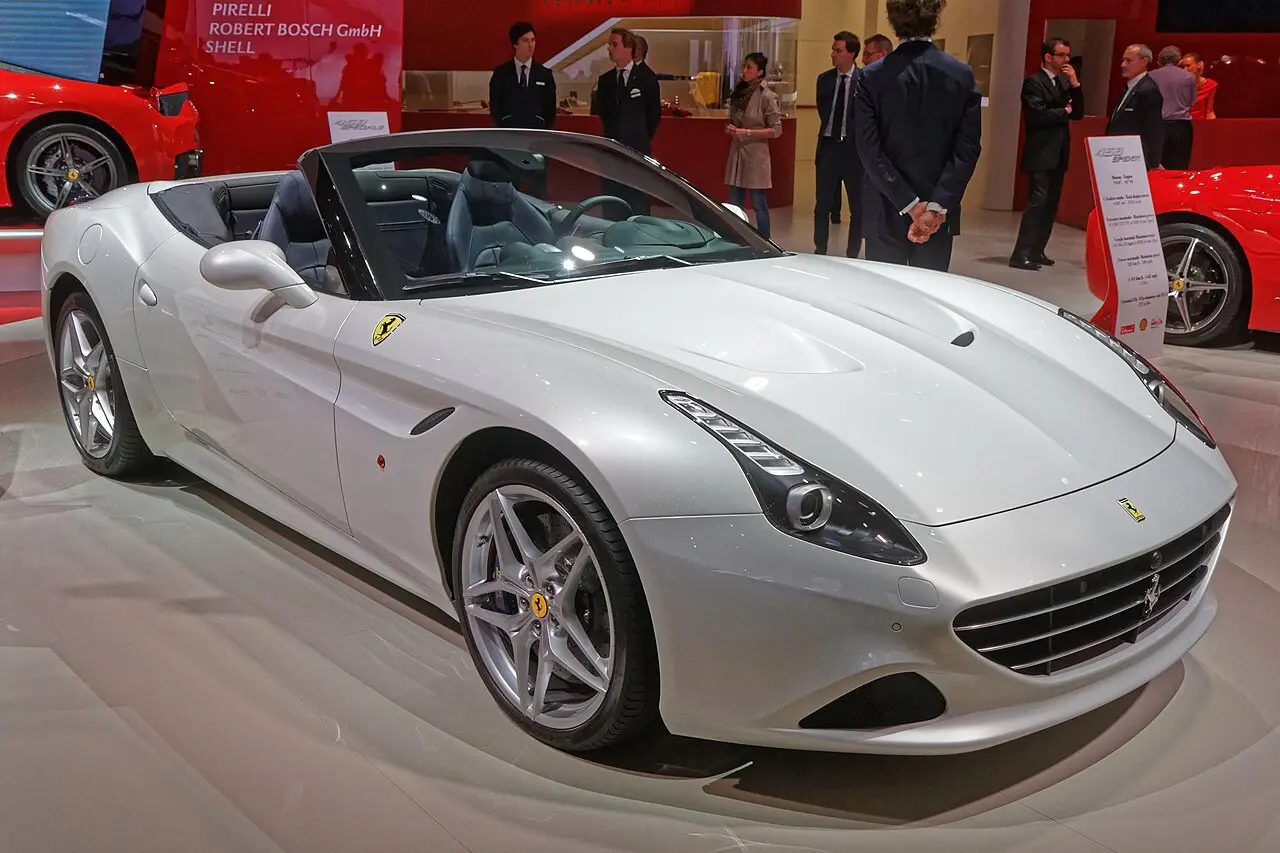
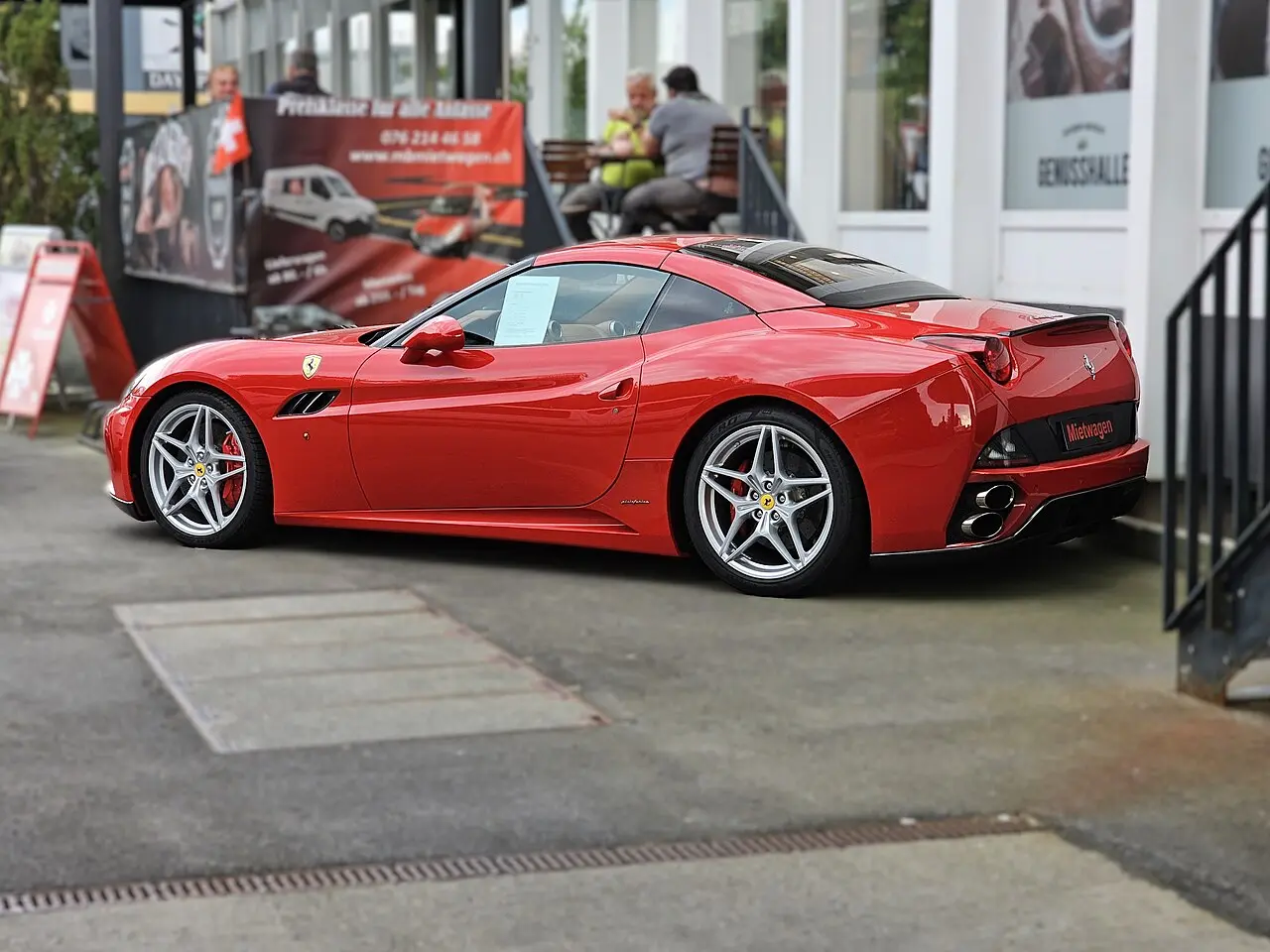
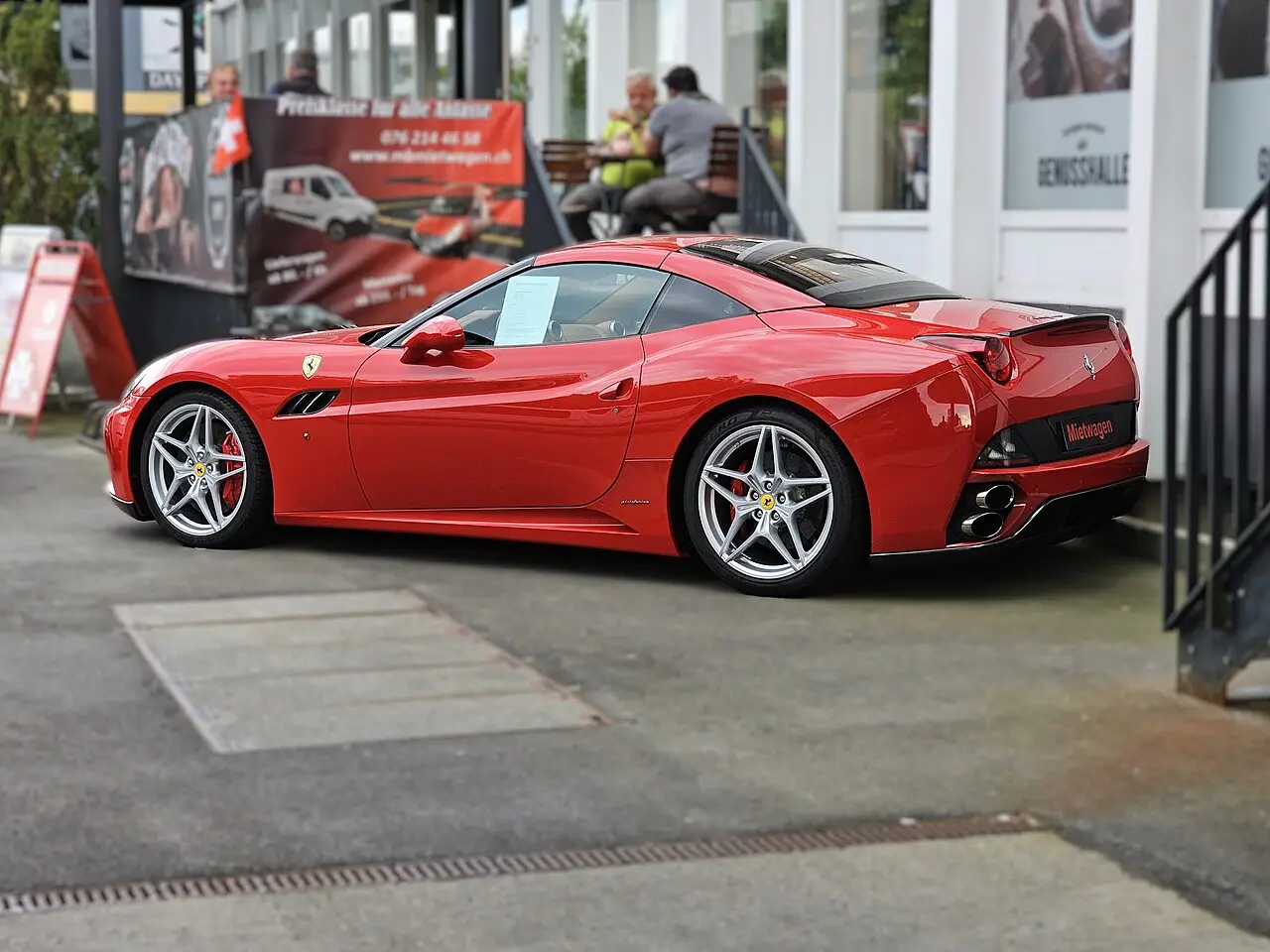
The official data lists 35 versions of the Ferrari California (2009–2018), in the European Union, the United Kingdom, France, the United States, and Canada. Each market publishes its own figures, measured on its own test procedure.
At a glance
Years in the data
2009–2018
Markets
European Union, United Kingdom, France, United States, Canada
Engines
3.9 L to 4.3 L
Power
338 kW (460 PS) to 412 kW (560 PS)
Fuels
Petrol
Lowest consumption (France)
10.7 L/100 km (NEDC)
Lowest consumption (United States)
12.4 L/100 km (EPA)
Lowest consumption (United Kingdom)
13.1 L/100 km (NEDC)
New registrations in the EU
9,657
What is the Ferrari California?
The Ferrari California is a front-engined V8 grand tourer with a folding hardtop. It combines open-air driving with a more comfort-focused cabin than Ferrari’s berlinettas, and its rear seats offer space for occasional passengers or luggage. It brought a flexible convertible layout to the GT side of Ferrari’s range while retaining the marque’s sporting character.
Generations and engines
The California family includes California (2009–2011), California 30 (2012–2013) and California T (2014–2017). Early versions used a 4.3-litre petrol V8; the California T switched to a turbocharged 3.9-litre V8. Across the market figures, engines range from 3.9 to 4.3 litres and power from 338 kW (460 PS) to 412 kW (560 PS). The turbo engine marked a change for Ferrari’s GT range.
How economical is the Ferrari California?
Official consumption figures vary by market and test procedure. France’s lowest listed figure is 10.7 L/100 km on NEDC; the UK figure is 13.1 L/100 km, also on NEDC. In the United States, the EPA figure is 12.4 L/100 km, or 19 MPG combined. Canada’s NRCan figure is 15.9 L/100 km on its 5-cycle test. NEDC, EPA and Canada’s 5-cycle procedures differ, so their results are not directly comparable.
Where was the Ferrari California sold?
The California appears in EU registration figures from 2010 to 2018, UK VCA figures for 2010, French ADEME figures from 2013 to 2015, US EPA figures from 2009 to 2018, and Canadian NRCan figures for 2010. EU registrations total 9,657. The most registered listed version was a 4.3-litre petrol California, with 2,322 registrations in 2010.
Questions and answers
What engines were offered in the Ferrari California?
The listed engines are 4.3-litre and 3.9-litre petrol V8s. Power ranges from 338 kW (460 PS) to 412 kW (560 PS).
What are the California generations?
California (2009–2011), California 30 (2012–2013), and California T (2014–2017).
What is the California’s official fuel consumption?
The lowest listed figures are 10.7 L/100 km under France’s NEDC test, 12.4 L/100 km (19 MPG combined) under the US EPA test, and 15.9 L/100 km under Canada’s 5-cycle test. The procedures differ by market.
New cars registered in the EU (plus Norway and Iceland), from the European Environment Agency. Figures on the NEDC procedure until 2020 and on WLTP from 2021; versions are grouped by engine and power, with their number of registrations.
Years and version
Engine
Power
Fuel
CO₂
EU registrations
2017
3.9 L
412 kW (560 PS)
Petrol
251 g/km
872
2016
3.9 L
412 kW (560 PS)
Petrol
257 g/km
1,314
2015
3.9 L
412 kW (560 PS)
Petrol
268 g/km
1,426
2015
4.3 L
360 kW (489 PS)
Petrol
281 g/km
20
2014
3.9 L
412 kW (560 PS)
Petrol
255 g/km
498
2014
4.3 L
360 kW (489 PS)
Petrol
278 g/km
234
France 10 versions
New cars on sale in France, from ADEME Car Labelling. NEDC figures until 2015, WLTP figures in the current catalogue.
Years and version
Engine
Power
Fuel
Gearbox
Consumption (combined)
CO₂
2015CALIFORNIA
–
360 kW (489 PS)
Petrol
7-speed automatic
11.5 L/100 km NEDC
270 g/km
2015CALIFORNIA
–
360 kW (489 PS)
Petrol
7-speed automatic
13.1 L/100 km NEDC
299 g/km
2015CALIFORNIA
–
360 kW (489 PS)
Petrol
7-speed automatic
13.1 L/100 km NEDC
299 g/km
2015CALIFORNIA
–
360 kW (489 PS)
Petrol
7-speed automatic
11.5 L/100 km NEDC
270 g/km
2015CALIFORNIA T
–
412 kW (560 PS)
Petrol
7-speed automatic
11.7 L/100 km NEDC
273 g/km
2015CALIFORNIA T
–
412 kW (560 PS)
Petrol
7-speed automatic
10.7 L/100 km NEDC
251 g/km
2014CALIFORNIA
–
360 kW (489 PS)
Petrol
7-speed automatic
13.1 L/100 km NEDC
299 g/km
2014CALIFORNIA
–
360 kW (489 PS)
Petrol
7-speed automatic
11.5 L/100 km NEDC
270 g/km
2014CALIFORNIA
–
360 kW (489 PS)
Petrol
7-speed automatic
11.5 L/100 km NEDC
270 g/km
2014CALIFORNIA
–
360 kW (489 PS)
Petrol
7-speed automatic
13.1 L/100 km NEDC
299 g/km
United States 3 versions
Model years sold in the USA, from the EPA and the Department of Energy (fueleconomy.gov). MPG on the EPA test; litres per 100 km = 235.215 ÷ MPG.
Years and version
Engine
Fuel
Gearbox
Drive
Consumption (combined)
CO₂
2015–2018SIDI
3.9 L
Petrol
7-speed automated manual
Rear-wheel drive
18 MPG (13.1 L/100 km) EPA
303 g/km
2017–2018SIDI; with Stop-Start option · SIDI; Stop-Start
3.9 L
Petrol
7-speed automated manual
Rear-wheel drive
19 MPG (12.4 L/100 km) EPA
297 g/km
2015–2016SIDI; with Stop-Start Option · SIDI; with Stop-Start option
3.9 L
Petrol
7-speed automated manual
Rear-wheel drive
19 MPG (12.4 L/100 km) EPA
298 g/km
Versions outside these generations
European Union 1 version
New cars registered in the EU (plus Norway and Iceland), from the European Environment Agency. Figures on the NEDC procedure until 2020 and on WLTP from 2021; versions are grouped by engine and power, with their number of registrations.
Years and version
Engine
Power
Fuel
CO₂
EU registrations
2018
3.9 L
412 kW (560 PS)
Petrol
251 g/km
122
Official figures are measured on standard test procedures and differ between markets. Your consumption depends on how, where and in what conditions you drive.