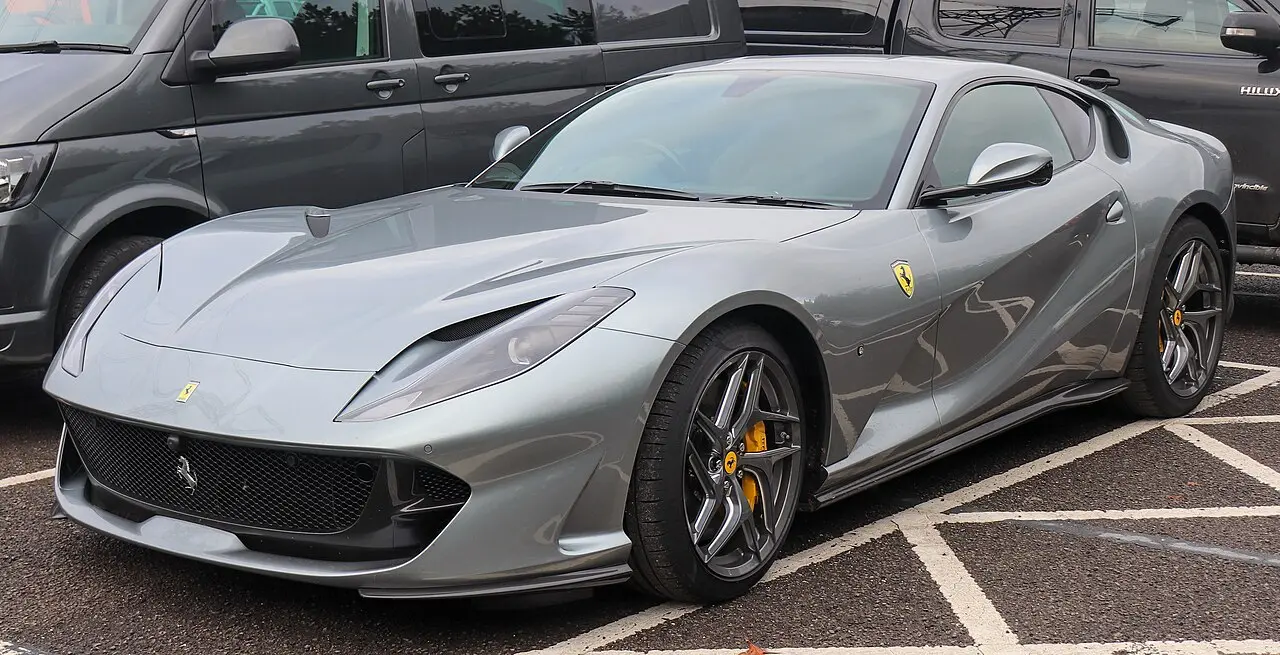
The official data lists 22 versions of the Ferrari 812 (2017–2026), in the European Union, the United Kingdom, France, the United States, and Canada. Each market publishes its own figures, measured on its own test procedure.
At a glance
Years in the data
2017–2026
Markets
European Union, United Kingdom, France, United States, Canada
Engines
6.4 L to 6.5 L
Power
585 kW (795 PS) to 607 kW (825 PS)
Fuels
Petrol
Lowest consumption (United Kingdom)
16.1 L/100 km (WLTP)
Lowest consumption (European Union)
16.3 L/100 km (WLTP)
Lowest consumption (United States)
16.8 L/100 km (EPA)
New registrations in the EU
6,722
What is the Ferrari 812?
The Ferrari 812 is a two-seat berlinetta with a V12 mounted ahead of the cabin and behind the front axle. It carries on Ferrari’s tradition of front-engined V12 road cars, with a layout suited to both fast road driving and longer journeys. The 812 GTS brings the same formula in open-top form, with a retractable hard top.
Ferrari introduced the 812 Superfast in 2017 as the next chapter in its V12 berlinetta line, building on the F12berlinetta and F12tdf. The generation has been built since 2017 and included the 812 GTS and the track-focused 812 Competizione. Ferrari’s first road car, the 125 S, also had a V12, making the engine central to the marque’s identity from the beginning.
Engines and power
The 812 uses a 6.5 L petrol V12. In the EU figures, power ranges from 585 kW (795 PS) to 607 kW (825 PS). The UK listing gives 585 kW (795 PS) with a 6.4 L engine; US and Canadian listings specify a 6.5 L engine. Ferrari’s official description identifies the 812 Superfast as a mid-front-engined V12 berlinetta.
How economical is the Ferrari 812?
The lowest listed EU consumption is 16.3 L/100 km on WLTP. The UK figure is 16.1 L/100 km, also on WLTP. The US EPA rates it at 14 MPG combined, with a listed metric figure of 16.8 L/100 km. Canada’s NRCan 5-cycle rating is 17.3 L/100 km. Test procedures differ between WLTP, EPA and Canada’s 5-cycle, so the market figures should be read within their own systems.
Where was the Ferrari 812 sold?
EU registration figures list the 812 from 2017 to 2025, with 6,722 registrations. The UK VCA listing covers 2020 to 2023, the US EPA listing 2018 to 2024, and the Canadian NRCan listing 2024. French ADEME figures list it for 2026.
Questions and answers
What engine does the Ferrari 812 have?
It has a 6.5 L petrol V12 in the EU, US and Canadian listings; the UK listing specifies 6.4 L.
How much power does the Ferrari 812 produce?
EU figures range from 585 kW (795 PS) to 607 kW (825 PS).
What is the Ferrari 812’s official fuel consumption?
The lowest listed figure is 16.3 L/100 km on the EU WLTP test. US and Canadian ratings use EPA and NRCan 5-cycle procedures.
New cars registered in the EU (plus Norway and Iceland), from the European Environment Agency. Figures on the NEDC procedure until 2020 and on WLTP from 2021; versions are grouped by engine and power, with their number of registrations.
Years and version
Engine
Power
Fuel
Consumption (combined)
CO₂
EU registrations
2025
6.5 L
607 kW (825 PS)
Petrol
16.5 L/100 km WLTP
377 g/km
25
2024
6.5 L
607 kW (825 PS)
Petrol
16.6 L/100 km WLTP
378 g/km
136
2024
6.5 L
585 kW (795 PS)
Petrol
16.4 L/100 km WLTP
373 g/km
105
2023
6.5 L
585 kW (795 PS)
Petrol
16.4 L/100 km WLTP
373 g/km
467
2023
6.5 L
607 kW (825 PS)
Petrol
16.6 L/100 km WLTP
379 g/km
202
2022
6.5 L
585 kW (795 PS)
Petrol
16.4 L/100 km WLTP
373 g/km
466
2022
6.5 L
607 kW (825 PS)
Petrol
16.9 L/100 km WLTP
384 g/km
95
2021
6.5 L
585 kW (795 PS)
Petrol
16.3 L/100 km WLTP
372 g/km
1,066
2020
6.5 L
585 kW (795 PS)
Petrol
–
341 g/km
1,691
2019
6.5 L
585 kW (795 PS)
Petrol
–
340 g/km
1,509
2018
6.5 L
585 kW (795 PS)
Petrol
–
340 g/km
890
2017
6.5 L
585 kW (795 PS)
Petrol
–
341 g/km
70
United Kingdom 2 versions
New cars on sale in the UK, from the Vehicle Certification Agency. NEDC figures until 2018 and WLTP figures after; years are the editions a version appeared in.
Years and version
Engine
Power
Fuel
Gearbox
Consumption (combined)
CO₂
2020–2023GTS · 812 GTS
6.4 L
585 kW (795 PS)
Petrol
7-speed automatic
16.4 L/100 km WLTP
373 g/km
2020–2023Superfast · 812 Superfast
6.4 L
585 kW (795 PS)
Petrol
7-speed automatic
16.1 L/100 km WLTP
366 g/km
France 2 versions
New cars on sale in France, from ADEME Car Labelling. NEDC figures until 2015, WLTP figures in the current catalogue.
Years and version
Engine
Power
Fuel
Gearbox
2026812 GTS
6.5 L
585 kW (795 PS)
Petrol
7-speed manual
2026812 Competizione
6.5 L
607 kW (825 PS)
Petrol
7-speed manual
United States 4 versions
Model years sold in the USA, from the EPA and the Department of Energy (fueleconomy.gov). MPG on the EPA test; litres per 100 km = 235.215 ÷ MPG.
Years and version
Engine
Fuel
Gearbox
Drive
Consumption (combined)
CO₂
2022–2024SIDI
6.5 L
Petrol
7-speed automated manual
Rear-wheel drive
14 MPG (16.8 L/100 km) EPA
405 g/km
2023–2024SIDI
6.5 L
Petrol
7-speed automated manual
Rear-wheel drive
14 MPG (16.8 L/100 km) EPA
403 g/km
2021–2023SIDI
6.5 L
Petrol
7-speed automated manual
Rear-wheel drive
13 MPG (18.1 L/100 km) EPA
413 g/km
2018–2021SIDI; Stop-Start · SIDI
6.5 L
Petrol
7-speed automated manual
Rear-wheel drive
13 MPG (18.1 L/100 km) EPA
411 g/km
Canada 2 versions
Model years sold in Canada, from Natural Resources Canada fuel consumption ratings (5-cycle test).
Years and version
Engine
Fuel
Gearbox
Consumption (combined)
CO₂
2024Two-seater
6.5 L
Petrol
7-speed automated manual
17.4 L/100 km 5-cycle
405 g/km
2024Two-seater
6.5 L
Petrol
7-speed automated manual
17.3 L/100 km 5-cycle
402 g/km
Official figures are measured on standard test procedures and differ between markets. Your consumption depends on how, where and in what conditions you drive.