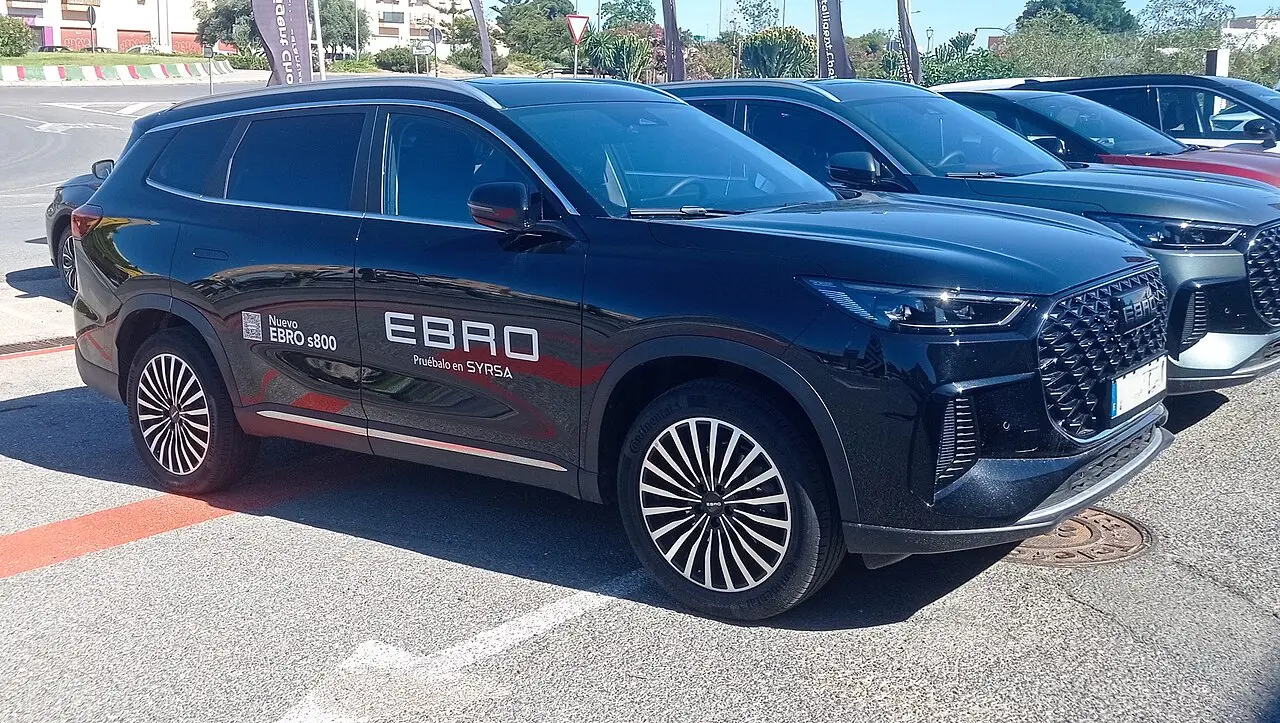
What is the EBRO S800?
The EBRO S800 is a large family SUV, positioned above the S700 in the marque’s range. Its upright shape and practical layout suit daily use and longer journeys. The S800 joined the S700 in EBRO’s return to passenger car production in Spain.
EBRO’s name has roots in Spain’s mid-century automotive industry. The current passenger car range is being developed in partnership with Chery, and the S800 is assembled at the EBRO Factory in Barcelona.
Generations
The S800 appears in European Union registration figures for 2025, with petrol and plug-in hybrid versions.
Engines and power
The European range includes 1.5-litre and 1.6-litre engines, producing from 105 kW (143 PS) to 108 kW (147 PS). The choices are plug-in hybrid and petrol. The plug-in hybrid can use electric power for part of a journey; the petrol version runs on its engine alone.
In EU registration figures, the 1.5-litre plug-in hybrid recorded 1,449 registrations and the 1.6-litre petrol version 1,419.
How economical is the EBRO S800?
The lowest listed WLTP figure for petrol, diesel or hybrid versions is 7.8 L/100 km. For the plug-in hybrid, the official weighted figure is 1.5 L/100 km. It assumes some driving is electric, so fuel use depends partly on how often the vehicle is charged and how much of a trip uses electric power.
WLTP is used for European figures. US EPA and Canadian 5-cycle results follow different procedures, so the numbers are not directly comparable. EU registrations for 2025 total 2,868.
Questions and answers
Where does the EBRO S800 sit in the range?
It is a large family SUV, positioned above the S700.
What powertrains are listed for the S800 in Europe?
A 1.5-litre plug-in hybrid and a 1.6-litre petrol version are listed, with outputs from 105 kW (143 PS) to 108 kW (147 PS).
What is the S800 plug-in hybrid’s WLTP figure?
Its official weighted figure is 1.5 L/100 km, assuming part of the driving is electric.
Which market’s figures are shown for the S800?
They cover the European Union, and the consumption figures use the WLTP procedure.