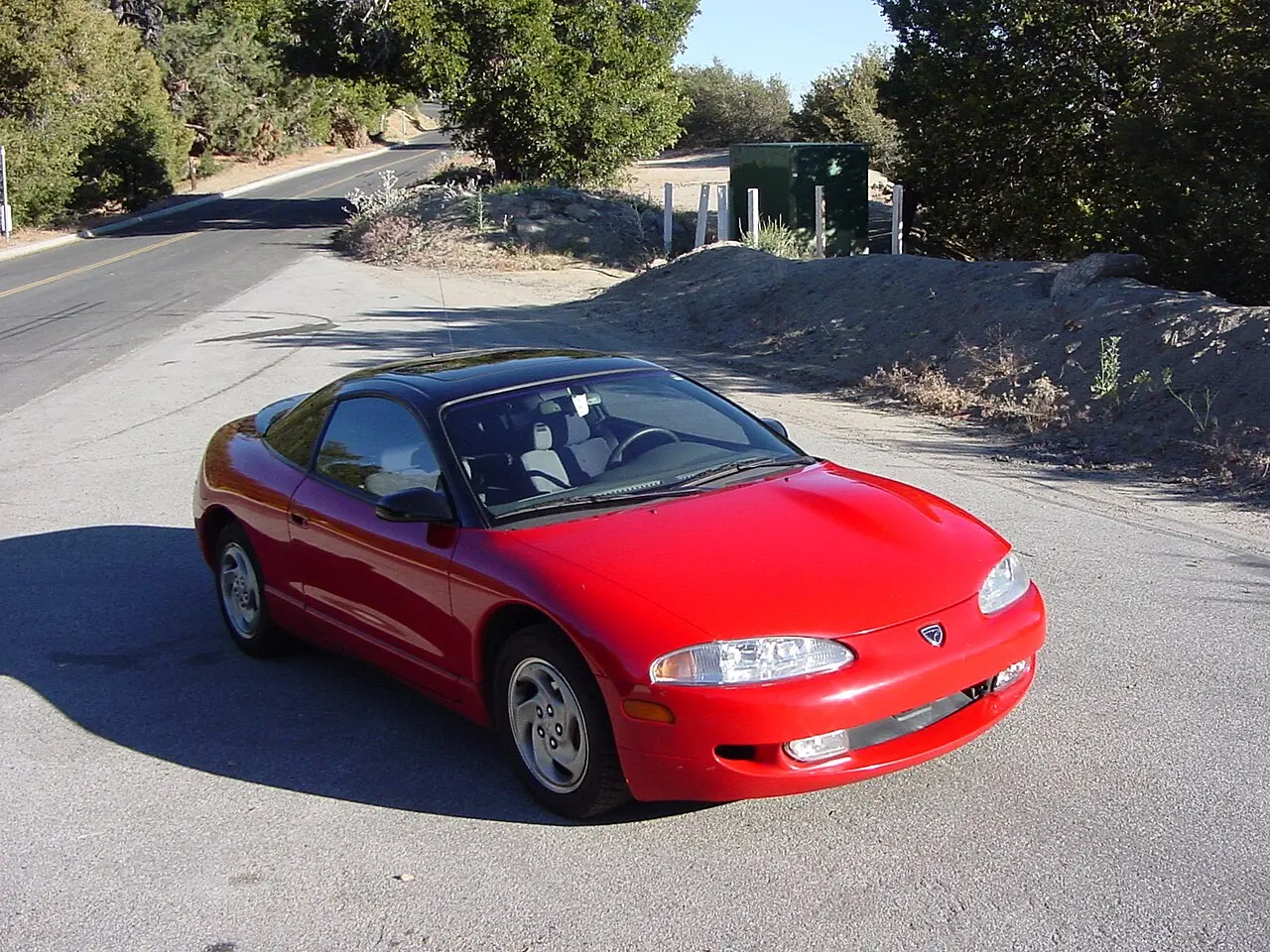
Eagle

Eagle Talon

Eagle Talon
Photo: User Mikeetc on en.wikipedia / Wikimedia Commons · CC BY-SA 3.0

The official data lists 38 versions of the Eagle Talon (1990–1998), in the United States and Canada. Each market publishes its own figures, measured on its own test procedure.

At a glance

Years in the data
1990–1998
Markets
United States, Canada
Engines
1.8 L to 2.0 L
Fuels
Petrol
Lowest consumption (United States)
9.8 L/100 km (EPA)
Lowest consumption (Canada)
10.1 L/100 km (5-cycle)

What is the Eagle Talon?

The Talon was a sporty compact coupe sold in the United States from 1990 to 1998 and in Canada from 1995 to 1998. Its two-door body and liftback rear gave it a different character from Eagle’s small sedans. It was developed through Diamond-Star Motors, the Chrysler and Mitsubishi joint venture, and shared its roots with the Mitsubishi Eclipse and Plymouth Laser.

Eagle was Chrysler’s passenger-car brand formed after its acquisition of American Motors. The Talon brought a sporty coupe to a range shaped in part by import-oriented models.

Talon generations

The first generation, identified as 1G, ran from 1990 to 1994. Its three-door body paired a sloping rear with a liftback opening. The range included naturally aspirated and turbocharged engines, with front-wheel drive and all-wheel drive available.

The second generation, or 2G, ran from 1995 to 1998. It brought a smoother, rounder exterior while retaining the compact coupe shape.

Engines and power

US versions had petrol engines from 1.8 to 2.0 litres. Canadian versions had 2.0-litre petrol engines. The range included naturally aspirated and turbocharged options.

How economical is the Eagle Talon?

US EPA figures for 1990–1998 show a lowest combined consumption of 9.8 L/100 km and a best combined rating of 24 MPG. Canadian NRCan figures for 1995–1998 show a lowest result of 10.1 L/100 km on the 5-cycle test. EPA and Canadian 5-cycle procedures differ, so the figures are best considered within their respective markets.

Where was the Talon sold?

The Talon was sold in the United States and Canada. US EPA figures cover 1990–1998, while Canadian NRCan figures cover 1995–1998.

Questions and answers

What kind of car was the Eagle Talon?

It was a sporty compact coupe with a liftback-style rear.

What years did the Talon generations cover?

The 1G ran from 1990 to 1994, and the 2G from 1995 to 1998.

What engine sizes were available?

US versions had petrol engines from 1.8 to 2.0 litres; Canadian versions had 2.0-litre petrol engines.

What is the lowest official consumption figure?

The lowest US EPA figure is 9.8 L/100 km combined. Canada’s NRCan 5-cycle result is 10.1 L/100 km.
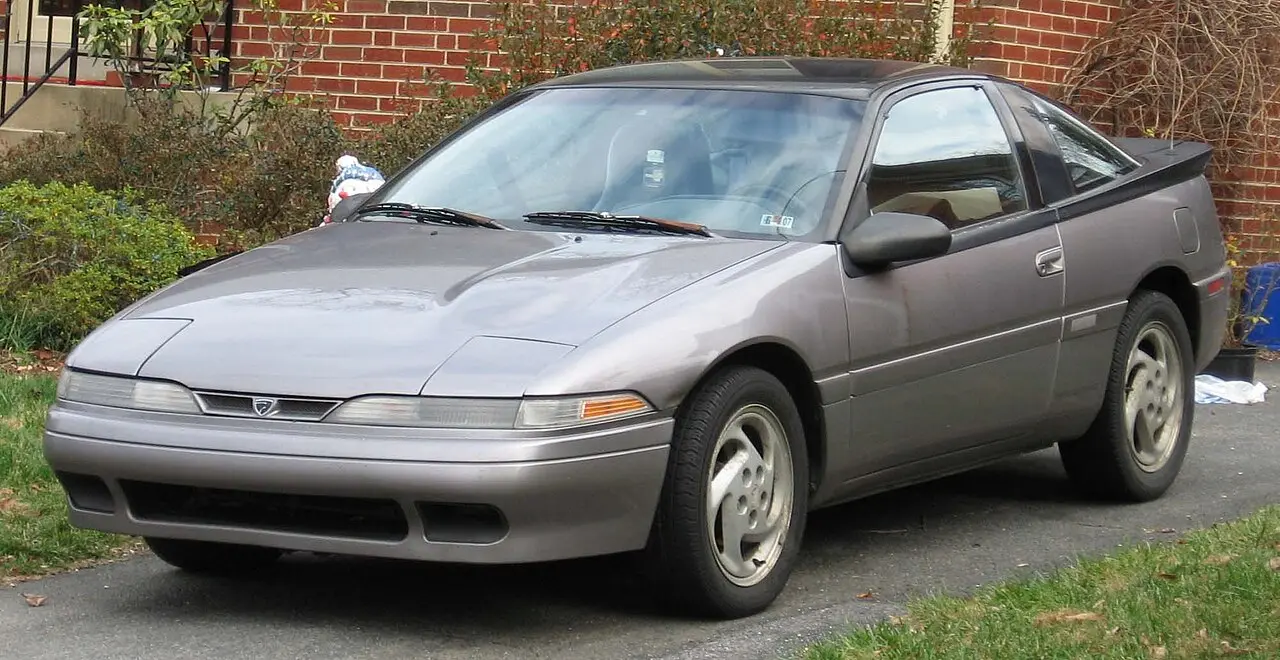
Talon first generation (1990–1994)

Eagle Talon first generation
Photo: IFCAR / Wikimedia Commons · Public domain

Model codes: 1G · Sold in: United States · References: en.wikipedia.org

Show all 10 versions

Talon second generation (1995–1998)

Eagle Talon second generation
Photo: User Mikeetc on en.wikipedia / Wikimedia Commons · CC BY-SA 3.0

Model codes: 2G · Sold in: United States and Canada · References: en.wikipedia.org

United States 17 versions

Model years sold in the USA, from the EPA and the Department of Energy (fueleconomy.gov). MPG on the EPA test; litres per 100 km = 235.215 ÷ MPG.

Years and versionEngineFuelGearboxDriveConsumption (combined)CO₂
1997–1998DOHC (FFS) · DOHC2.0 LPetrol4-speed automaticFront-wheel drive22 MPG (10.7 L/100 km) EPA251 g/km
1995–1998DOHC TURBO (FFS,TRBO) · DOHC-T/C2.0 LPetrol4-speed automaticFour- or all-wheel drive19 MPG (12.4 L/100 km) EPA291 g/km
1996–1998DOHC TURBO (FFS,TRBO) · DOHC-T/C2.0 LPetrol5-speed manualFour- or all-wheel drive21 MPG (11.2 L/100 km) EPA263 g/km
1998DOHC-T/C2.0 LPetrol4-speed automaticFront-wheel drive20 MPG (11.8 L/100 km) EPA276 g/km
1998DOHC2.0 LPetrol5-speed manualFront-wheel drive24 MPG (9.8 L/100 km) EPA230 g/km
1998DOHC-T/C2.0 LPetrol5-speed manualFront-wheel drive23 MPG (10.2 L/100 km) EPA240 g/km
1998DOHC2.0 LPetrol5-speed manualFront-wheel drive23 MPG (10.2 L/100 km) EPA240 g/km
1997DOHC (FFS)2.0 LPetrol5-speed manualFront-wheel drive23 MPG (10.2 L/100 km) EPA240 g/km
1995–1997DOHC TURBO (FFS,TRBO)2.0 LPetrol5-speed manualFront-wheel drive24 MPG (9.8 L/100 km) EPA230 g/km
1996–1997DOHC TURBO (FFS,TRBO)2.0 LPetrol4-speed automaticFront-wheel drive20 MPG (11.8 L/100 km) EPA276 g/km
1995–1996DOHC (FFS)2.0 LPetrol5-speed manualFront-wheel drive23 MPG (10.2 L/100 km) EPA240 g/km
1996DOHC (FFS)2.0 LPetrol4-speed automaticFront-wheel drive21 MPG (11.2 L/100 km) EPA263 g/km
1995DOHC (FFS)2.0 LPetrol4-speed automaticFront-wheel drive22 MPG (10.7 L/100 km) EPA251 g/km
1995DOHC TURBO (FFS,TRBO)2.0 LPetrol4-speed automaticFront-wheel drive22 MPG (10.7 L/100 km) EPA251 g/km
1995DOHC (FFS)2.0 LPetrol5-speed manualFront-wheel drive23 MPG (10.2 L/100 km) EPA240 g/km
1995DOHC TURBO (FFS,TRBO)2.0 LPetrol5-speed manualFour- or all-wheel drive21 MPG (11.2 L/100 km) EPA263 g/km

Canada 11 versions

Model years sold in Canada, from Natural Resources Canada fuel consumption ratings (5-cycle test).

Years and versionEngineFuelGearboxConsumption (combined)CO₂
1996–1998Subcompact2.0 LPetrol4-speed automatic12.3 L/100 km 5-cycle283 g/km
1996–1998Subcompact2.0 LPetrol5-speed manual11.0 L/100 km 5-cycle253 g/km
1997–1998Subcompact2.0 LPetrol5-speed manual10.1 L/100 km 5-cycle232 g/km
1998Subcompact2.0 LPetrol4-speed automatic10.9 L/100 km 5-cycle251 g/km
1997Subcompact2.0 LPetrol4-speed automatic10.7 L/100 km 5-cycle246 g/km
1996Subcompact2.0 LPetrol4-speed automatic11.1 L/100 km 5-cycle255 g/km
1996Subcompact2.0 LPetrol5-speed manual10.3 L/100 km 5-cycle237 g/km
1995Subcompact2.0 LPetrol4-speed automatic10.5 L/100 km 5-cycle242 g/km
1995Subcompact2.0 LPetrol5-speed manual10.2 L/100 km 5-cycle235 g/km
1995Subcompact2.0 LPetrol4-speed automatic12.3 L/100 km 5-cycle283 g/km
1995Subcompact2.0 LPetrol5-speed manual11.3 L/100 km 5-cycle260 g/km

Official figures are measured on standard test procedures and differ between markets. Your consumption depends on how, where and in what conditions you drive.