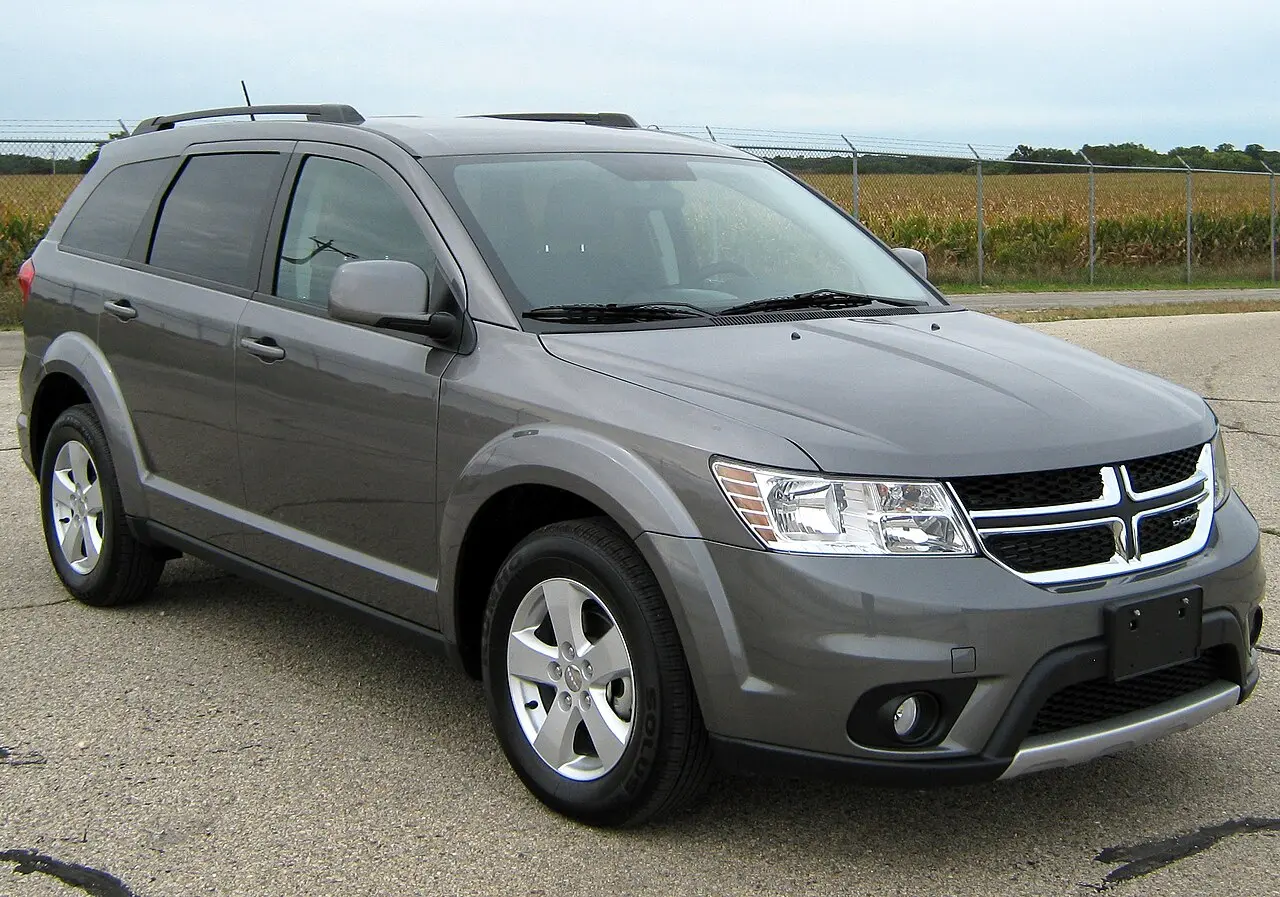
The official data lists 58 versions of the Dodge Journey (2009–2020), in the European Union, the United Kingdom, the United States, and Canada. Each market publishes its own figures, measured on its own test procedure.
At a glance
Years in the data
2009–2020
Markets
European Union, United Kingdom, United States, Canada
Engines
2.0 L to 3.6 L
Power
103 kW (140 PS) to 136 kW (185 PS)
Fuels
Petrol, Diesel, Flex fuel (E85)
Lowest consumption (United Kingdom)
6.3 L/100 km (NEDC)
Lowest consumption (United States)
10.7 L/100 km (EPA)
Lowest consumption (Canada)
10.7 L/100 km (5-cycle)
New registrations in the EU
12,171
What is the Dodge Journey?
The Journey is a crossover with a cabin designed to carry passengers and luggage. Its available third row gave it a family-oriented role, and Dodge described it as a crossover utility vehicle.
The Journey’s single JC generation ran from 2009 to 2020. It combined crossover styling with flexible seating and offered petrol and diesel engines in different markets.
Engines and power
EU registration figures from 2010 to 2016 show 2.0- to 2.7-litre engines, including petrol and diesel, with power from 103 kW (140 PS) to 136 kW (185 PS). UK VCA listings cover 2009–2010 and 2.0- to 2.4-litre petrol and diesel engines. US EPA and Canadian NRCan listings span 2009–2020, with 2.4- to 3.6-litre petrol or E85 flex-fuel versions.
How economical is the Dodge Journey?
The lowest listed UK consumption is 6.3 L/100 km on the NEDC test. The lowest US figure is 10.7 L/100 km, and the best combined EPA rating is 22 MPG. Canada’s lowest listed figure is also 10.7 L/100 km on the 5-cycle test. NEDC, EPA and Canada’s 5-cycle procedures differ, so results are best read within each market.
Where was the Journey sold?
EU registration figures cover 2010–2016, and UK VCA listings cover 2009–2010. US EPA and Canadian NRCan listings both span 2009–2020.
Questions and answers
How many Journey generations were there?
The Journey had one listed generation, the JC, covering 2009–2020.
Was the Journey available with a diesel engine?
Yes. EU and UK listings include diesel versions, including a 2.0-litre diesel in EU registrations.
What is the lowest listed Journey consumption?
The lowest listed figure is 6.3 L/100 km in the UK on the NEDC test.
New cars registered in the EU (plus Norway and Iceland), from the European Environment Agency. Figures on the NEDC procedure until 2020 and on WLTP from 2021; versions are grouped by engine and power, with their number of registrations.
Years and version
Engine
Power
Fuel
CO₂
EU registrations
2016
2.4 L
125 kW (170 PS)
Petrol
226 g/km
50
2016
2.4 L
129 kW (175 PS)
Petrol
239 g/km
22
2013
2.0 L
–
Other fuel
176 g/km
32
2013
2.0 L
103 kW (140 PS)
Diesel
176 g/km
28
2012
2.0 L
103 kW (140 PS)
Diesel
165 g/km
61
2011
2.0 L
103 kW (140 PS)
Diesel
172 g/km
1,190
2011
2.0 L
103 kW (140 PS)
Diesel
169 g/km
680
2011
2.4 L
125 kW (170 PS)
Petrol
219 g/km
320
2011
2.7 L
136 kW (185 PS)
Petrol
246 g/km
162
2010
2.0 L
–
Diesel
174 g/km
8,016
2010
2.4 L
–
Petrol
216 g/km
1,088
2010
2.7 L
–
Petrol
246 g/km
494
2010
–
–
Other fuel
186 g/km
28
United Kingdom 5 versions
New cars on sale in the UK, from the Vehicle Certification Agency. NEDC figures until 2018 and WLTP figures after; years are the editions a version appeared in.
Years and version
Engine
Fuel
Gearbox
Consumption (combined)
CO₂
2009–201009MY 2.0td (From 3 Dec 08) · 2.0td
2.0 L
Diesel
6-speed manual
6.3 L/100 km NEDC
165 g/km
2009–201009MY 2.0td (From 3 Dec 08) · 2.0td
2.0 L
Diesel
6-speed automatic
6.7 L/100 km NEDC
176 g/km
2009–201009MY 2.4 Manual 5 · 2.4
2.4 L
Petrol
5-speed manual
8.8 L/100 km NEDC
209 g/km
200909MY 2.0td Manual 6
2.0 L
Diesel
6-speed manual
6.5 L/100 km NEDC
170 g/km
200909MY 2.0td Auto 6
2.0 L
Diesel
6-speed automatic
7.0 L/100 km NEDC
186 g/km
United States 16 versions
Model years sold in the USA, from the EPA and the Department of Energy (fueleconomy.gov). MPG on the EPA test; litres per 100 km = 235.215 ÷ MPG.
Years and version
Engine
Fuel
Gearbox
Drive
Consumption (combined)
CO₂
2014–2020
2.4 L
Petrol
4-speed automatic
Front-wheel drive
21 MPG (11.2 L/100 km) EPA
261 g/km
2014–2019
3.6 L
Petrol
6-speed automatic
All-wheel drive
19 MPG (12.4 L/100 km) EPA
292 g/km
2017–2019FFV
3.6 L
Flex fuel (E85)
6-speed automatic
Front-wheel drive
19 MPG (12.4 L/100 km) EPA
283 g/km
2014–2016FFV
3.6 L
Flex fuel (E85)
6-speed automatic
Front-wheel drive
19 MPG (12.4 L/100 km) EPA
284 g/km
2013
2.4 L
Petrol
4-speed automatic
Front-wheel drive
21 MPG (11.2 L/100 km) EPA
260 g/km
2013FFV
3.6 L
Flex fuel (E85)
6-speed automatic
Front-wheel drive
20 MPG (11.8 L/100 km) EPA
281 g/km
2013
3.6 L
Petrol
6-speed automatic
All-wheel drive
19 MPG (12.4 L/100 km) EPA
289 g/km
2011–2012
2.4 L
Petrol
4-speed automatic
Front-wheel drive
22 MPG (10.7 L/100 km) EPA
251 g/km
2011–2012FFV
3.6 L
Flex fuel (E85)
6-speed automatic
Front-wheel drive
20 MPG (11.8 L/100 km) EPA
276 g/km
2012
3.6 L
Petrol
6-speed automatic
All-wheel drive
19 MPG (12.4 L/100 km) EPA
291 g/km
2011
3.6 L
Petrol
6-speed automatic
Four-wheel drive
19 MPG (12.4 L/100 km) EPA
291 g/km
2009–2010
2.4 L
Petrol
4-speed automatic
Front-wheel drive
21 MPG (11.2 L/100 km) EPA
263 g/km
2010
3.5 L
Petrol
6-speed automatic
Front-wheel drive
19 MPG (12.4 L/100 km) EPA
291 g/km
2010
3.5 L
Petrol
6-speed automatic
All-wheel drive
18 MPG (13.1 L/100 km) EPA
307 g/km
2009CMODE
3.5 L
Petrol
6-speed automatic
Four- or all-wheel drive
17 MPG (13.8 L/100 km) EPA
325 g/km
2009
3.5 L
Petrol
6-speed automatic
Front-wheel drive
18 MPG (13.1 L/100 km) EPA
307 g/km
Canada 24 versions
Model years sold in Canada, from Natural Resources Canada fuel consumption ratings (5-cycle test).
Years and version
Engine
Fuel
Gearbox
Consumption (combined)
CO₂
2017–2020Sport utility vehicle: Small
2.4 L
Petrol
4-speed automatic
11.1 L/100 km 5-cycle
261 g/km
2017–2019Sport utility vehicle: Small
3.6 L
Petrol
6-speed automatic
12.1 L/100 km 5-cycle
284 g/km
2017–2019Sport utility vehicle: Small
3.6 L
Flex fuel (E85)
6-speed automatic
16.4 L/100 km 5-cycle
274 g/km
2017–2019Sport utility vehicle: Small
3.6 L
Petrol
6-speed automatic
12.4 L/100 km 5-cycle
292 g/km
2016Sport utility vehicle: Small
2.4 L
Petrol
4-speed automatic
11.1 L/100 km 5-cycle
260 g/km
2016Sport utility vehicle: Small
3.6 L
Petrol
6-speed automatic
12.1 L/100 km 5-cycle
283 g/km
2016Sport utility vehicle: Small
3.6 L
Flex fuel (E85)
6-speed automatic
16.2 L/100 km 5-cycle
270 g/km
2016Sport utility vehicle: Small
3.6 L
Petrol
6-speed automatic
12.4 L/100 km 5-cycle
292 g/km
2013–2015Sport utility vehicle: Small
2.4 L
Petrol
4-speed automatic
11.1 L/100 km 5-cycle
255 g/km
2014–2015Sport utility vehicle: Small
3.6 L
Flex fuel (E85)
6-speed automatic
16.2 L/100 km 5-cycle
259 g/km
2014–2015Sport utility vehicle: Small
3.6 L
Petrol
6-speed automatic
12.4 L/100 km 5-cycle
285 g/km
2015Sport utility vehicle: Small
3.6 L
Petrol
6-speed automatic
12.1 L/100 km 5-cycle
278 g/km
2013–2014Sport utility vehicle: Small
3.6 L
Petrol
6-speed automatic
12.0 L/100 km 5-cycle
276 g/km
2013Sport utility vehicle: Small
3.6 L
Flex fuel (E85)
6-speed automatic
16.2 L/100 km 5-cycle
259 g/km
2013Sport utility vehicle: Small
3.6 L
Petrol
6-speed automatic
12.3 L/100 km 5-cycle
283 g/km
2011–2012Sport utility vehicle
2.4 L
Petrol
4-speed automatic
10.7 L/100 km 5-cycle
246 g/km
2011–2012Sport utility vehicle
3.6 L
Petrol
6-speed automatic
11.9 L/100 km 5-cycle
274 g/km
2011–2012Sport utility vehicle
3.6 L
Flex fuel (E85)
6-speed automatic
16.1 L/100 km 5-cycle
258 g/km
2011–2012Sport utility vehicle
3.6 L
Petrol
6-speed automatic
12.5 L/100 km 5-cycle
288 g/km
2009–2010Sport utility vehicle
2.4 L
Petrol
4-speed automatic
11.1 L/100 km 5-cycle
255 g/km
2010Sport utility vehicle
3.5 L
Petrol
6-speed automatic
12.6 L/100 km 5-cycle
290 g/km
2010Sport utility vehicle
3.5 L
Petrol
6-speed automatic
13.0 L/100 km 5-cycle
299 g/km
2009Sport utility vehicle
3.5 L
Petrol
6-speed automatic
12.9 L/100 km 5-cycle
297 g/km
2009Sport utility vehicle
3.5 L
Petrol
6-speed automatic
13.4 L/100 km 5-cycle
308 g/km
Official figures are measured on standard test procedures and differ between markets. Your consumption depends on how, where and in what conditions you drive.