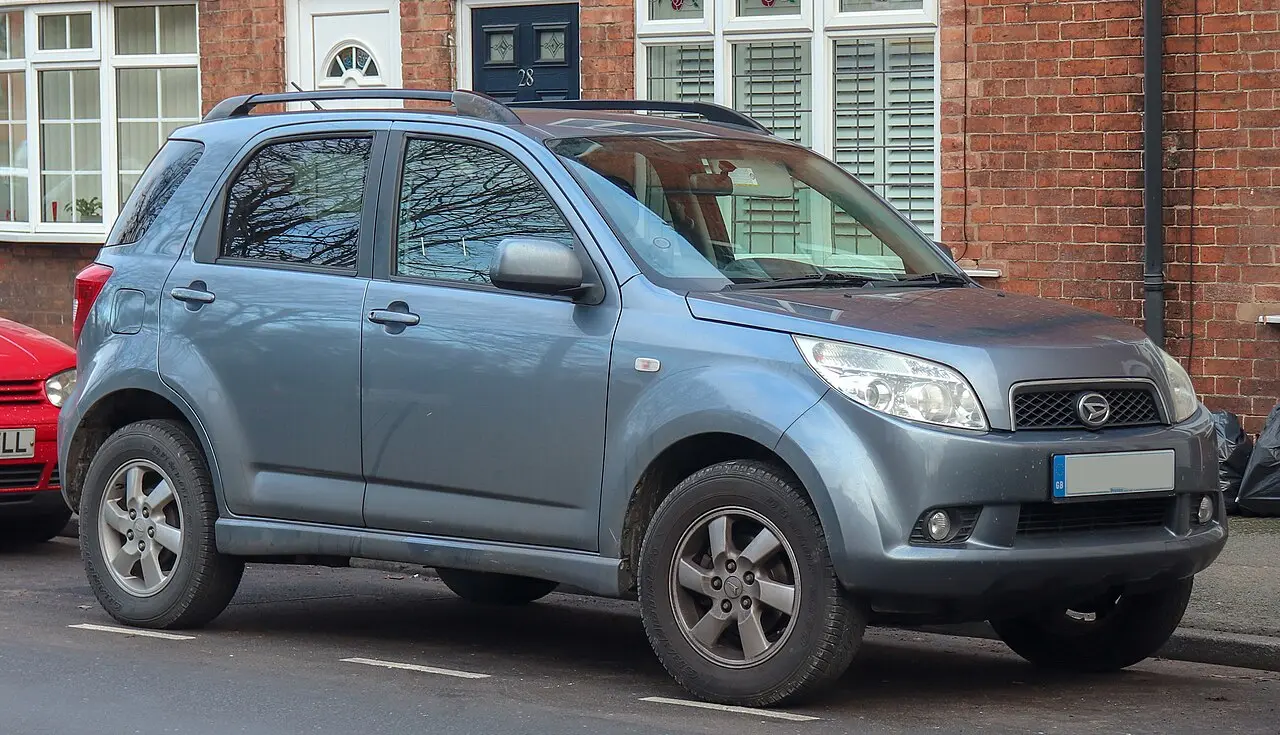
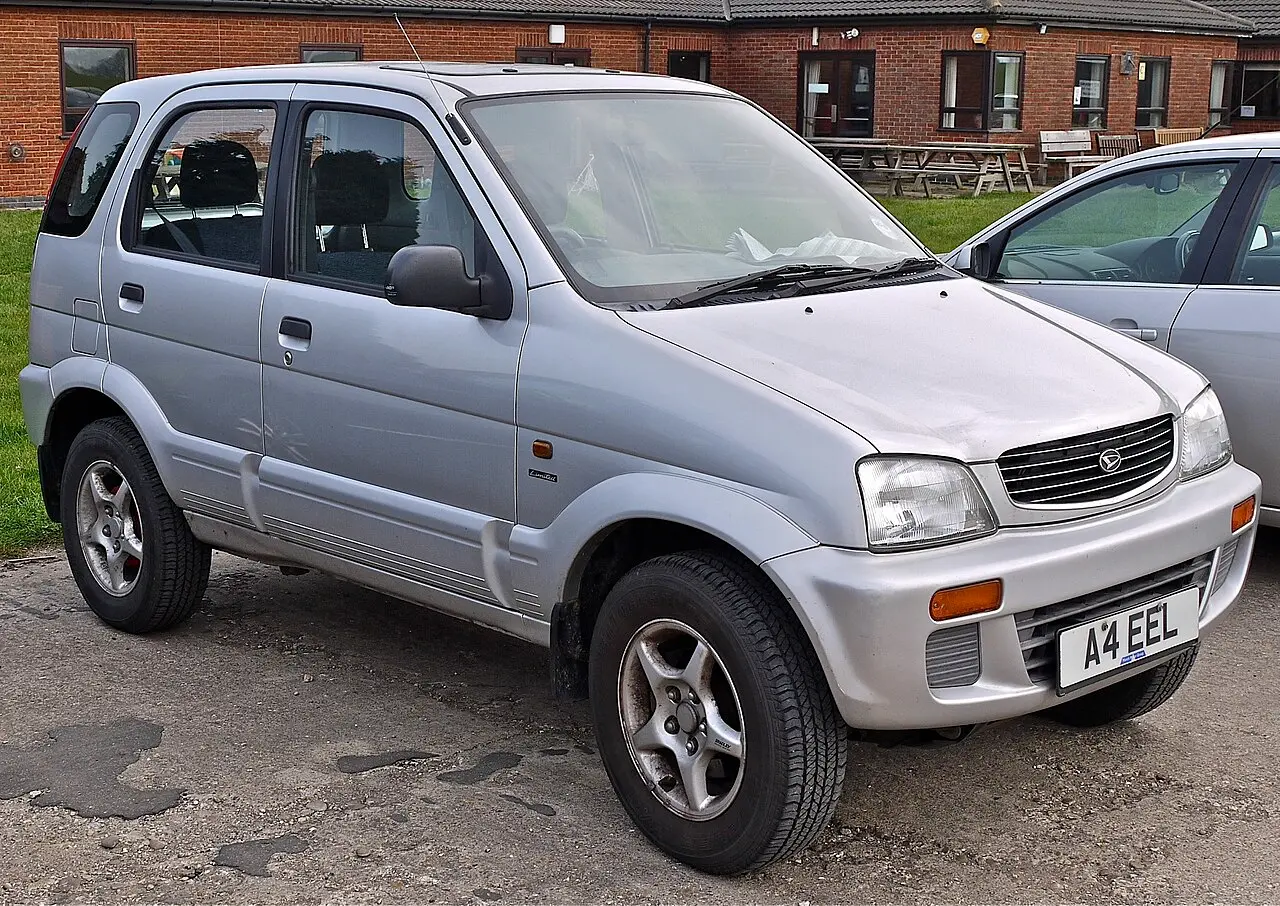
The official data lists 30 versions of the Daihatsu Terios (2000–2013), in the European Union, the United Kingdom, and France. Each market publishes its own figures, measured on its own test procedure.
At a glance
Years in the data
2000–2013
Markets
European Union, United Kingdom, France
Engines
1.3 L to 1.5 L
Power
63 kW (86 PS) to 77 kW (105 PS)
Fuels
Petrol, LPG
Lowest consumption (France)
7.4 L/100 km (NEDC)
Lowest consumption (United Kingdom)
7.7 L/100 km (NEDC)
New registrations in the EU
27,002
What is the Daihatsu Terios?
The Terios is a compact SUV, with a taller body and more ground clearance than a small hatchback. Daihatsu introduced it as a compact four-wheel-drive model, bringing SUV practicality to a smaller vehicle.
The first generation (2000–2005) was followed by the second (2006–2017), which brought a complete redesign. The Terios remained part of Daihatsu’s compact SUV range.
Engines and power
The European Union (EEA) recorded 15 Terios versions from 2010–2013, with engines from 1.3 L to 1.5 L and power from 63 kW (86 PS) to 77 kW (105 PS). Listings include petrol, LPG and other fuel entries. The most registered entries were 1.5 L petrol versions: 8,662 registrations in 2010, followed by a 75 kW (102 PS) version with 4,698 in 2011 and 3,220 in 2012.
How economical is the Daihatsu Terios?
The lowest UK VCA figure is 7.7 L/100 km on the NEDC test. UK listings cover 12 petrol versions from 2000–2010, with engines from 1.3 L to 1.5 L. France’s ADEME listing covers three petrol versions in 2012, with power of 75 kW (102 PS) and a lowest NEDC figure of 7.4 L/100 km.
Where was the Terios sold?
The Terios appears in European Union, UK and French market listings. EEA registrations totalled 27,002 from 2010–2013. The model was also sold in other parts of the world, with local line-ups varying by market.
Questions and answers
When were the Terios generations sold?
The first generation ran from 2000–2005, followed by the second from 2006–2017.
What engine sizes and power are listed for the Terios in the EU?
The 2010–2013 EEA entries span 1.3 L to 1.5 L and 63 kW (86 PS) to 77 kW (105 PS).
What is the lowest listed Terios fuel consumption?
The lowest figure is 7.4 L/100 km on the NEDC test in the French ADEME listing for 2012. The UK VCA minimum is 7.7 L/100 km, also on NEDC.
New cars registered in the EU (plus Norway and Iceland), from the European Environment Agency. Figures on the NEDC procedure until 2020 and on WLTP from 2021; versions are grouped by engine and power, with their number of registrations.
Years and version
Engine
Power
Fuel
CO₂
EU registrations
2013
1.5 L
75 kW (102 PS)
Petrol
175 g/km
646
2012
1.5 L
75 kW (102 PS)
Petrol
175 g/km
3,220
2012
–
–
Petrol
176 g/km
150
2011
1.5 L
75 kW (102 PS)
Petrol
176 g/km
4,698
2011
1.5 L
77 kW (105 PS)
Petrol
178 g/km
1,870
2011
–
–
Petrol
175 g/km
904
2011
1.5 L
77 kW (105 PS)
LPG
173 g/km
194
2011
1.3 L
63 kW (86 PS)
Petrol
173 g/km
188
2011
1.5 L
77 kW (105 PS)
Petrol
176 g/km
12
2010
1.5 L
–
Petrol
181 g/km
8,662
2010
–
–
Petrol
184 g/km
2,608
2010
1.5 L
–
LPG
173 g/km
1,998
2010
1.3 L
–
Petrol
177 g/km
1,658
2010
1.5 L
–
Petrol
176 g/km
146
2010
–
–
Other fuel
177 g/km
48
United Kingdom 8 versions
New cars on sale in the UK, from the Vehicle Certification Agency. NEDC figures until 2018 and WLTP figures after; years are the editions a version appeared in.
Years and version
Engine
Fuel
Gearbox
Consumption (combined)
CO₂
2007–2010J210 1.5L EFi SE 4WD · J210 1.5L EFi SE 4WD (from VIN 1033198)
1.5 L
Petrol
4-speed automatic
8.5 L/100 km NEDC
201 g/km
2008–2010J210 1.5L EFi S 4WD (from VIN 1033198) · J210 1.5L EFi S 4WD
New cars on sale in France, from ADEME Car Labelling. NEDC figures until 2015, WLTP figures in the current catalogue.
Years and version
Engine
Power
Fuel
Gearbox
Consumption (combined)
CO₂
2012TERIOS SPORT
–
75 kW (102 PS)
Petrol
5-speed manual
7.4 L/100 km NEDC
173 g/km
2012TERIOS LUXURY BVM
–
75 kW (102 PS)
Petrol
5-speed manual
7.7 L/100 km NEDC
179 g/km
2012TERIOS LUXURY BVA
–
75 kW (102 PS)
Petrol
4-speed automatic
7.7 L/100 km NEDC
181 g/km
Official figures are measured on standard test procedures and differ between markets. Your consumption depends on how, where and in what conditions you drive.