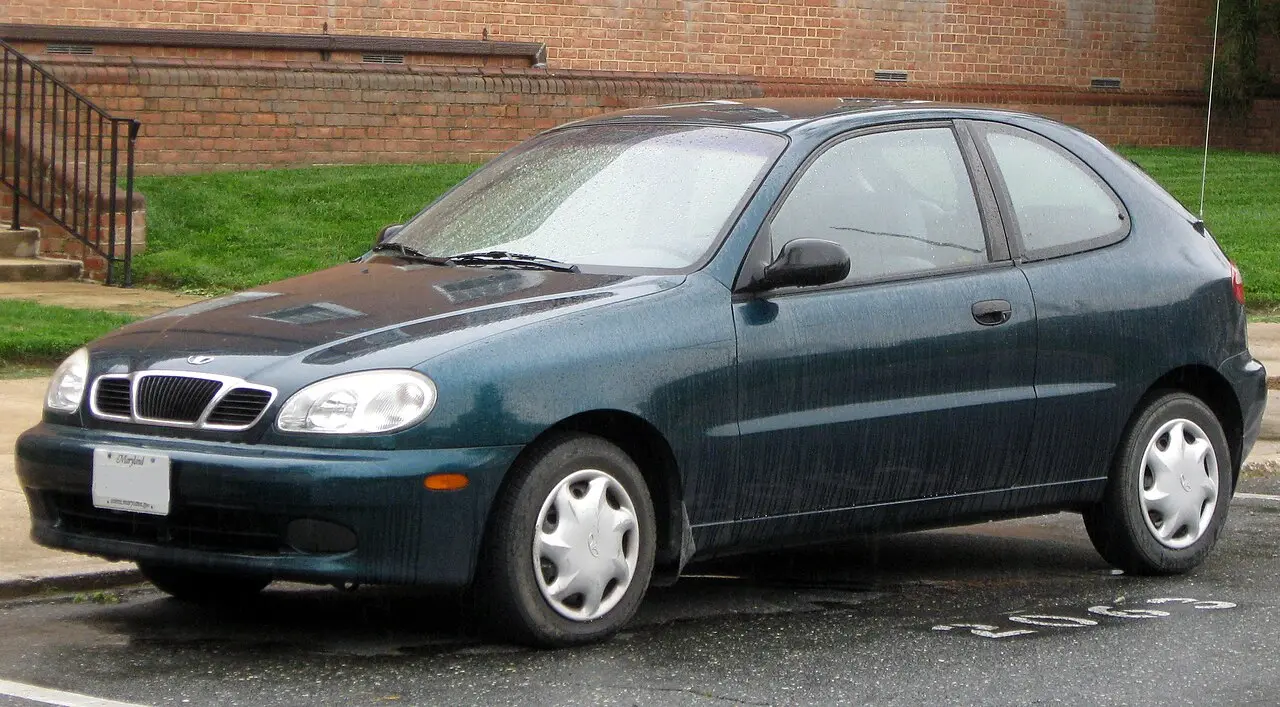
The official data lists 25 versions of the Daewoo Lanos (1998–2003), in the United Kingdom, the United States, and Canada. Each market publishes its own figures, measured on its own test procedure.
At a glance
Years in the data
1998–2003
Markets
United Kingdom, United States, Canada
Engines
1.3 L to 1.6 L
Fuels
Petrol
Lowest consumption (United Kingdom)
7.2 L/100 km (NEDC)
Lowest consumption (Canada)
8.9 L/100 km (5-cycle)
Lowest consumption (United States)
9.0 L/100 km (EPA)
What is the Daewoo Lanos?
The Lanos was a small family car and the entry point of Daewoo’s range, below the Nubira and Leganza. It came as a hatchback or saloon, with the hatchback offering a compact shape and the saloon a separate boot.
Giorgetto Giugiaro designed the Lanos. Its body styles included three-door and five-door hatchbacks, as well as a four-door saloon.
Lanos generations
The Lanos had one generation in these markets: T100, sold from 1998 to 2003. T150 identifies the updated form of the same generation.
Engines and fuel consumption
The listed petrol engines ranged from 1.3 to 1.6 litres in the UK, and 1.5 to 1.6 litres in the US and Canada. The lowest UK VCA figure is 7.2 L/100 km on the NEDC test. In the US, the EPA figure is 9 L/100 km, with a best combined rating of 26 MPG. Canada’s lowest listed figure is 8.9 L/100 km on NRCan’s five-cycle test. Each procedure measures fuel use differently, so the figures are best read within their own market.
Where was the Lanos sold?
The Lanos appears in official figures for the UK from 2000 to 2002, the US from 1998 to 2003 and Canada from 1999 to 2002.
Questions and answers
What body styles did the Lanos have?
It was offered as a three-door or five-door hatchback and as a four-door saloon.
What does T150 mean?
T150 identifies the updated form of the Lanos; T100 is the original code. Both belong to the same generation.
How much fuel does the Lanos use officially?
The lowest listed figures are 7.2 L/100 km on the UK NEDC test, 9 L/100 km on the US EPA test and 8.9 L/100 km on Canada’s NRCan five-cycle test.
New cars on sale in the UK, from the Vehicle Certification Agency. NEDC figures until 2018 and WLTP figures after; years are the editions a version appeared in.
Years and version
Engine
Fuel
Gearbox
Consumption (combined)
CO₂
2001–20021.4 S (SOHC) · 1.4 SE (SOHC)
1.3 L
Petrol
5-speed manual
7.2 L/100 km NEDC
204 g/km
2001–20021.6 SX (DOHC)
1.6 L
Petrol
5-speed manual
7.9 L/100 km NEDC
206 g/km
2001–20021.6 SX (DOHC)
1.6 L
Petrol
4-speed automatic
8.1 L/100 km NEDC
223 g/km
20011.4 S (SOHC) · 1.4 SE (SOHC)
1.3 L
Petrol
5-speed manual
7.9 L/100 km NEDC
214 g/km
20011.6 SX (DOHC)
1.6 L
Petrol
5-speed manual
8.2 L/100 km NEDC
206 g/km
20011.6 SX (DOHC)
1.6 L
Petrol
4-speed automatic
8.9 L/100 km NEDC
249 g/km
20001.4 S (SOHC) · 1.4 SE (SOHC)
1.3 L
Petrol
5-speed manual
7.9 L/100 km NEDC
184 g/km
20001.6 SX (DOHC)
1.6 L
Petrol
5-speed manual
8.2 L/100 km NEDC
192 g/km
20001.6 SX (DOHC)
1.6 L
Petrol
4-speed automatic
8.9 L/100 km NEDC
209 g/km
United States 9 versions
Model years sold in the USA, from the EPA and the Department of Energy (fueleconomy.gov). MPG on the EPA test; litres per 100 km = 235.215 ÷ MPG.
Years and version
Engine
Fuel
Gearbox
Drive
Consumption (combined)
CO₂
2003DOHC-IL4, EMS
1.6 L
Petrol
4-speed automatic
Front-wheel drive
23 MPG (10.2 L/100 km) EPA
240 g/km
2003DOHC-IL4
1.6 L
Petrol
5-speed manual
Front-wheel drive
24 MPG (9.8 L/100 km) EPA
230 g/km
1998–2002SOHC-IL4
1.5 L
Petrol
5-speed manual
Front-wheel drive
26 MPG (9.0 L/100 km) EPA
212 g/km
1999–2002SOHC-IL4, EMS · EMS
1.5 L
Petrol
4-speed automatic
Front-wheel drive
25 MPG (9.4 L/100 km) EPA
221 g/km
2001–2002EMS · SOHC-IL4, EMS
1.6 L
Petrol
4-speed automatic
Front-wheel drive
23 MPG (10.2 L/100 km) EPA
240 g/km
2001–2002SOHC-IL4
1.6 L
Petrol
5-speed manual
Front-wheel drive
25 MPG (9.4 L/100 km) EPA
221 g/km
1998–2000DOHC-IL4, EMS
1.6 L
Petrol
4-speed automatic
Front-wheel drive
24 MPG (9.8 L/100 km) EPA
230 g/km
1998–2000DOHC-IL4
1.6 L
Petrol
5-speed manual
Front-wheel drive
26 MPG (9.0 L/100 km) EPA
212 g/km
1998SOHC-IL4, EMS
1.5 L
Petrol
4-speed automatic
Front-wheel drive
25 MPG (9.4 L/100 km) EPA
221 g/km
Canada 7 versions
Model years sold in Canada, from Natural Resources Canada fuel consumption ratings (5-cycle test).
Years and version
Engine
Fuel
Gearbox
Consumption (combined)
CO₂
2002Compact
1.5 L
Petrol
4-speed automatic
9.3 L/100 km 5-cycle
214 g/km
2002Compact
1.5 L
Petrol
5-speed manual
8.9 L/100 km 5-cycle
205 g/km
1999–2002Compact · Subcompact
1.6 L
Petrol
4-speed automatic
9.8 L/100 km 5-cycle
225 g/km
2002Compact
1.6 L
Petrol
5-speed manual
8.9 L/100 km 5-cycle
205 g/km
1999–2001Compact · Subcompact
1.5 L
Petrol
4-speed automatic
9.4 L/100 km 5-cycle
216 g/km
1999–2001Compact · Subcompact
1.5 L
Petrol
5-speed manual
8.9 L/100 km 5-cycle
205 g/km
1999–2001Compact · Subcompact
1.6 L
Petrol
5-speed manual
9.0 L/100 km 5-cycle
207 g/km
Official figures are measured on standard test procedures and differ between markets. Your consumption depends on how, where and in what conditions you drive.