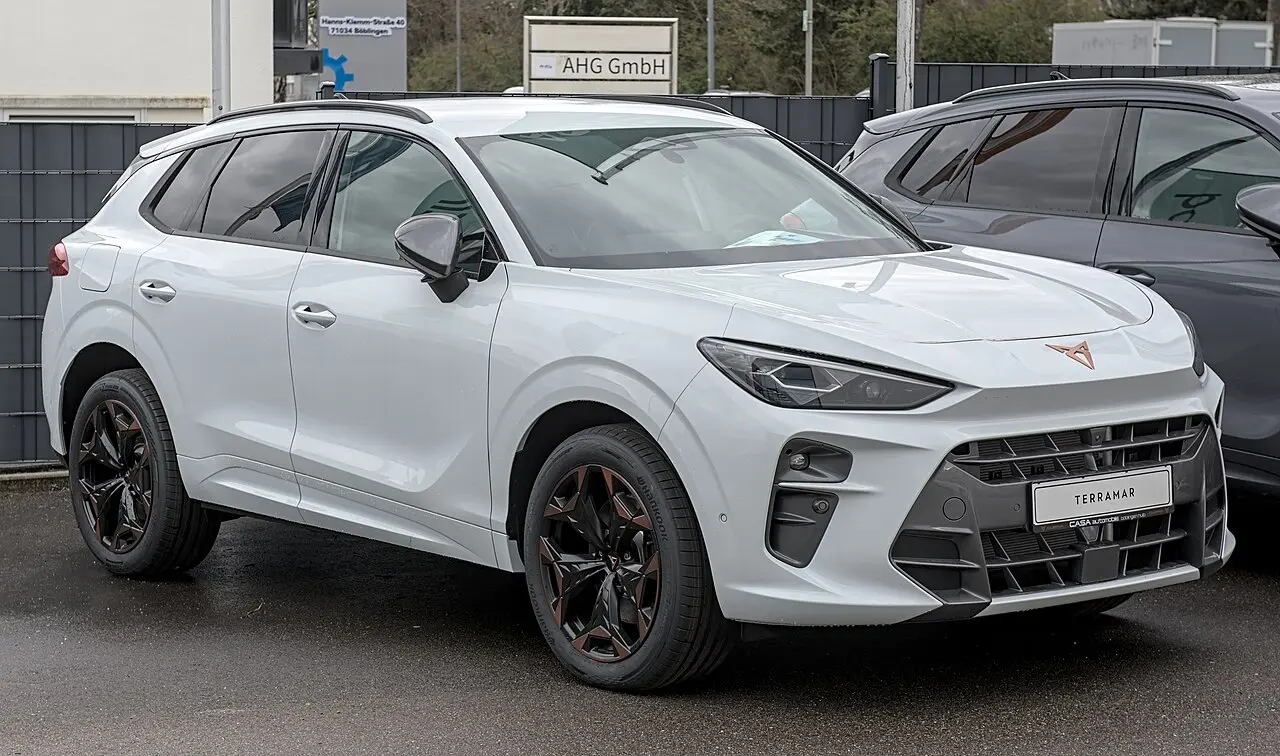
What is the CUPRA Terramar?
The Terramar is a sporty SUV that joined CUPRA’s range in 2024. Its roomy SUV shape and raised seating position give it an everyday family-car role, while its design carries the brand’s distinctive triangular lights and copper-toned details. The name refers to the Terramar circuit near Sitges, where CUPRA was introduced in 2018.
CUPRA grew from SEAT’s performance-car identity into a standalone brand in 2018. The Terramar brings that sporting focus to an SUV, with petrol, hybrid and plug-in hybrid powertrains.
Generations and engines
The first-generation Terramar spans 2024 to today. It is the model’s first generation, with no earlier Terramar to compare it with. European Union versions have engines from 1.5 L to 2.0 L and power from 110 kW (150 PS) to 195 kW (265 PS). The range includes petrol, hybrid and plug-in hybrid versions.
The 1.5 L hybrid at 110 kW (150 PS) recorded the most European Union registrations in 2025, with 14,721. The 1.5 L plug-in hybrid at 110 kW (150 PS) followed with 10,865, and the 1.5 L plug-in hybrid at 130 kW (177 PS) recorded 10,251.
How economical is the CUPRA Terramar?
The lowest stated consumption for petrol, diesel and hybrid versions is 6.1 L/100 km on the WLTP test. The plug-in hybrid’s lowest official weighted figure is 0.5 L/100 km, also on WLTP. That figure assumes some driving is electric, so it does not describe a journey made entirely on petrol.
The Terramar recorded 49,193 European Union registrations in 2024–2025. Test procedures differ between markets: Europe uses WLTP or, for some older figures, NEDC; the USA uses EPA testing; Canada uses a 5-cycle procedure.
Questions and answers
When did the CUPRA Terramar first appear?
The first generation spans 2024 to today. European Union registrations cover 2024–2025.
What engines and power outputs are available?
European Union versions have 1.5 L to 2.0 L engines and power from 110 kW (150 PS) to 195 kW (265 PS).
What is the Terramar’s lowest official consumption figure?
The lowest stated plug-in hybrid figure is 0.5 L/100 km on WLTP, a weighted figure that assumes some driving is electric. The lowest stated figure for petrol, diesel and hybrid versions is 6.1 L/100 km on WLTP.
How many European Union registrations does the Terramar have?
It recorded 49,193 European Union registrations in 2024–2025.