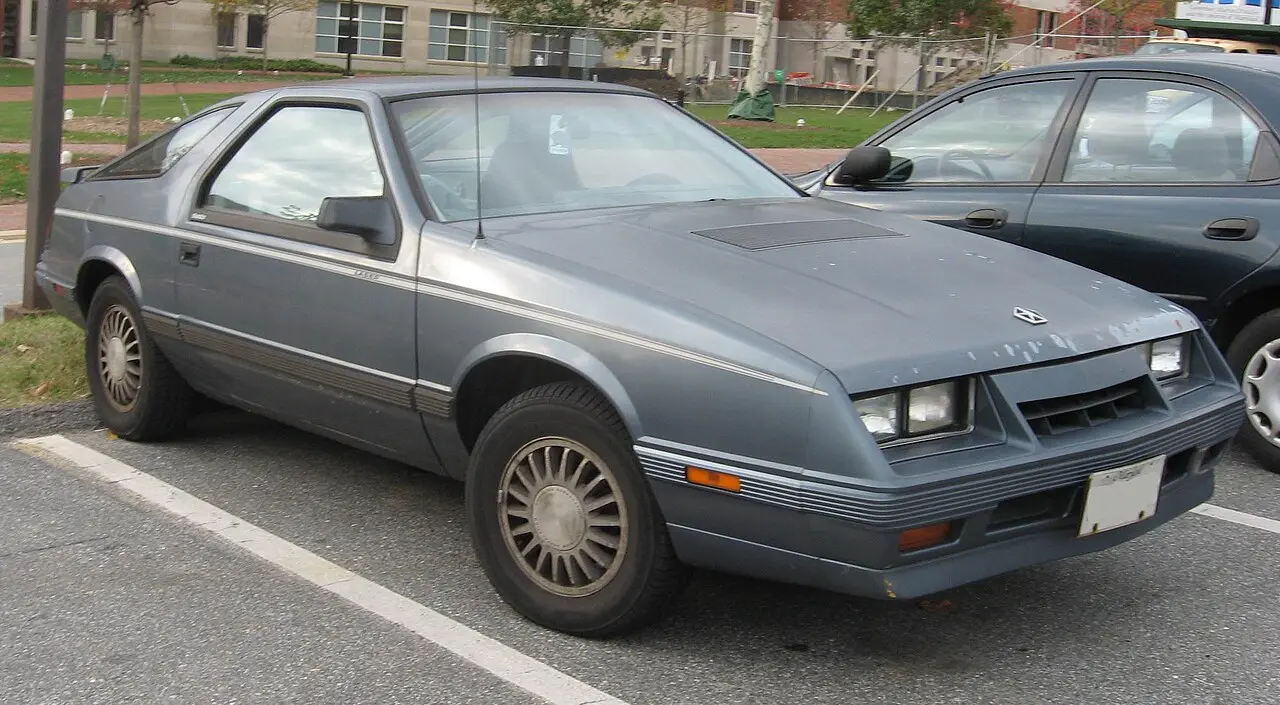
The official data lists 20 versions of the Chrysler Laser (1984–1987), in the United States. Each market publishes its own figures, measured on its own test procedure.
At a glance
Years in the data
1984–1987
Markets
United States
Engines
2.2 L to 2.5 L
Fuels
Petrol
Lowest consumption (United States)
9.0 L/100 km (EPA)
What is the Chrysler Laser?
The Chrysler Laser was a front-wheel-drive sport coupe with a hatchback body. It brought a lower, sportier shape to Chrysler’s range in the 1980s.
The G-body generation ran from 1984 to 1986. The US EPA market figures cover model years 1984 to 1987.
Engines and power
The US-market versions used petrol engines from 2.2 L to 2.5 L. The range listed for 1984 to 1987 includes 20 versions.
How economical is the Chrysler Laser?
The best combined EPA figure listed for the Laser is 26 MPG. A separate lowest-consumption figure is 9 L/100 km, but it is grouped with petrol, diesel and hybrid versions and cannot be attributed to this petrol-only model. EPA testing in the United States differs from the WLTP or NEDC procedures used in Europe and Canada’s 5-cycle test.
Where was the Laser sold?
The figures cover the United States, with EPA model-year entries from 1984 to 1987. The G-body generation is identified as a US-market model.
Questions and answers
What body style was the Chrysler Laser?
It was a front-wheel-drive sport coupe with a hatchback body.
Which years did the Laser generation run?
The G-body generation ran from 1984 to 1986; the EPA model-year entries cover 1984 to 1987.
What engines are listed for the Laser?
The US versions used petrol engines from 2.2 L to 2.5 L.
Model years sold in the USA, from the EPA and the Department of Energy (fueleconomy.gov). MPG on the EPA test; litres per 100 km = 235.215 ÷ MPG.
Years and version
Engine
Fuel
Gearbox
Drive
Consumption (combined)
CO₂
1986(FFS)
2.2 L
Petrol
3-speed automatic
Front-wheel drive
22 MPG (10.7 L/100 km) EPA
251 g/km
1985–1986(FFS,TRBO)
2.2 L
Petrol
3-speed automatic
Front-wheel drive
19 MPG (12.4 L/100 km) EPA
291 g/km
1986(FFS), SIL
2.2 L
Petrol
5-speed manual
Front-wheel drive
26 MPG (9.0 L/100 km) EPA
212 g/km
1985–1986(FFS,TRBO)
2.2 L
Petrol
5-speed manual
Front-wheel drive
20 MPG (11.8 L/100 km) EPA
276 g/km
1986(FFS)
2.5 L
Petrol
3-speed automatic
Front-wheel drive
21 MPG (11.2 L/100 km) EPA
263 g/km
1986(FFS), SIL
2.5 L
Petrol
5-speed manual
Front-wheel drive
24 MPG (9.8 L/100 km) EPA
230 g/km
1985(FFS) CA model
2.2 L
Petrol
3-speed automatic
Front-wheel drive
21 MPG (11.2 L/100 km) EPA
263 g/km
1985(FFS,TRBO) CA model
2.2 L
Petrol
3-speed automatic
Front-wheel drive
19 MPG (12.4 L/100 km) EPA
291 g/km
1985(FFS) CA model, SIL
2.2 L
Petrol
5-speed manual
Front-wheel drive
23 MPG (10.2 L/100 km) EPA
240 g/km
1985(FFS) CA model, SIL
2.2 L
Petrol
5-speed manual
Front-wheel drive
23 MPG (10.2 L/100 km) EPA
240 g/km
1985(FFS)
2.2 L
Petrol
3-speed automatic
Front-wheel drive
21 MPG (11.2 L/100 km) EPA
263 g/km
1985(FFS), SIL
2.2 L
Petrol
5-speed manual
Front-wheel drive
24 MPG (9.8 L/100 km) EPA
230 g/km
1984(FFS)
2.2 L
Petrol
3-speed automatic
–
22 MPG (10.7 L/100 km) EPA
251 g/km
1984(FFS,TRBO) · (FFS,TRBO) CA model
2.2 L
Petrol
3-speed automatic
–
19 MPG (12.4 L/100 km) EPA
291 g/km
1984(FFS)
2.2 L
Petrol
5-speed manual
–
22 MPG (10.7 L/100 km) EPA
251 g/km
1984(FFS,TRBO) · (FFS,TRBO) CA model
2.2 L
Petrol
5-speed manual
–
20 MPG (11.8 L/100 km) EPA
276 g/km
1984(FFS) CA model
2.2 L
Petrol
3-speed automatic
–
21 MPG (11.2 L/100 km) EPA
263 g/km
1984(FFS) CA model
2.2 L
Petrol
5-speed manual
–
23 MPG (10.2 L/100 km) EPA
240 g/km
Versions outside these generations
United States 2 versions
Model years sold in the USA, from the EPA and the Department of Energy (fueleconomy.gov). MPG on the EPA test; litres per 100 km = 235.215 ÷ MPG.
Years and version
Engine
Fuel
Gearbox
Drive
Consumption (combined)
CO₂
1987(FFS,TRBO)
2.2 L
Petrol
3-speed automatic
Front-wheel drive
19 MPG (12.4 L/100 km) EPA
291 g/km
1987(FFS,TRBO)
2.2 L
Petrol
5-speed manual
Front-wheel drive
21 MPG (11.2 L/100 km) EPA
263 g/km
Official figures are measured on standard test procedures and differ between markets. Your consumption depends on how, where and in what conditions you drive.