Chrysler

Chrysler 300

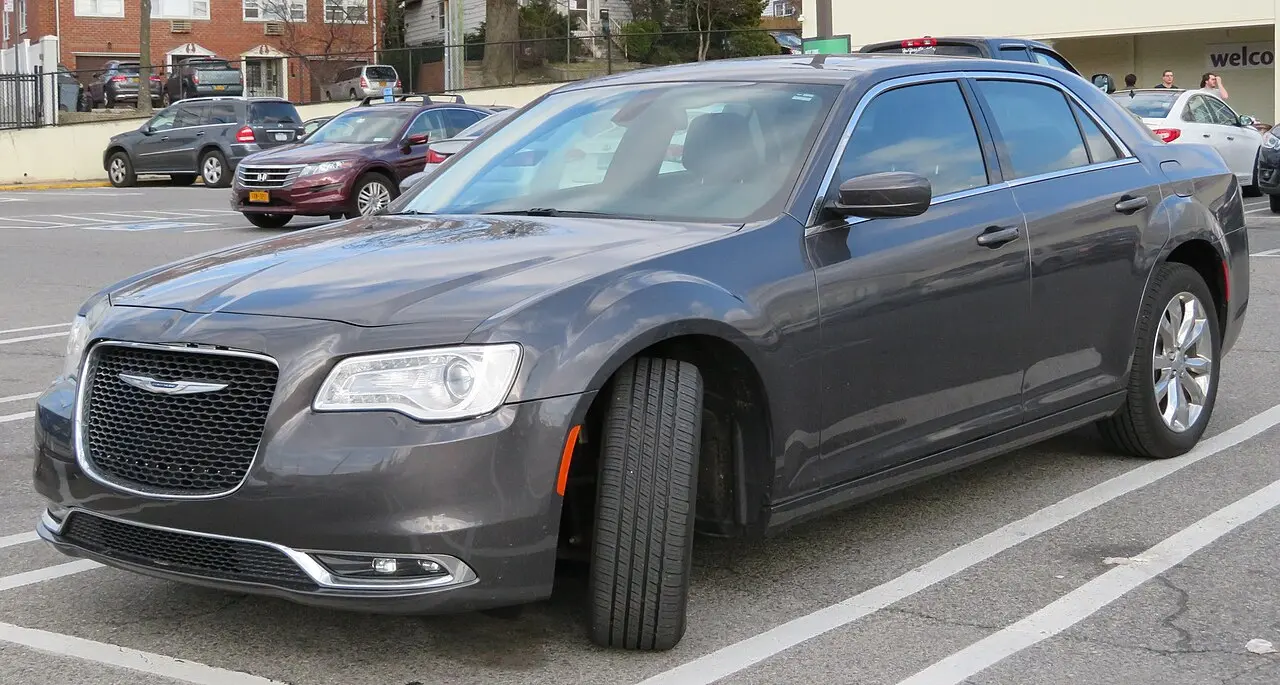
Chrysler 300
Photo: Kevauto / Wikimedia Commons · CC BY-SA 4.0

The official data lists 80 versions of the Chrysler 300 (2005–2023), in the European Union, the United States, and Canada. Each market publishes its own figures, measured on its own test procedure.

At a glance

Years in the data
2005–2023
Markets
European Union, United States, Canada
Engines
2.7 L to 6.4 L
Power
140 kW (190 PS) to 176 kW (239 PS)
Fuels
Diesel, Petrol, Flex fuel (E85)
Lowest consumption (United States)
10.2 L/100 km (EPA)
Lowest consumption (Canada)
10.2 L/100 km (5-cycle)
New registrations in the EU
7,335

What kind of car is the Chrysler 300?

The Chrysler 300 is a large sedan with a formal, upright shape. It sits near the upper end of Chrysler’s range, with a roomy cabin and engines that span from everyday power to V8 performance. Its broad grille and long bonnet give it a distinctive look.

The 300 name has a long history at Chrysler. The modern car revived the name in 2005, bringing the HEMI V8 back to the brand after a long absence.

Chrysler 300 generations

The first generation, known by the LX code, ran from 2005 to 2010. Its bold proportions and available HEMI V8 gave the large sedan a distinctive character.

The second generation, LD, followed from 2011 to 2023. It kept the large-sedan layout and familiar visual identity, while continuing to offer a broad range of engines.

Engines, power and official fuel figures

Engine choices varied by market. In the United States, the range spans 2.7 to 6.4 litres, with petrol and flex fuel E85. Canada’s range spans 3.5 to 6.4 litres, also with petrol and E85. In EU registration figures, engines span 2.7 to 6.1 litres, with diesel, petrol and other fuel types. The listed EU power range is 140 kW (190 PS) to 176 kW (239 PS).

The lowest listed US consumption is 10.2 L/100 km, and the best combined rating is 23 MPG, both under the EPA procedure. Canada’s lowest listed figure is 10.2 L/100 km under NRCan’s 5-cycle procedure. European fuel tests use WLTP or NEDC, depending on the vehicle and year. These procedures differ, so results across markets are not directly interchangeable.

Where was the Chrysler 300 sold?

US EPA and Canadian NRCan figures cover 2005–2023. EU registration figures cover 2010–2014, when 7,335 cars were registered. The most common listed EU configuration was the 3.0-litre diesel, with 5,096 registrations in 2010.

Questions and answers

What type of car is the Chrysler 300?

It is a large sedan, positioned toward the upper end of Chrysler’s range.

What are the Chrysler 300 generations?

The LX first generation ran from 2005 to 2010; the LD second generation ran from 2011 to 2023.

What is the Chrysler 300’s best combined EPA rating?

The best listed combined rating is 23 MPG under the US EPA procedure.

How does the Canadian fuel test differ from the US rating?

Canada uses NRCan’s 5-cycle procedure, while the United States uses EPA ratings. The test methods differ, so results are not directly equivalent.

300 first generation (2005–2010)

Chrysler 300 first generation
Photo: Damian B Oh / Wikimedia Commons · CC BY-SA 4.0

Model codes: LX · References: en.wikipedia.org

Show all 34 versions

300 second generation (2011–2023)

Chrysler 300 second generation
Photo: Kevauto / Wikimedia Commons · CC BY-SA 4.0

Model codes: LD · References: en.wikipedia.org

European Union 7 versions

New cars registered in the EU (plus Norway and Iceland), from the European Environment Agency. Figures on the NEDC procedure until 2020 and on WLTP from 2021; versions are grouped by engine and power, with their number of registrations.

Years and versionEnginePowerFuelCO₂EU registrations
20143.0 L176 kW (239 PS)Diesel189 g/km110
20133.0 L140 kW (190 PS)Diesel191 g/km387
20123.0 L176 kW (239 PS)Diesel188 g/km441
20113.0 L160 kW (218 PS)Diesel214 g/km492
20113.0 L155 kW (211 PS)Diesel211 g/km102
20112.7 L130 kW (177 PS)Petrol250 g/km18
20113.0 L176 kW (239 PS)Diesel187 g/km17

United States 17 versions

Model years sold in the USA, from the EPA and the Department of Energy (fueleconomy.gov). MPG on the EPA test; litres per 100 km = 235.215 ÷ MPG.

Years and versionEngineFuelGearboxDriveConsumption (combined)CO₂
2013–20233.6 LPetrol8-speed automaticAll-wheel drive21 MPG (11.2 L/100 km) EPA258 g/km
2013–20233.6 LPetrol8-speed automaticRear-wheel drive23 MPG (10.2 L/100 km) EPA242 g/km
2015–20235.7 LPetrol8-speed automaticRear-wheel drive19 MPG (12.4 L/100 km) EPA290 g/km
20236.4 LPetrol8-speed automaticRear-wheel drive18 MPG (13.1 L/100 km) EPA308 g/km
2013–2019FFV3.6 LFlex fuel (E85)8-speed automaticAll-wheel drive21 MPG (11.2 L/100 km) EPA258 g/km
2013–2019FFV3.6 LFlex fuel (E85)8-speed automaticRear-wheel drive23 MPG (10.2 L/100 km) EPA242 g/km
2013–20145.7 LPetrol5-speed automaticAll-wheel drive18 MPG (13.1 L/100 km) EPA313 g/km
20145.7 LPetrol5-speed automaticRear-wheel drive18 MPG (13.1 L/100 km) EPA303 g/km
20146.4 LPetrol5-speed automaticRear-wheel drive17 MPG (13.8 L/100 km) EPA324 g/km
20135.7 LPetrol5-speed automaticRear-wheel drive19 MPG (12.4 L/100 km) EPA296 g/km
20136.4 LPetrol5-speed automaticRear-wheel drive17 MPG (13.8 L/100 km) EPA323 g/km
2011–20123.6 LPetrol5-speed automaticRear-wheel drive21 MPG (11.2 L/100 km) EPA263 g/km
2012FFV3.6 LFlex fuel (E85)8-speed automaticRear-wheel drive23 MPG (10.2 L/100 km) EPA240 g/km
2012FFV3.6 LFlex fuel (E85)8-speed automaticAll-wheel drive21 MPG (11.2 L/100 km) EPA263 g/km
2011–20125.7 LPetrol5-speed automaticAll-wheel drive18 MPG (13.1 L/100 km) EPA307 g/km
20126.4 LPetrol5-speed automaticRear-wheel drive17 MPG (13.8 L/100 km) EPA325 g/km
2011FFV3.6 LFlex fuel (E85)5-speed automaticRear-wheel drive21 MPG (11.2 L/100 km) EPA263 g/km

Canada 22 versions

Model years sold in Canada, from Natural Resources Canada fuel consumption ratings (5-cycle test).

Years and versionEngineFuelGearboxConsumption (combined)CO₂
2017–2023Full-size3.6 LPetrol8-speed automatic10.3 L/100 km 5-cycle242 g/km
2017–2023Full-size3.6 LPetrol8-speed automatic11.0 L/100 km 5-cycle258 g/km
2018–2023Full-size5.7 LPetrol8-speed automatic12.3 L/100 km 5-cycle289 g/km
2023Full-size6.4 LPetrol8-speed automatic13.1 L/100 km 5-cycle307 g/km
2017–2019Full-size3.6 LFlex fuel (E85)8-speed automatic15.0 L/100 km 5-cycle248 g/km
2018–2019Full-size3.6 LFlex fuel (E85)8-speed automatic14.2 L/100 km 5-cycle234 g/km
2016Full-size3.6 LPetrol8-speed automatic10.3 L/100 km 5-cycle240 g/km
2016Full-size3.6 LFlex fuel (E85)8-speed automatic13.9 L/100 km 5-cycle229 g/km
2016Full-size3.6 LPetrol8-speed automatic10.9 L/100 km 5-cycle257 g/km
2016Full-size3.6 LFlex fuel (E85)8-speed automatic14.8 L/100 km 5-cycle243 g/km
2012–2015Full-size3.6 LFlex fuel (E85)8-speed automatic13.9 L/100 km 5-cycle222 g/km
2014–2015Full-size3.6 LPetrol8-speed automatic10.3 L/100 km 5-cycle237 g/km
2014–2015Full-size3.6 LPetrol8-speed automatic10.9 L/100 km 5-cycle251 g/km
2014–2015Full-size3.6 LFlex fuel (E85)8-speed automatic14.8 L/100 km 5-cycle237 g/km
2014Full-size5.7 LPetrol5-speed automatic13.4 L/100 km 5-cycle308 g/km
2012–2014Full-size6.4 LPetrol5-speed automatic13.8 L/100 km 5-cycle317 g/km
2012–2013Full-size3.6 LPetrol8-speed automatic10.2 L/100 km 5-cycle235 g/km
2012–2013Full-size3.6 LPetrol8-speed automatic11.0 L/100 km 5-cycle253 g/km
2012–2013Full-size3.6 LFlex fuel (E85)8-speed automatic14.8 L/100 km 5-cycle237 g/km
2011–2013Full-size5.7 LPetrol5-speed automatic13.4 L/100 km 5-cycle308 g/km
2011–2012Full-size3.6 LPetrol5-speed automatic11.2 L/100 km 5-cycle258 g/km
2011–2012Full-size3.6 LFlex fuel (E85)5-speed automatic15.7 L/100 km 5-cycle251 g/km

Official figures are measured on standard test procedures and differ between markets. Your consumption depends on how, where and in what conditions you drive.