Caterham

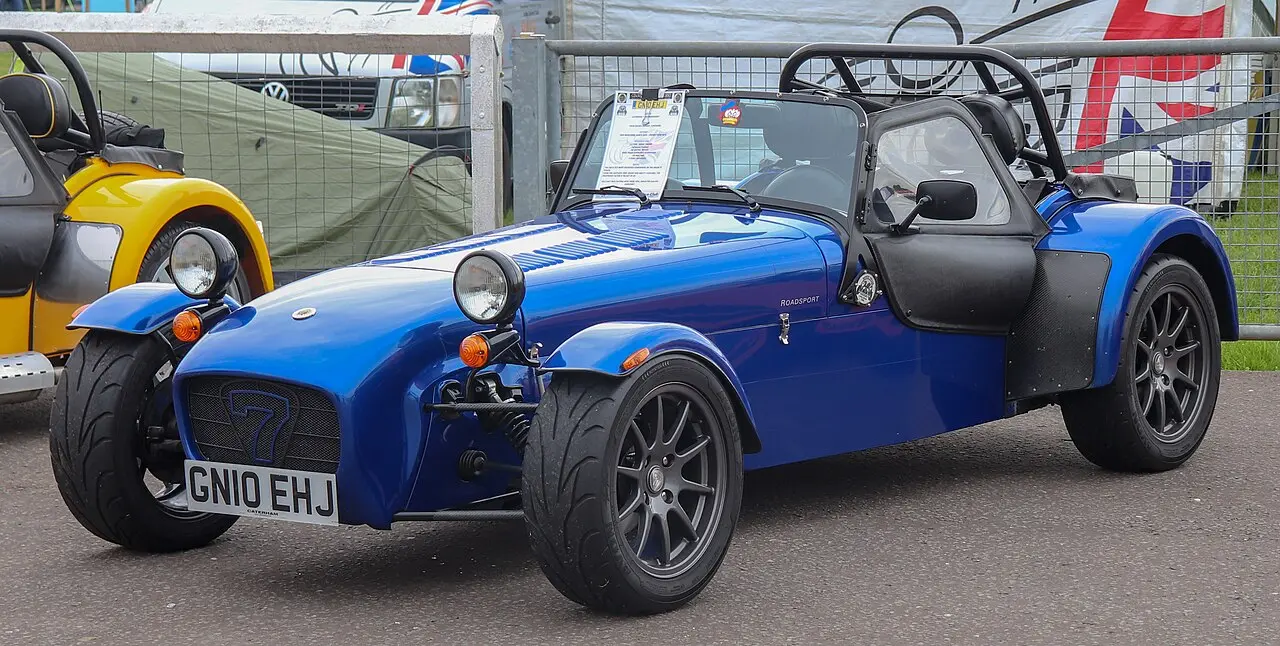
Caterham Seven

Caterham Seven
Photo: Vauxford / Wikimedia Commons · CC BY-SA 4.0

The official data lists 53 versions of the Caterham Seven (2010–2025), in the European Union. Each market publishes its own figures, measured on its own test procedure.

At a glance

Years in the data
2010–2025
Markets
European Union
Engines
0.7 L to 2.0 L
Power
59 kW (80 PS) to 176 kW (239 PS)
Fuels
Petrol
Lowest consumption (European Union)
4.8 L/100 km (WLTP)
New registrations in the EU
3,342

What is the Caterham Seven?

The Caterham Seven is a lightweight, open two-seat sports car with exposed front wheels. It is the centrepiece of Caterham’s range, built around a simple idea: keep the car light and direct so the driver feels closely connected to the road. Its compact, pared-back layout suits people drawn to an involving drive and happy with limited weather protection and luggage space.

The Seven began as a Lotus, designed by Colin Chapman and first built in 1957. Caterham took over the rights to build and develop it in 1973, carrying the original lightweight philosophy forward while evolving the car over time.

Caterham Seven generations

The listed generation is the Series 3, or S3, which dates from 1974 and continues today. Over that long run, Caterham has kept the Seven’s familiar open, lightweight formula while developing its engines and versions.

Engines and power

In European Union registration figures from 2010 to 2025, the Seven appears with petrol engines from 0.7 to 2.0 litres. Power spans 59 kW (80 PS) to 176 kW (239 PS), giving the range a broad spread while keeping its compact, lightweight character.

The most registered versions include the 0.7-litre petrol model with 59 kW (80 PS), recorded from 2014 to 2018, and 1.6-litre petrol models with 100 kW (136 PS), recorded in 2020 and 2021.

Fuel consumption, CO₂ and markets

Across 53 versions, the Seven recorded 3,342 EU registrations from 2010 to 2025. The lowest listed consumption is 4.8 L/100 km on the WLTP test. European WLTP results use a different procedure from US EPA ratings and Canada’s 5-cycle results, so figures from those markets are not directly comparable.

The European figures describe registrations in the European Economic Area. Caterham’s history and identity remain closely tied to the Seven, its lightweight British sports car.

Questions and answers

What kind of car is the Caterham Seven?

It is a lightweight, open two-seat sports car with exposed front wheels.

Which generation of the Caterham Seven is listed?

The Series 3, or S3, dates from 1974 and continues today.

What engines and power are listed for the Seven in the EU?

The EU figures list petrol engines from 0.7 to 2.0 litres, with power from 59 kW (80 PS) to 176 kW (239 PS).

What is the lowest listed fuel consumption?

The lowest listed figure is 4.8 L/100 km on the WLTP test.

Seven Series 3 (since 1974)

Caterham Seven Series 3
Photo: Vauxford / Wikimedia Commons · CC BY-SA 4.0

Model codes: S3 · References: caterhamcars.com, en.wikipedia.org, pistonheads.com

European Union 53 versions

New cars registered in the EU (plus Norway and Iceland), from the European Environment Agency. Figures on the NEDC procedure until 2020 and on WLTP from 2021; versions are grouped by engine and power, with their number of registrations.

Years and versionEnginePowerFuelConsumption (combined)CO₂Electric rangeEU registrations
20252.0 L127 kW (173 PS)Petrol6.6 L/100 km WLTP148 g/km–66
20252.0 L168 kW (228 PS)Petrol7.8 L/100 km WLTP176 g/km–31
20252.0 L128 kW (174 PS)Petrol6.5 L/100 km WLTP148 g/km–24
20250.7 L62 kW (84 PS)Petrol4.8 L/100 km WLTP109 g/km–17
20242.0 L127 kW (173 PS)Petrol6.6 L/100 km WLTP148 g/km–125
2022–20240.7 L62 kW (84 PS)Petrol4.8 L/100 km WLTP109 g/km–71
20242.0 L128 kW (174 PS)Petrol6.5 L/100 km WLTP148 g/km–23
20242.0 L167 kW (227 PS)Petrol7.8 L/100 km WLTP172 g/km–10
20232.0 L127 kW (173 PS)Petrol6.7 L/100 km WLTP148 g/km–53
20232.0 L128 kW (174 PS)Petrol6.5 L/100 km WLTP148 g/km–26
20230.7 L63 kW (86 PS)Petrol4.8 L/100 km WLTP110 g/km–16
20221.6 L100 kW (136 PS)Petrol8.2 L/100 km WLTP146 g/km–64
20222.0 L177 kW (241 PS)Petrol8.6 L/100 km WLTP193 g/km–30
20220.7 L63 kW (86 PS)Petrol4.8 L/100 km WLTP113 g/km–15
20222.0 L176 kW (239 PS)Petrol6.6 L/100 km WLTP191 g/km233 km14
20211.6 L100 kW (136 PS)Petrol8.3 L/100 km WLTP145 g/km–274
20212.0 L177 kW (241 PS)Petrol–191 g/km–34
20212.0 L176 kW (239 PS)Petrol6.4 L/100 km WLTP191 g/km–16
20201.6 L100 kW (136 PS)Petrol–160 g/km–203
20202.0 L176 kW (239 PS)Petrol–203 g/km–34
20202.0 L177 kW (241 PS)Petrol–199 g/km–24
20191.6 L100 kW (136 PS)Petrol–162 g/km–188
20192.0 L176 kW (239 PS)Petrol–206 g/km–54
20192.0 L177 kW (241 PS)Petrol–204 g/km–28
2014–20180.7 L59 kW (80 PS)Petrol–114 g/km–278
20181.6 L100 kW (136 PS)Petrol–144 g/km–106
20182.0 L176 kW (239 PS)Petrol–179 g/km–28
20171.6 L100 kW (136 PS)Petrol–144 g/km–70
20172.0 L176 kW (239 PS)Petrol–179 g/km–42
20172.0 L127 kW (173 PS)Petrol–185 g/km–10
20172.0 L177 kW (241 PS)Petrol–179 g/km–10
20161.6 L100 kW (136 PS)Petrol–146 g/km–124
20162.0 L176 kW (239 PS)Petrol–179 g/km–42
20162.0 L177 kW (241 PS)Petrol–179 g/km–22
20162.0 L127 kW (173 PS)Petrol–198 g/km–12
20152.0 L176 kW (239 PS)Petrol–179 g/km–40
20151.6 L100 kW (136 PS)Petrol–146 g/km–20
20152.0 L177 kW (241 PS)Petrol–179 g/km–16
20151.6 L85 kW (116 PS)Petrol–154 g/km–14
20152.0 L127 kW (173 PS)Petrol–203 g/km–14
20142.0 L176 kW (239 PS)Petrol–179 g/km–50
20141.6 L85 kW (116 PS)Petrol–156 g/km–36
20142.0 L177 kW (241 PS)Petrol–179 g/km–20
20131.6 L85 kW (116 PS)Petrol–157 g/km–78
20132.0 L176 kW (239 PS)Petrol–179 g/km–48
20132.0 L127 kW (173 PS)Petrol–202 g/km–32
20122.0 L127 kW (173 PS)Petrol–206 g/km–146
20121.6 L85 kW (116 PS)Petrol–157 g/km–116
20112.0 L127 kW (173 PS)Petrol–196 g/km–158
20111.6 L85 kW (116 PS)Petrol–153 g/km–108
20102.0 L–Petrol–188 g/km–162
20101.6 L–Petrol–150 g/km–88
20102.3 L–Petrol–261 g/km–12

Official figures are measured on standard test procedures and differ between markets. Your consumption depends on how, where and in what conditions you drive.