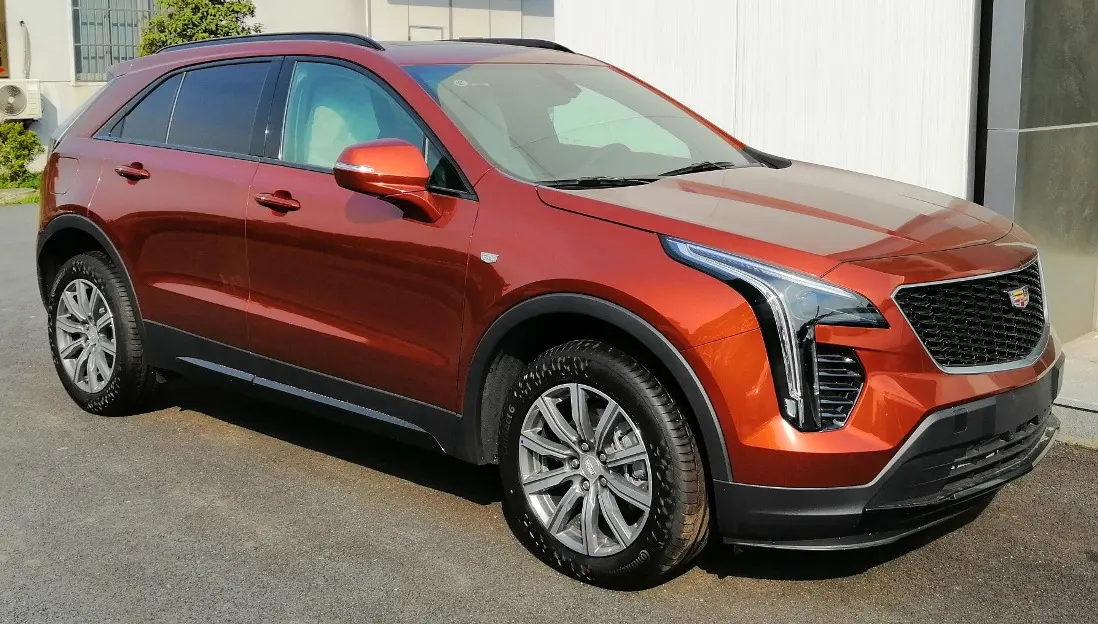
The official data lists 40 versions of the Cadillac XT4 (2019–2025), in the European Union, the United Kingdom, the United States, and Canada. Each market publishes its own figures, measured on its own test procedure.
At a glance
Years in the data
2019–2025
Markets
European Union, United Kingdom, United States, Canada
Engines
2.0 L to 2.0 L
Power
128 kW (174 PS) to 230 kW (313 PS)
Fuels
Petrol, Diesel
Lowest consumption (United Kingdom)
6.4 L/100 km (WLTP)
Lowest consumption (European Union)
6.6 L/100 km (WLTP)
Lowest consumption (Canada)
8.9 L/100 km (5-cycle)
New registrations in the EU
1,630
What kind of SUV is the Cadillac XT4?
The XT4 is a compact luxury crossover SUV, bringing Cadillac’s styling and cabin features to a smaller format. Its first generation ran from 2019 to 2025 on the E2XX platform.
A 2024 update refreshed the interior with a wide display across the dashboard, while keeping the XT4’s compact crossover shape.
XT4 engines and power
The XT4 uses 2.0 L engines in the listed markets. EU figures include petrol and diesel versions, with outputs from 128 kW (174 PS) to 169 kW (230 PS). UK figures also include petrol and diesel and show outputs from 128 kW (174 PS) to 230 kW (313 PS). US and Canadian versions use 2.0 L petrol engines.
The model appears in EU registration figures from 2019 to 2024, UK figures from 2020 to 2025, and US and Canadian figures from 2019 to 2025.
How economical is the Cadillac XT4?
The lowest listed EU consumption is 6.6 L/100 km on WLTP; the UK figure is 6.4 L/100 km, also on WLTP. In the United States, the lowest listed figure is 9 L/100 km under EPA testing, with a best combined rating of 26 MPG. Canada’s lowest listed figure is 8.9 L/100 km on the NRCan 5-cycle test. WLTP, EPA and the Canadian 5-cycle procedure differ, so the figures are best compared within their own markets.
EU registration figures from 2019 to 2024 total 1,630. European versions include petrol and diesel options, while US and Canadian versions are petrol.
Questions and answers
When was the Cadillac XT4 sold?
The first generation ran from 2019 to 2025. EU registration figures cover 2019 to 2024; UK figures run from 2020 to 2025, and US and Canadian figures from 2019 to 2025.
What engines does the XT4 use?
The listed engine size is 2.0 L. EU and UK versions include petrol and diesel; US and Canadian versions are petrol.
What is the XT4’s official fuel consumption?
The lowest listed figures are 6.6 L/100 km in EU WLTP testing, 6.4 L/100 km in UK WLTP testing, 9 L/100 km under the US EPA procedure and 8.9 L/100 km on Canada’s 5-cycle test.
New cars registered in the EU (plus Norway and Iceland), from the European Environment Agency. Figures on the NEDC procedure until 2020 and on WLTP from 2021; versions are grouped by engine and power, with their number of registrations.
Years and version
Engine
Power
Fuel
Consumption (combined)
CO₂
EU registrations
2024
2.0 L
169 kW (230 PS)
Petrol
9.3 L/100 km WLTP
213 g/km
69
2024
2.0 L
128 kW (174 PS)
Diesel
6.7 L/100 km WLTP
174 g/km
20
2023
2.0 L
169 kW (230 PS)
Petrol
9.3 L/100 km WLTP
213 g/km
258
2023
2.0 L
128 kW (174 PS)
Diesel
6.7 L/100 km WLTP
176 g/km
63
2022
2.0 L
169 kW (230 PS)
Petrol
9.2 L/100 km WLTP
213 g/km
235
2022
2.0 L
128 kW (174 PS)
Diesel
6.8 L/100 km WLTP
177 g/km
233
2021
2.0 L
169 kW (230 PS)
Petrol
9.3 L/100 km WLTP
213 g/km
410
2021
2.0 L
128 kW (174 PS)
Diesel
6.6 L/100 km WLTP
175 g/km
176
2020
2.0 L
128 kW (174 PS)
Diesel
–
169 g/km
118
2019
2.0 L
171 kW (232 PS)
Petrol
–
177 g/km
34
2019
2.0 L
171 kW (232 PS)
Diesel
–
181 g/km
14
United Kingdom 9 versions
New cars on sale in the UK, from the Vehicle Certification Agency. NEDC figures until 2018 and WLTP figures after; years are the editions a version appeared in.
Years and version
Engine
Power
Fuel
Gearbox
Consumption (combined)
CO₂
2025350D AWD AT9
2.0 L
128 kW (174 PS)
Diesel
9-speed automatic
6.9 L/100 km WLTP
180 g/km
2025350D FWD AT9
2.0 L
128 kW (174 PS)
Diesel
9-speed automatic
6.4 L/100 km WLTP
167 g/km
2025350T AWD AT9
2.0 L
169 kW (230 PS)
Petrol
9-speed automatic
9.3 L/100 km WLTP
213 g/km
2024350D FWD AT9
2.0 L
174 kW (237 PS)
Diesel
9-speed automatic
6.4 L/100 km WLTP
167 g/km
2024350D AWD AT9
2.0 L
174 kW (237 PS)
Diesel
9-speed automatic
6.9 L/100 km WLTP
180 g/km
2024350T AWD AT9
2.0 L
230 kW (313 PS)
Petrol
9-speed automatic
9.3 L/100 km WLTP
213 g/km
2020–2023350D AWD AT9
2.0 L
128 kW (174 PS)
Diesel
9-speed automatic
6.9 L/100 km WLTP
180 g/km
2020–2023350D FWD AT9
2.0 L
128 kW (174 PS)
Diesel
9-speed automatic
6.4 L/100 km WLTP
167 g/km
2021–2023350T AWD AT9
2.0 L
169 kW (230 PS)
Petrol
9-speed automatic
9.3 L/100 km WLTP
213 g/km
United States 10 versions
Model years sold in the USA, from the EPA and the Department of Energy (fueleconomy.gov). MPG on the EPA test; litres per 100 km = 235.215 ÷ MPG.
Years and version
Engine
Fuel
Gearbox
Drive
Consumption (combined)
CO₂
2024–2025SIDI
2.0 L
Petrol
9-speed automatic
Front-wheel drive
26 MPG (9.0 L/100 km) EPA
213 g/km
2025SIDI
2.0 L
Petrol
9-speed automatic
All-wheel drive
25 MPG (9.4 L/100 km) EPA
222 g/km
2024SIDI
2.0 L
Petrol
9-speed automatic
All-wheel drive
25 MPG (9.4 L/100 km) EPA
224 g/km
2023SIDI
2.0 L
Petrol
9-speed automatic
Front-wheel drive
26 MPG (9.0 L/100 km) EPA
212 g/km
2023SIDI
2.0 L
Petrol
9-speed automatic
All-wheel drive
24 MPG (9.8 L/100 km) EPA
230 g/km
2022SIDI
2.0 L
Petrol
9-speed automatic
Front-wheel drive
26 MPG (9.0 L/100 km) EPA
212 g/km
2022SIDI
2.0 L
Petrol
9-speed automatic
All-wheel drive
24 MPG (9.8 L/100 km) EPA
226 g/km
2019–2021SIDI
2.0 L
Petrol
9-speed automatic
Front-wheel drive
26 MPG (9.0 L/100 km) EPA
209 g/km
2021SIDI
2.0 L
Petrol
9-speed automatic
All-wheel drive
24 MPG (9.8 L/100 km) EPA
229 g/km
2019–2020SIDI
2.0 L
Petrol
9-speed automatic
All-wheel drive
24 MPG (9.8 L/100 km) EPA
227 g/km
Canada 10 versions
Model years sold in Canada, from Natural Resources Canada fuel consumption ratings (5-cycle test).
Years and version
Engine
Fuel
Gearbox
Consumption (combined)
CO₂
2025Sport utility vehicle: Small
2.0 L
Petrol
9-speed automatic
9.5 L/100 km 5-cycle
222 g/km
2024Sport utility vehicle: Small
2.0 L
Petrol
9-speed automatic
9.1 L/100 km 5-cycle
214 g/km
2024Sport utility vehicle: Small
2.0 L
Petrol
9-speed automatic
9.5 L/100 km 5-cycle
224 g/km
2023Sport utility vehicle: Small
2.0 L
Petrol
9-speed automatic
9.1 L/100 km 5-cycle
214 g/km
2023Sport utility vehicle: Small
2.0 L
Petrol
9-speed automatic
9.7 L/100 km 5-cycle
228 g/km
2022Sport utility vehicle: Small
2.0 L
Petrol
9-speed automatic
9.0 L/100 km 5-cycle
211 g/km
2022Sport utility vehicle: Small
2.0 L
Petrol
9-speed automatic
9.7 L/100 km 5-cycle
225 g/km
2019–2021Sport utility vehicle: Small
2.0 L
Petrol
9-speed automatic
9.7 L/100 km 5-cycle
227 g/km
2021Sport utility vehicle: Small
2.0 L
Petrol
9-speed automatic
8.9 L/100 km 5-cycle
209 g/km
2019–2020Sport utility vehicle: Small
2.0 L
Petrol
9-speed automatic
8.9 L/100 km 5-cycle
209 g/km
Official figures are measured on standard test procedures and differ between markets. Your consumption depends on how, where and in what conditions you drive.