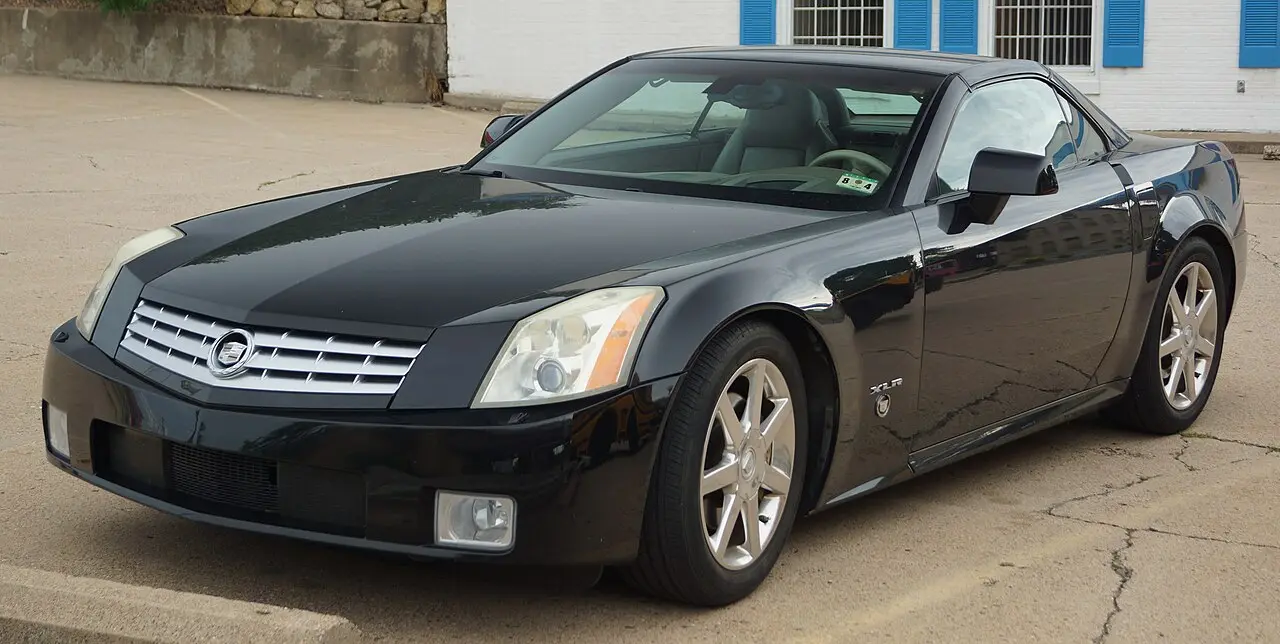
Cadillac

Cadillac XLR

Cadillac XLR
Photo: Greg Gjerdingen from Willmar, USA / Wikimedia Commons · CC BY 2.0

The official data lists 17 versions of the Cadillac XLR (2004–2009), in the United Kingdom, the United States, and Canada. Each market publishes its own figures, measured on its own test procedure.

At a glance

Years in the data
2004–2009
Markets
United Kingdom, United States, Canada
Engines
4.4 L to 4.6 L
Fuels
Petrol
Lowest consumption (United Kingdom)
12.3 L/100 km (NEDC)
Lowest consumption (Canada)
13.0 L/100 km (5-cycle)
Lowest consumption (United States)
13.1 L/100 km (EPA)

What is the Cadillac XLR?

The Cadillac XLR is a two-seat luxury roadster with rear-wheel drive and a powered hardtop that folds away. With the roof raised, it has the look of a coupe; lower it and the car becomes an open-top cruiser. Its angular styling brought Cadillac’s design language to a more personal, driver-focused car.

Cadillac made one generation, from 2004 to 2009. The range included the XLR-V, a more powerful version with a supercharged engine. The XLR paired the comfort of a grand tourer with the freedom of a convertible.

Engines and power

The XLR used petrol V8 engines, with sizes from 4.4 L to 4.6 L across the markets shown. The XLR-V had a supercharged engine.

How economical is the Cadillac XLR?

Official figures vary by market because each uses its own test procedure. In the United States, the EPA gives the XLR a best combined rating of 18 MPG, or a lowest listed consumption of 13.1 L/100 km. Canada’s NRCan 5-cycle figure is 13 L/100 km. In the United Kingdom, the VCA’s NEDC figure is 12.3 L/100 km. NEDC, EPA and Canada’s 5-cycle results are not direct like-for-like comparisons.

Where was it sold?

Official figures cover the United States and Canada from 2004 to 2009, and the United Kingdom from 2006 to 2007. The XLR’s first generation ended in 2009.

Questions and answers

Was the Cadillac XLR a convertible?

Yes. It was a two-seat roadster with a powered retractable hardtop.

What engine did the XLR have?

It used petrol V8 engines from 4.4 L to 4.6 L. The XLR-V had a supercharged engine.

What is the XLR’s best official fuel economy figure?

The lowest listed consumption is 12.3 L/100 km under the UK VCA’s NEDC procedure. The best U.S. EPA combined rating is 18 MPG.

XLR First generation (2004–2009)

Cadillac XLR First generation
Photo: Greg Gjerdingen from Willmar, USA / Wikimedia Commons · CC BY 2.0

Model codes: GMX215 · References: en.wikipedia.org, cars.com

United Kingdom 5 versions

New cars on sale in the UK, from the Vehicle Certification Agency. NEDC figures until 2018 and WLTP figures after; years are the editions a version appeared in.

Years and versionEngineFuelGearboxConsumption (combined)CO₂
2006–20074.4 - V8 AUT4.4 LPetrol6-speed automatic14.9 L/100 km NEDC354 g/km
20074.4 - V8 AUT4.4 LPetrol6-speed automatic14.3 L/100 km NEDC339 g/km
2006–20074.6 - V8 AUT · 4.6 - V8 AUT (06MY)4.6 LPetrol5-speed automatic12.5 L/100 km NEDC297 g/km
2006–20074.6 - V8 AUT4.6 LPetrol5-speed automatic12.3 L/100 km NEDC291 g/km
20074.6 - V8 AUT4.6 LPetrol6-speed automatic12.8 L/100 km NEDC305 g/km

United States 5 versions

Model years sold in the USA, from the EPA and the Department of Energy (fueleconomy.gov). MPG on the EPA test; litres per 100 km = 235.215 ÷ MPG.

Years and versionEngineFuelGearboxDriveConsumption (combined)CO₂
2009CLKUP4.4 LPetrol6-speed automaticRear-wheel drive17 MPG (13.8 L/100 km) EPA325 g/km
2007–20093MODE CLKUP · CLKUP4.6 LPetrol6-speed automaticRear-wheel drive18 MPG (13.1 L/100 km) EPA307 g/km
20082MODE CLKUP4.4 LPetrol6-speed automaticRear-wheel drive16 MPG (14.7 L/100 km) EPA345 g/km
2006–20072MODE CLKUP · 3MODE CLKUP4.4 LPetrol6-speed automaticRear-wheel drive16 MPG (14.7 L/100 km) EPA345 g/km
2004–2006CLKUP · 2MODE CLKUP4.6 LPetrol5-speed automaticRear-wheel drive18 MPG (13.1 L/100 km) EPA307 g/km

Canada 7 versions

Model years sold in Canada, from Natural Resources Canada fuel consumption ratings (5-cycle test).

Years and versionEngineFuelGearboxConsumption (combined)CO₂
2009Two-seater4.4 LPetrol6-speed automatic14.0 L/100 km 5-cycle322 g/km
2007–2009Two-seater4.6 LPetrol6-speed automatic13.0 L/100 km 5-cycle299 g/km
2008Two-seater4.4 LPetrol6-speed automatic14.7 L/100 km 5-cycle338 g/km
2007Two-seater4.4 LPetrol6-speed automatic14.9 L/100 km 5-cycle343 g/km
2006Two-seater4.6 LPetrol5-speed automatic13.2 L/100 km 5-cycle304 g/km
2005Two-seater4.6 LPetrol5-speed automatic13.3 L/100 km 5-cycle306 g/km
2004Two-seater4.6 LPetrol5-speed automatic13.3 L/100 km 5-cycle306 g/km

Official figures are measured on standard test procedures and differ between markets. Your consumption depends on how, where and in what conditions you drive.