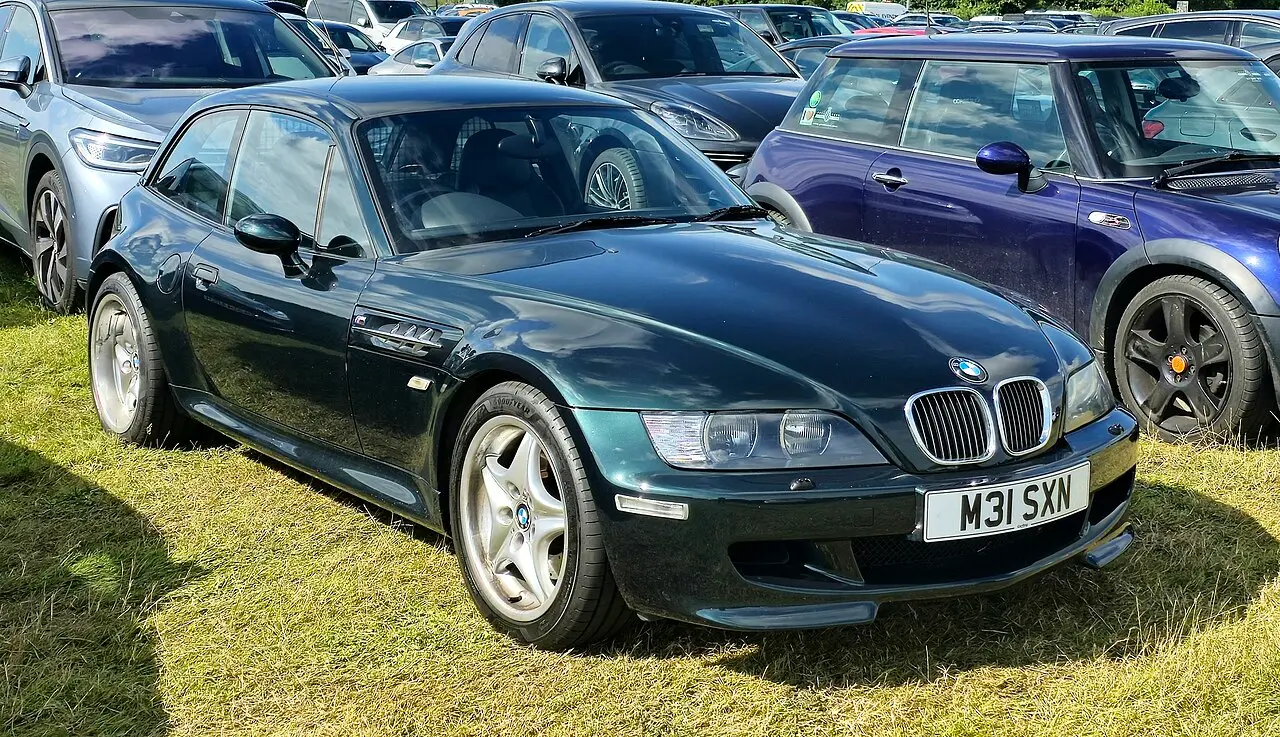
The official data lists 32 versions of the BMW Z3 (1996–2002), in the United States and Canada. Each market publishes its own figures, measured on its own test procedure.
At a glance
Years in the data
1996–2002
Markets
United States, Canada
Engines
1.9 L to 3.0 L
Fuels
Petrol
Lowest consumption (United States)
9.8 L/100 km (EPA)
Lowest consumption (Canada)
10.0 L/100 km (5-cycle)
What is the BMW Z3?
The Z3 is a compact two-seat BMW sports car, best known as a soft-top roadster. A coupé also joined the range. Its long bonnet, short rear and open cabin give it the classic roadster shape.
Generation and engines
The Z3’s first and only generation ran from 1996 to 2002. BMW’s internal codes for the roadster and coupé are E36/7 and E36/8. BMW Group Classic describes the roadster as based on the 3 Series of its era, and notes that the coupé joined the range in 1998. The listed US and Canadian versions use petrol engines from 1.9 to 3.0 litres.
Fuel consumption and markets
US EPA figures list consumption as low as 9.8 L/100 km, with a combined rating of 24 MPG. Canada’s 5-cycle figure is 10 L/100 km. The tests use different procedures, so each result is best understood within its market. The US and Canadian figures cover 1996–2002; the Z3 generation also appears in EU, UK and French market listings.
Questions and answers
Was the BMW Z3 a roadster or a coupé?
It was best known as a two-seat soft-top roadster, and a coupé version also joined the range.
When was the Z3 generation sold?
Its first and only generation ran from 1996 to 2002.
What engines are listed for the Z3?
The US and Canadian versions use petrol engines from 1.9 to 3.0 litres.
How economical is the BMW Z3?
The lowest listed figure is 9.8 L/100 km under the EPA, with a 24 MPG combined rating; Canada’s 5-cycle figure is 10 L/100 km.
Model codes: E36/7, E36/8 · Sold in: United States, Canada, European Union, United Kingdom, and France · References: en.wikipedia.org
United States 16 versions
Model years sold in the USA, from the EPA and the Department of Energy (fueleconomy.gov). MPG on the EPA test; litres per 100 km = 235.215 ÷ MPG.
Years and version
Engine
Fuel
Gearbox
Drive
Consumption (combined)
CO₂
2001–20023MODE
2.5 L
Petrol
5-speed automatic
Rear-wheel drive
20 MPG (11.8 L/100 km) EPA
276 g/km
2001–2002
2.5 L
Petrol
5-speed manual
Rear-wheel drive
20 MPG (11.8 L/100 km) EPA
276 g/km
2001–2002
3.0 L
Petrol
5-speed manual
Rear-wheel drive
21 MPG (11.2 L/100 km) EPA
263 g/km
2001–20023MODE
3.0 L
Petrol
5-speed automatic
Rear-wheel drive
20 MPG (11.8 L/100 km) EPA
276 g/km
2001–20023MODE
3.0 L
Petrol
5-speed automatic
Rear-wheel drive
19 MPG (12.4 L/100 km) EPA
291 g/km
1999–2000
2.5 L
Petrol
4-speed automatic
Rear-wheel drive
19 MPG (12.4 L/100 km) EPA
291 g/km
1999–2000
2.5 L
Petrol
5-speed manual
Rear-wheel drive
20 MPG (11.8 L/100 km) EPA
276 g/km
1998–2000FFS
2.8 L
Petrol
5-speed manual
Rear-wheel drive
19 MPG (12.4 L/100 km) EPA
291 g/km
1999–2000
2.8 L
Petrol
4-speed automatic
Rear-wheel drive
19 MPG (12.4 L/100 km) EPA
291 g/km
1997–1998(FFS)
1.9 L
Petrol
4-speed automatic
Rear-wheel drive
23 MPG (10.2 L/100 km) EPA
240 g/km
1997–1998(FFS)
1.9 L
Petrol
5-speed manual
Rear-wheel drive
24 MPG (9.8 L/100 km) EPA
230 g/km
1998
2.8 L
Petrol
4-speed automatic
Rear-wheel drive
18 MPG (13.1 L/100 km) EPA
307 g/km
1996–1997(FFS)
1.9 L
Petrol
4-speed automatic
Rear-wheel drive
23 MPG (10.2 L/100 km) EPA
240 g/km
1996–1997(FFS)
1.9 L
Petrol
5-speed manual
Rear-wheel drive
23 MPG (10.2 L/100 km) EPA
240 g/km
1997(FFS)
2.8 L
Petrol
4-speed automatic
Rear-wheel drive
19 MPG (12.4 L/100 km) EPA
291 g/km
1997(FFS)
2.8 L
Petrol
5-speed manual
Rear-wheel drive
20 MPG (11.8 L/100 km) EPA
276 g/km
Canada 16 versions
Model years sold in Canada, from Natural Resources Canada fuel consumption ratings (5-cycle test).
Years and version
Engine
Fuel
Gearbox
Consumption (combined)
CO₂
2001–2002Two-seater
2.5 L
Petrol
5-speed manual
11.5 L/100 km 5-cycle
265 g/km
2002Two-seater
2.5 L
Petrol
5-speed automatic
11.6 L/100 km 5-cycle
267 g/km
2001–2002Two-seater
3.0 L
Petrol
5-speed automatic
11.9 L/100 km 5-cycle
274 g/km
2001–2002Two-seater
3.0 L
Petrol
5-speed manual
11.0 L/100 km 5-cycle
253 g/km
2001Two-seater
2.5 L
Petrol
4-speed automatic
11.6 L/100 km 5-cycle
267 g/km
1999–2000Two-seater · Subcompact
2.5 L
Petrol
4-speed automatic
12.1 L/100 km 5-cycle
278 g/km
1999–2000Two-seater · Subcompact
2.5 L
Petrol
5-speed manual
11.6 L/100 km 5-cycle
267 g/km
1999–2000Two-seater · Subcompact
2.8 L
Petrol
4-speed automatic
12.1 L/100 km 5-cycle
278 g/km
1999–2000Two-seater · Subcompact
2.8 L
Petrol
5-speed manual
12.1 L/100 km 5-cycle
278 g/km
1996–1998Two-seater
1.9 L
Petrol
4-speed automatic
10.2 L/100 km 5-cycle
235 g/km
1997–1998Two-seater
1.9 L
Petrol
5-speed manual
10.0 L/100 km 5-cycle
230 g/km
1998Two-seater
2.8 L
Petrol
4-speed automatic
12.7 L/100 km 5-cycle
292 g/km
1998Two-seater
2.8 L
Petrol
5-speed manual
12.3 L/100 km 5-cycle
283 g/km
1997Two-seater
2.8 L
Petrol
4-speed automatic
12.5 L/100 km 5-cycle
288 g/km
1997Two-seater
2.8 L
Petrol
5-speed manual
12.2 L/100 km 5-cycle
281 g/km
1996Two-seater
1.9 L
Petrol
5-speed manual
10.1 L/100 km 5-cycle
232 g/km
Official figures are measured on standard test procedures and differ between markets. Your consumption depends on how, where and in what conditions you drive.