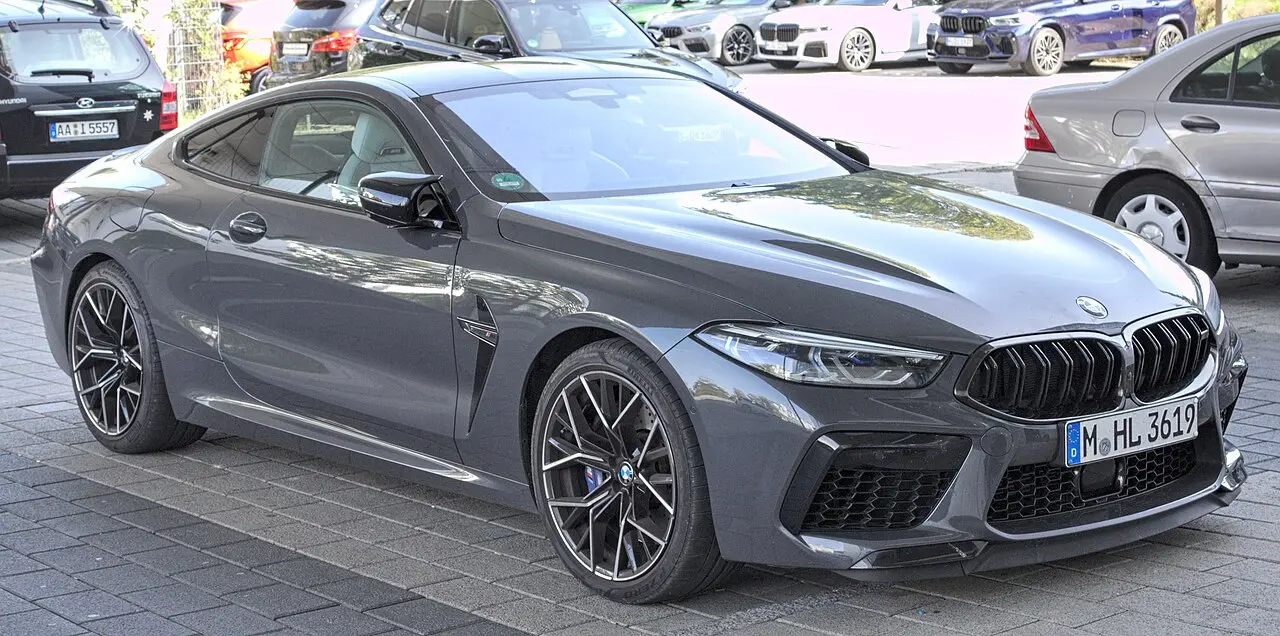
The official data lists 28 versions of the BMW M8 (2019–2026), in the European Union, the United Kingdom, France, the United States, and Canada. Each market publishes its own figures, measured on its own test procedure.
At a glance
Years in the data
2019–2026
Markets
European Union, United Kingdom, France, United States, Canada
Engines
4.4 L to 4.4 L
Power
441 kW (600 PS) to 460 kW (625 PS)
Fuels
Petrol
Lowest consumption (France)
11.0 L/100 km (WLTP)
Lowest consumption (European Union)
11.0 L/100 km (WLTP)
Lowest consumption (United Kingdom)
11.3 L/100 km (WLTP)
New registrations in the EU
6,860
What is the BMW M8?
The M8 is BMW M’s high-performance version of the 8 Series grand tourer. The range includes a coupé, a convertible and a four-door Gran Coupé, combining a long-distance touring character with performance-focused engineering.
Generations and engines
The first M8 generation, F91, has been built since 2019. BMW used the related F92 and F93 codes for the coupé and Gran Coupé body styles. Every listed version has a 4.4-litre petrol engine. EU figures span outputs from 441 kW (600 PS) to 460 kW (625 PS); UK and French figures list 460 kW (625 PS).
Fuel consumption and markets
The lowest listed EU consumption is 11 L/100 km on the WLTP test. France lists the same figure, while the UK figure is 11.3 L/100 km WLTP. In the United States, the EPA rating is 13.8 L/100 km, or 17 MPG combined; Canada’s 5-cycle rating is 13.7 L/100 km. Test procedures differ: Europe uses WLTP or, for some older results, NEDC; the United States uses EPA testing, and Canada uses a 5-cycle test. EU registration figures record 6,860 M8s from 2019 to 2025. The model is also listed in UK and French figures for 2025–2026, and US and Canadian figures for 2020–2025.
Questions and answers
What engine does the BMW M8 use?
The listed M8 versions use a 4.4-litre petrol engine. EU outputs range from 441 kW (600 PS) to 460 kW (625 PS).
How much fuel does the M8 use?
The lowest listed figures are 11 L/100 km WLTP in the EU and France, 11.3 L/100 km WLTP in the UK, 13.8 L/100 km under the EPA, and 13.7 L/100 km under Canada’s 5-cycle test.
Which M8 body styles are there?
The range includes a coupé, convertible and four-door Gran Coupé.
When was the first M8 generation sold?
The first generation has been built since 2019. Its related body codes are F91, F92 and F93.
New cars registered in the EU (plus Norway and Iceland), from the European Environment Agency. Figures on the NEDC procedure until 2020 and on WLTP from 2021; versions are grouped by engine and power, with their number of registrations.
Years and version
Engine
Power
Fuel
Consumption (combined)
CO₂
EU registrations
2025
4.4 L
460 kW (625 PS)
Petrol
11.4 L/100 km WLTP
262 g/km
290
2024
4.4 L
460 kW (625 PS)
Petrol
11.3 L/100 km WLTP
260 g/km
443
2023
4.4 L
460 kW (625 PS)
Petrol
11.4 L/100 km WLTP
261 g/km
603
2023
4.4 L
441 kW (600 PS)
Petrol
11.4 L/100 km WLTP
263 g/km
11
2022
4.4 L
460 kW (625 PS)
Petrol
11.4 L/100 km WLTP
260 g/km
580
2022
4.4 L
441 kW (600 PS)
Petrol
11.3 L/100 km WLTP
261 g/km
23
2021
4.4 L
460 kW (625 PS)
Petrol
11.0 L/100 km WLTP
260 g/km
1,537
2021
4.4 L
441 kW (600 PS)
Petrol
11.1 L/100 km WLTP
259 g/km
77
2020
4.4 L
460 kW (625 PS)
Petrol
–
245 g/km
2,333
2020
4.4 L
441 kW (600 PS)
Petrol
–
245 g/km
113
2019
4.4 L
460 kW (625 PS)
Petrol
13.1 kWh/100 km NEDC
244 g/km
850
United Kingdom 4 versions
New cars on sale in the UK, from the Vehicle Certification Agency. NEDC figures until 2018 and WLTP figures after; years are the editions a version appeared in.
Years and version
Engine
Power
Fuel
Gearbox
Consumption (combined)
CO₂
2025–2026M8 Competition Convertible · F93 M8 Competition Gran Coupé
4.4 L
460 kW (625 PS)
Petrol
8-speed automatic
11.6 L/100 km WLTP
261 g/km
2025–2026M8 Competition Convertible · F93 M8 Competition Gran Coupé
4.4 L
460 kW (625 PS)
Petrol
8-speed automatic
11.4 L/100 km WLTP
264 g/km
2025–2026F92 M8 Competition Coupé
4.4 L
460 kW (625 PS)
Petrol
8-speed automatic
11.4 L/100 km WLTP
257 g/km
2025–2026F92 M8 Competition Coupé
4.4 L
460 kW (625 PS)
Petrol
8-speed automatic
11.3 L/100 km WLTP
260 g/km
France 3 versions
New cars on sale in France, from ADEME Car Labelling. NEDC figures until 2015, WLTP figures in the current catalogue.
Model years sold in the USA, from the EPA and the Department of Energy (fueleconomy.gov). MPG on the EPA test; litres per 100 km = 235.215 ÷ MPG.
Years and version
Engine
Fuel
Gearbox
Drive
Consumption (combined)
CO₂
2023–2025SIDI
4.4 L
Petrol
8-speed automatic
All-wheel drive
17 MPG (13.8 L/100 km) EPA
321 g/km
2022SIDI
4.4 L
Petrol
8-speed automatic
All-wheel drive
17 MPG (13.8 L/100 km) EPA
324 g/km
2021SIDI
4.4 L
Petrol
8-speed automatic
All-wheel drive
17 MPG (13.8 L/100 km) EPA
323 g/km
2020SIDI
4.4 L
Petrol
8-speed automatic
All-wheel drive
17 MPG (13.8 L/100 km) EPA
322 g/km
Canada 6 versions
Model years sold in Canada, from Natural Resources Canada fuel consumption ratings (5-cycle test).
Years and version
Engine
Fuel
Gearbox
Consumption (combined)
CO₂
2025Subcompact · Mid-size
4.4 L
Petrol
8-speed automatic
13.8 L/100 km 5-cycle
321 g/km
2024Subcompact · Mid-size
4.4 L
Petrol
8-speed automatic
13.7 L/100 km 5-cycle
321 g/km
2023Subcompact · Mid-size
4.4 L
Petrol
8-speed automatic
13.7 L/100 km 5-cycle
321 g/km
2022Subcompact · Mid-size
4.4 L
Petrol
8-speed automatic
13.8 L/100 km 5-cycle
322 g/km
2021Subcompact · Mid-size
4.4 L
Petrol
8-speed automatic
13.8 L/100 km 5-cycle
323 g/km
2020Subcompact · Mid-size
4.4 L
Petrol
8-speed automatic
13.8 L/100 km 5-cycle
322 g/km
Official figures are measured on standard test procedures and differ between markets. Your consumption depends on how, where and in what conditions you drive.