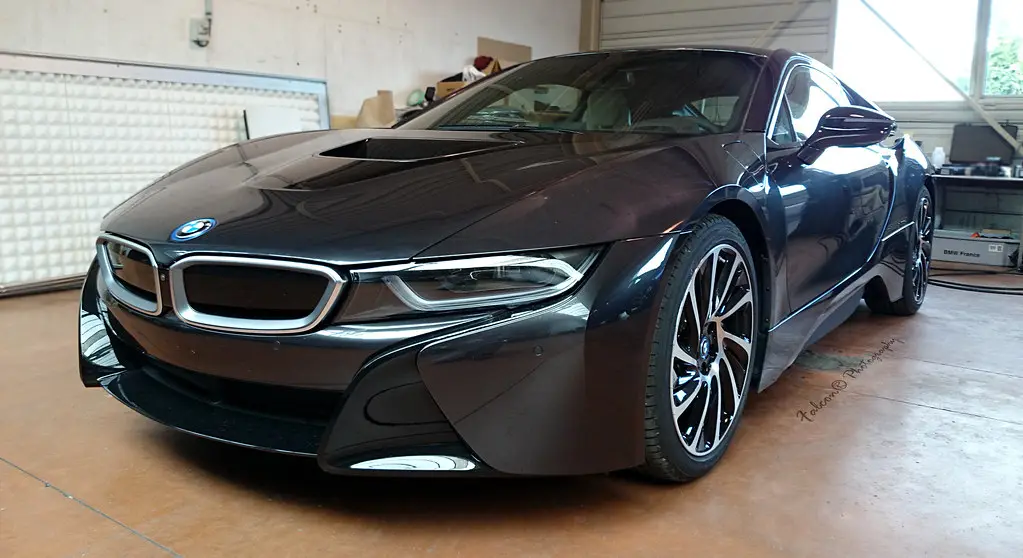
The official data lists 21 versions of the BMW i8 (2014–2021), in the European Union, the United States, and Canada. Each market publishes its own figures, measured on its own test procedure.
At a glance
Years in the data
2014–2021
Markets
European Union, United States, Canada
Engines
1.5 L to 1.5 L
Power
75 kW (102 PS) to 170 kW (231 PS)
Fuels
Plug-in hybrid, Hybrid, Petrol, Electric
Plug-in hybrid, weighted (European Union)
2.2 L/100 km (WLTP)
Plug-in hybrid, weighted (Canada)
8.3 L/100 km (5-cycle)
New registrations in the EU
15,562
What is the BMW i8?
The BMW i8 is a plug-in hybrid sports car offered as a coupé and an open-top roadster. It was part of BMW’s i sub-brand, which explored electric drive and new construction methods. Its concept paired electric driving with a compact petrol engine for longer journeys.
The i8’s first and only generation, codes I12 and I15, ran from 2014–2020. Its structure combined a carbon-fibre passenger cell with an aluminium drive module, a distinctive approach to lightweight construction.
Engines and power
The i8 pairs a 1.5 L petrol engine with electric drive. EU registration figures list outputs from 75 kW (102 PS) to 170 kW (231 PS); the leading EU versions were 170 kW (231 PS) hybrids. US and Canadian figures also cover 1.5 L plug-in hybrids.
The i8 can use electric power for some driving, with its petrol engine available for longer journeys.
How economical is the BMW i8?
The lowest listed EU plug-in hybrid figure is 2.2 L/100 km on the WLTP test. This weighted figure assumes part of the driving is electric, so it reflects a mix of electric and petrol use.
The lowest listed figure is 8.4 L/100 km in the USA under EPA testing and 8.3 L/100 km in Canada under the 5-cycle procedure. These results use different test procedures: WLTP in Europe, EPA in the USA and 5-cycle testing in Canada.
Where was the BMW i8 sold?
The i8 appears in official figures for the EU, USA and Canada. EU registration figures span 2014–2021 and record 15,562 cars. US figures span 2014–2020, and Canadian figures span 2015–2020. The model was offered as both a coupé and an open-top roadster.
Questions and answers
Was the BMW i8 fully electric?
No. It was a plug-in hybrid with a 1.5 L petrol engine and electric drive.
What is the BMW i8’s lowest official consumption figure?
The lowest listed figure is 2.2 L/100 km WLTP for an EU plug-in hybrid. The weighted value assumes some driving is electric.
What body styles did the BMW i8 have?
It was offered as a coupé and an open-top roadster.
What years did the BMW i8 generation run?
Its first and only generation, codes I12 and I15, ran from 2014–2020.
New cars registered in the EU (plus Norway and Iceland), from the European Environment Agency. Figures on the NEDC procedure until 2020 and on WLTP from 2021; versions are grouped by engine and power, with their number of registrations.
Years and version
Engine
Power
Fuel
Consumption (combined)
CO₂
Electric range
EU registrations
2020
1.5 L
170 kW (231 PS)
Plug-in hybrid
14.1 kWh/100 km NEDC
45 g/km
53 km
1,052
2019
1.5 L
170 kW (231 PS)
Plug-in hybrid
8.3 kWh/100 km NEDC
45 g/km
–
1,798
2019
1.5 L
75 kW (102 PS)
Plug-in hybrid
14.3 kWh/100 km NEDC
46 g/km
–
57
2018
1.5 L
170 kW (231 PS)
Hybrid
12.9 kWh/100 km NEDC
47 g/km
–
2,520
2018
1.5 L
75 kW (102 PS)
Hybrid
13.5 kWh/100 km NEDC
47 g/km
–
144
2018
1.5 L
170 kW (231 PS)
Petrol
11.9 kWh/100 km NEDC
74 g/km
–
16
2016–2017
1.5 L
170 kW (231 PS)
Hybrid
11.9 kWh/100 km NEDC
49 g/km
–
4,123
2016–2017
1.5 L
75 kW (102 PS)
Hybrid
11.9 kWh/100 km NEDC
49 g/km
–
75
2017
1.5 L
255 kW (347 PS)
Hybrid
–
49 g/km
–
14
2016
1.5 L
266 kW (362 PS)
Petrol
–
176 g/km
–
26
2015
1.5 L
170 kW (231 PS)
Hybrid
11.9 kWh/100 km NEDC
51 g/km
–
3,665
2015
1.5 L
170 kW (231 PS)
Other fuel
11.9 kWh/100 km NEDC
49 g/km
–
24
2014
1.5 L
170 kW (231 PS)
Hybrid
11.9 kWh/100 km NEDC
50 g/km
–
1,889
2014
Electric motor
–
Electric
–
0 g/km
–
27
2014
1.5 L
170 kW (231 PS)
Electric
11.9 kWh/100 km NEDC
49 g/km
–
27
United States 3 versions
Model years sold in the USA, from the EPA and the Department of Energy (fueleconomy.gov). MPG on the EPA test; litres per 100 km = 235.215 ÷ MPG.
Years and version
Engine
Fuel
Gearbox
Drive
Consumption (combined)
CO₂
2019–2020SIDI; PHEV
1.5 L
Plug-in hybrid
6-speed automatic
All-wheel drive
27 MPG (8.7 L/100 km) EPA
119 g/km
2017SIDI; PHEV
1.5 L
Plug-in hybrid
6-speed automatic
All-wheel drive
28 MPG (8.4 L/100 km) EPA
124 g/km
2014–2016SIDI; PHEV
1.5 L
Plug-in hybrid
6-speed automatic
All-wheel drive
28 MPG (8.4 L/100 km) EPA
123 g/km
Canada 2 versions
Model years sold in Canada, from Natural Resources Canada fuel consumption ratings (5-cycle test).
Years and version
Engine
Fuel
Gearbox
Consumption (combined)
CO₂
Electric range
2019–2020Subcompact · Two-seater
1.5 L
Plug-in hybrid
6-speed automatic
8.7 L/100 km 5-cycle
118 g/km
29 km
2015–2017Subcompact
1.5 L
Plug-in hybrid
6-speed automatic
8.3 L/100 km 5-cycle
123 g/km
24 km
Versions outside these generations
European Union 1 version
New cars registered in the EU (plus Norway and Iceland), from the European Environment Agency. Figures on the NEDC procedure until 2020 and on WLTP from 2021; versions are grouped by engine and power, with their number of registrations.
Years and version
Engine
Power
Fuel
Consumption (combined)
CO₂
Electric range
EU registrations
2021
1.5 L
170 kW (231 PS)
Plug-in hybrid
2.2 L/100 km WLTP14.0 kWh/100 km WLTP
51 g/km
51 km
105
Official figures are measured on standard test procedures and differ between markets. Your consumption depends on how, where and in what conditions you drive.