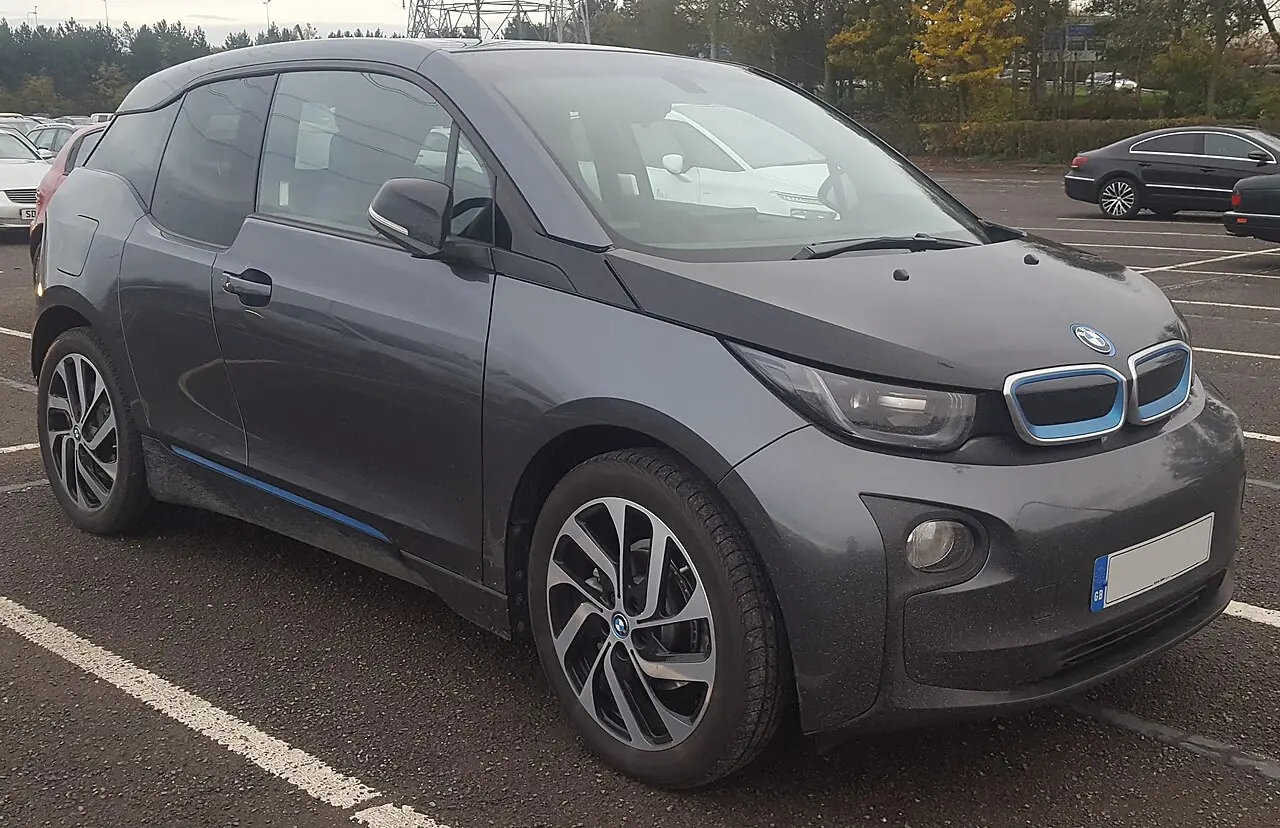
The official data lists 93 versions of the BMW i3 (2013–2025), in the European Union, France, the United States, and Canada. Each market publishes its own figures, measured on its own test procedure.
At a glance
Years in the data
2013–2025
Markets
European Union, France, United States, Canada
Engines
0.6 L to 1.5 L
Power
25 kW (34 PS) to 170 kW (231 PS)
Fuels
Electric, Plug-in hybrid, Hybrid, Petrol
Plug-in hybrid, weighted (France)
0.6 L/100 km (NEDC)
Plug-in hybrid, weighted (United States)
6.0 L/100 km (EPA)
New registrations in the EU
281,753
What is the BMW i3?
The BMW i3 is a compact city car with an upright shape and a cabin designed around electric driving. Rather than adapting a petrol model, BMW gave it a dedicated electric-car architecture.
The i3’s passenger cell used carbon-fibre-reinforced plastic, joined to an aluminium structure carrying the powertrain, chassis and battery. Alongside battery-electric versions, some markets also offered a plug-in hybrid with a small petrol engine that extended its driving range.
BMW i3 generation
The i3 had one generation, I01, which ran from 2014 to 2022. BMW updated its electric system and model range during that time while keeping its compact, upright format. The car was built at BMW’s Leipzig plant.
Engines and power
The i3 was offered as a battery-electric car, with a plug-in hybrid range-extender version in some markets. EU registration figures from 2013 to 2025 classify versions across electric, plug-in hybrid and other fuel types, with power from 25 kW (34 PS) to 170 kW (231 PS). The most registered EU entries were electric versions rated at 75 kW (102 PS).
The range varied by market. US and Canadian figures include electric and plug-in hybrid versions. Canadian listed power spans 125 kW (170 PS) to 135 kW (184 PS).
Energy use and emissions
For plug-in hybrid versions, France lists a weighted consumption figure of 0.6 L/100 km on NEDC. The US EPA figure is 6 L/100 km, and Canada’s 5-cycle figure is also 6 L/100 km. These weighted figures assume some driving is electric.
Test procedures differ: France’s result uses NEDC, the US uses EPA, and Canada uses its 5-cycle test. EU registrations total 281,753 i3s across the period shown.
Where was the BMW i3 sold?
Figures are available for the EU, France, the United States and Canada. Its dedicated electric design and production at BMW’s Leipzig plant made the i3 a distinctive part of the range.
Questions and answers
When was the BMW i3 sold?
Its I01 generation ran from 2014 to 2022. EU registration figures extend from 2013 to 2025.
Was the BMW i3 fully electric?
It was offered as a battery-electric car, and some markets also had a plug-in hybrid range-extender version.
What is the lowest listed plug-in hybrid consumption?
France lists 0.6 L/100 km on NEDC. The US and Canada each list 6 L/100 km using their respective procedures.
Model codes: I01 · Sold in: United States, Canada, European Union, and France · References: bmwusa.com, press.bmwgroup.com
European Union 61 versions
New cars registered in the EU (plus Norway and Iceland), from the European Environment Agency. Figures on the NEDC procedure until 2020 and on WLTP from 2021; versions are grouped by engine and power, with their number of registrations.
Years and version
Engine
Power
Fuel
Consumption (combined)
CO₂
Electric range
EU registrations
2022
Electric motor
125 kW (170 PS)
Electric
15.1 kWh/100 km WLTP
0 g/km
326 km
6,844
2022
Electric motor
135 kW (184 PS)
Electric
15.6 kWh/100 km WLTP
0 g/km
330 km
6,493
2022
Electric motor
75 kW (102 PS)
Electric
15.6 kWh/100 km WLTP
0 g/km
295 km
2,896
2021
Electric motor
75 kW (102 PS)
Electric
15.0 kWh/100 km WLTP
0 g/km
320 km
36,426
2021
Electric motor
125 kW (170 PS)
Electric
15.8 kWh/100 km WLTP
0 g/km
298 km
3,386
2021
Electric motor
135 kW (184 PS)
Electric
16.4 kWh/100 km WLTP
0 g/km
285 km
1,267
2021
Electric motor
90 kW (122 PS)
Electric
–
0 g/km
–
38
2020
Electric motor
75 kW (102 PS)
Electric
13.6 kWh/100 km NEDC
0 g/km
335 km
39,342
2020
Electric motor
125 kW (170 PS)
Electric
14.5 kWh/100 km NEDC
0 g/km
301 km
3,780
2020
Electric motor
135 kW (184 PS)
Electric
15.6 kWh/100 km NEDC
0 g/km
282 km
1,450
2020
0.6 L
28 kW (38 PS)
Plug-in hybrid
14.0 kWh/100 km NEDC
13 g/km
198 km
66
2020
1.5 L
170 kW (231 PS)
Plug-in hybrid
14.0 kWh/100 km NEDC
44 g/km
52 km
32
2020
Electric motor
221 kW (300 PS)
Electric
–
0 g/km
–
14
2019
Electric motor
75 kW (102 PS)
Electric
13.9 kWh/100 km NEDC
0 g/km
–
51,018
2019
Electric motor
125 kW (170 PS)
Electric
13.5 kWh/100 km NEDC
0 g/km
–
7,610
2019
Electric motor
135 kW (184 PS)
Electric
15.1 kWh/100 km NEDC
0 g/km
–
2,574
2019
0.6 L
75 kW (102 PS)
Plug-in hybrid
6.0 kWh/100 km NEDC
13 g/km
–
1,008
2019
0.6 L
–
Plug-in hybrid
13.8 kWh/100 km NEDC
13 g/km
–
249
2019
0.6 L
28 kW (38 PS)
Plug-in hybrid
13.2 kWh/100 km NEDC
13 g/km
–
164
2019
1.5 L
170 kW (231 PS)
Plug-in hybrid
13.4 kWh/100 km NEDC
46 g/km
–
19
2018
Electric motor
75 kW (102 PS)
Electric
13.9 kWh/100 km NEDC
0 g/km
–
18,629
2018
0.6 L
–
Hybrid
11.8 kWh/100 km NEDC
14 g/km
–
4,288
2018
Electric motor
125 kW (170 PS)
Electric
14.0 kWh/100 km NEDC
0 g/km
–
3,520
2018
0.6 L
75 kW (102 PS)
Hybrid
11.9 kWh/100 km NEDC
15 g/km
–
3,446
2018
0.6 L
28 kW (38 PS)
Hybrid
11.9 kWh/100 km NEDC
13 g/km
–
2,440
2018
Electric motor
135 kW (184 PS)
Electric
15.4 kWh/100 km NEDC
0 g/km
–
1,591
2018
0.6 L
125 kW (170 PS)
Hybrid
11.7 kWh/100 km NEDC
15 g/km
–
646
2018
0.6 L
135 kW (184 PS)
Hybrid
12.5 kWh/100 km NEDC
15 g/km
–
388
2018
1.5 L
170 kW (231 PS)
Hybrid
11.9 kWh/100 km NEDC
46 g/km
–
110
2018
–
125 kW (170 PS)
Other fuel
13.8 kWh/100 km NEDC
93 g/km
–
42
2018
Electric motor
28 kW (38 PS)
Electric
11.9 kWh/100 km NEDC
0 g/km
–
26
2018
0.6 L
115 kW (156 PS)
Hybrid
11.5 kWh/100 km NEDC
13 g/km
–
18
2018
0.6 L
28 kW (38 PS)
Petrol
–
14 g/km
–
14
2018
0.6 L
113 kW (154 PS)
Hybrid
11.3 kWh/100 km NEDC
12 g/km
–
12
2018
–
135 kW (184 PS)
Other fuel
14.1 kWh/100 km NEDC
72 g/km
–
11
2017
Electric motor
75 kW (102 PS)
Electric
12.8 kWh/100 km NEDC
0 g/km
–
14,326
2017
0.6 L
75 kW (102 PS)
Hybrid
11.5 kWh/100 km NEDC
12 g/km
–
9,294
2017
Electric motor
125 kW (170 PS)
Electric
12.7 kWh/100 km NEDC
0 g/km
–
2,536
2017
0.6 L
28 kW (38 PS)
Hybrid
11.4 kWh/100 km NEDC
12 g/km
–
2,322
2017
0.6 L
125 kW (170 PS)
Hybrid
11.5 kWh/100 km NEDC
14 g/km
–
818
2014–2017
1.5 L
170 kW (231 PS)
Hybrid
11.9 kWh/100 km NEDC
49 g/km
–
453
2017
0.6 L
–
Hybrid
11.5 kWh/100 km NEDC
14 g/km
–
250
2017
0.6 L
188 kW (256 PS)
Hybrid
13.4 kWh/100 km NEDC
12 g/km
–
76
2017
Electric motor
135 kW (184 PS)
Electric
14.3 kWh/100 km NEDC
0 g/km
–
36
2017
0.6 L
135 kW (184 PS)
Hybrid
12.5 kWh/100 km NEDC
14 g/km
–
18
2016
Electric motor
75 kW (102 PS)
Electric
12.9 kWh/100 km NEDC
0 g/km
–
9,442
2016
0.6 L
75 kW (102 PS)
Hybrid
11.5 kWh/100 km NEDC
15 g/km
–
9,292
2016
0.6 L
28 kW (38 PS)
Hybrid
11.5 kWh/100 km NEDC
13 g/km
–
1,408
2016
Electric motor
125 kW (170 PS)
Electric
12.9 kWh/100 km NEDC
0 g/km
–
665
2016
0.6 L
125 kW (170 PS)
Hybrid
11.6 kWh/100 km NEDC
13 g/km
–
97
2015
0.6 L
75 kW (102 PS)
Hybrid
11.5 kWh/100 km NEDC
16 g/km
–
8,853
2015
Electric motor
75 kW (102 PS)
Electric
12.9 kWh/100 km NEDC
0 g/km
–
6,693
2015
0.6 L
28 kW (38 PS)
Hybrid
11.5 kWh/100 km NEDC
13 g/km
–
634
2014–2015
Electric motor
125 kW (170 PS)
Electric
12.9 kWh/100 km NEDC
0 g/km
–
249
2014–2015
0.6 L
25 kW (34 PS)
Hybrid
11.5 kWh/100 km NEDC
13 g/km
–
139
2015
0.6 L
125 kW (170 PS)
Hybrid
–
13 g/km
–
36
2015
0.6 L
125 kW (170 PS)
Other fuel
–
13 g/km
–
30
2014
Electric motor
75 kW (102 PS)
Electric
12.9 kWh/100 km NEDC
0 g/km
–
5,940
2014
0.6 L
75 kW (102 PS)
Hybrid
11.5 kWh/100 km NEDC
12 g/km
–
5,632
2014
0.6 L
28 kW (38 PS)
Hybrid
11.5 kWh/100 km NEDC
14 g/km
–
426
2014
Electric motor
78 kW (106 PS)
Electric
12.9 kWh/100 km NEDC
0 g/km
–
35
France 5 versions
New cars on sale in France, from ADEME Car Labelling. NEDC figures until 2015, WLTP figures in the current catalogue.
Years and version
Engine
Power
Fuel
Gearbox
Consumption (combined)
CO₂
2015i3
Electric motor
–
Electric
Continuously variable (CVT)
–
–
2015i3 avec Prolongateur d'autonomie
–
28 kW (38 PS)
Plug-in hybrid
Continuously variable (CVT)
0.6 L/100 km NEDC
13 g/km
2015i8
–
170 kW (231 PS)
Plug-in hybrid
6-speed automatic
2.1 L/100 km NEDC
49 g/km
2014i3 avec Prolongateur d'autonomie
–
28 kW (38 PS)
Plug-in hybrid
Continuously variable (CVT)
0.6 L/100 km NEDC
13 g/km
2014i3
Electric motor
75 kW (102 PS)
Electric
Continuously variable (CVT)
–
–
United States 8 versions
Model years sold in the USA, from the EPA and the Department of Energy (fueleconomy.gov). MPG on the EPA test; litres per 100 km = 235.215 ÷ MPG.
Years and version
Engine
Fuel
Gearbox
Drive
Consumption (combined)
CO₂
Electric range
2019–2021
Electric motor
Electric
Automatic
Rear-wheel drive
113 MPGe EPA
0 g/km
246 km
2019–2021PHEV
0.6 L
Plug-in hybrid
Automatic
Rear-wheel drive
31 MPG (7.6 L/100 km) EPA
14 g/km
–
2017–2018
Electric motor
Electric
Automatic
Rear-wheel drive
118 MPGe EPA
0 g/km
183 km
2018
Electric motor
Electric
Automatic
Rear-wheel drive
112 MPGe EPA
0 g/km
172 km
2017–2018PHEV; 94 Amp-hour battery · PHEV
0.6 L
Plug-in hybrid
Automatic
Rear-wheel drive
35 MPG (6.7 L/100 km) EPA
18 g/km
–
2014–2017
Electric motor
Electric
Automatic
Rear-wheel drive
124 MPGe EPA
0 g/km
130 km
2016PHEV
0.6 L
Plug-in hybrid
Automatic
Rear-wheel drive
39 MPG (6.0 L/100 km) EPA
23 g/km
–
2014–2015PHEV
0.6 L
Plug-in hybrid
Automatic
Rear-wheel drive
39 MPG (6.0 L/100 km) EPA
25 g/km
–
Canada 9 versions
Model years sold in Canada, from Natural Resources Canada fuel consumption ratings (5-cycle test).
Years and version
Engine
Power
Fuel
Gearbox
Consumption (combined)
CO₂
Electric range
2019–2021Subcompact
Electric motor
125 kW (170 PS)
Electric
Automatic
18.5 kWh/100 km 5-cycle
0 g/km
246 km
2019–2021Subcompact
Electric motor
135 kW (184 PS)
Electric
Automatic
18.5 kWh/100 km 5-cycle
0 g/km
246 km
2019–2021Subcompact
0.6 L
–
Plug-in hybrid
Automatic
7.7 L/100 km 5-cycle
14 g/km
203 km
2017–2018Subcompact
Electric motor
125 kW (170 PS)
Electric
Automatic
17.8 kWh/100 km 5-cycle
0 g/km
183 km
2018Subcompact
Electric motor
135 kW (184 PS)
Electric
Automatic
18.9 kWh/100 km 5-cycle
0 g/km
172 km
2018Subcompact
0.6 L
–
Plug-in hybrid
Automatic
6.8 L/100 km 5-cycle
18 g/km
156 km
2015–2017Subcompact
Electric motor
125 kW (170 PS)
Electric
Automatic
16.8 kWh/100 km 5-cycle
0 g/km
130 km
2017Subcompact
0.6 L
–
Plug-in hybrid
Automatic
6.7 L/100 km 5-cycle
18 g/km
156 km
2015–2016Subcompact
0.6 L
–
Plug-in hybrid
Automatic
6.0 L/100 km 5-cycle
22 g/km
116 km
Versions outside these generations
European Union 10 versions
New cars registered in the EU (plus Norway and Iceland), from the European Environment Agency. Figures on the NEDC procedure until 2020 and on WLTP from 2021; versions are grouped by engine and power, with their number of registrations.
Years and version
Engine
Power
Fuel
Consumption (combined)
CO₂
Electric range
EU registrations
2024–2025
Electric motor
170 kW (231 PS)
Electric
–
0 g/km
–
115
2024–2025
Electric motor
140 kW (190 PS)
Electric
–
0 g/km
–
40
2024
Electric motor
180 kW (245 PS)
Electric
–
0 g/km
–
30
2024
Electric motor
75 kW (102 PS)
Electric
15.8 kWh/100 km WLTP
0 g/km
297 km
19
2023
Electric motor
135 kW (184 PS)
Electric
16.4 kWh/100 km WLTP
0 g/km
281 km
18
2013–2014
0.6 L
–
Electric
11.5 kWh/100 km NEDC
13 g/km
–
98
2013
Electric motor
75 kW (102 PS)
Electric
12.9 kWh/100 km NEDC
0 g/km
–
1,180
2013
0.6 L
75 kW (102 PS)
Hybrid
11.5 kWh/100 km NEDC
13 g/km
–
551
2013
0.6 L
75 kW (102 PS)
Petrol
11.5 kWh/100 km NEDC
13 g/km
–
91
2013
0.6 L
25 kW (34 PS)
Hybrid
–
13 g/km
–
54
Official figures are measured on standard test procedures and differ between markets. Your consumption depends on how, where and in what conditions you drive.