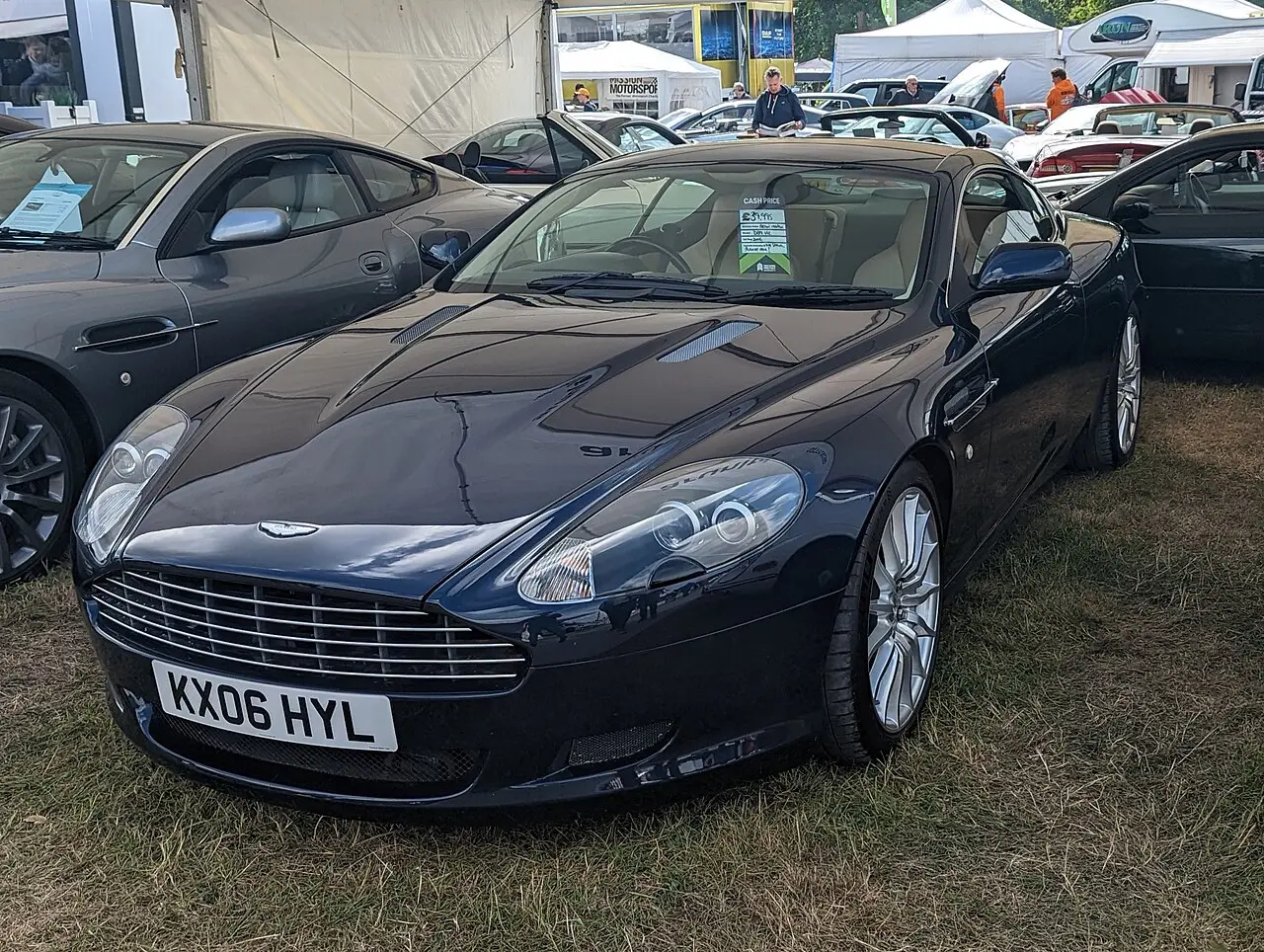
The official data lists 59 versions of the Aston Martin DB9 (2000–2017), in the European Union, the United Kingdom, France, the United States, and Canada. Each market publishes its own figures, measured on its own test procedure.
At a glance
Years in the data
2000–2017
Markets
European Union, United Kingdom, France, United States, Canada
Engines
5.9 L to 5.9 L
Power
350 kW (476 PS) to 403 kW (548 PS)
Fuels
Petrol
Lowest consumption (United Kingdom)
14.0 L/100 km (NEDC)
Lowest consumption (France)
14.3 L/100 km (NEDC)
Lowest consumption (Canada)
15.2 L/100 km (5-cycle)
New registrations in the EU
2,906
What is the Aston Martin DB9?
The DB9 is a two-door grand touring car, offered as a coupe and as the Volante convertible. Its front-engined layout and long bonnet give it the classic proportions of an Aston Martin grand tourer. The DB9 was a central model in the range before the DB11 succeeded it. The DB name honours David Brown, who acquired Aston Martin in 1947; the company was founded in 1913.
The DB9 generation ran from 2004 to 2016. Its design gave the marque’s familiar grand touring proportions a cleaner, more modern look. Updates came during its production run, while the listed versions retained a 5.9-litre petrol engine.
Engines and power
Every listed DB9 version uses a 5.9-litre petrol engine. EU figures span 350 kW (476 PS) to 403 kW (548 PS); French figures cover 350 kW (476 PS) to 381 kW (518 PS).
The DB9’s V12 was paired with either a fixed-roof coupe body or an open-top Volante. Availability varied by market and model year.
How economical is the Aston Martin DB9?
In the UK, the lowest listed consumption is 14 L/100 km on NEDC; France lists 14.3 L/100 km, also on NEDC. These figures use the same test procedure, while results from other procedures may differ.
The EPA’s lowest listed US figure is 15.7 L/100 km, with a combined rating of 15 MPG. Canada lists a low of 15.2 L/100 km on the NRCan 5-cycle test. EPA, NRCan 5-cycle and European NEDC procedures differ, and figures vary by version.
Where was the DB9 sold?
Official DB9 figures appear for the European Union, the UK, France, the United States and Canada. EU figures cover 2010–2017; UK figures span 2004–2017, and French figures cover 2012–2014. US figures span 2000–2016, while Canadian figures cover 2007–2016.
Questions and answers
What years was the DB9 made?
The DB9 generation ran from 2004 to 2016. Official market figures extend through 2017 in the European Union and UK.
What engine does the DB9 have?
The listed DB9 versions use a 5.9-litre petrol engine, with EU outputs from 350 kW (476 PS) to 403 kW (548 PS).
What is the DB9’s lowest official fuel consumption?
The lowest listed figure is 14 L/100 km in UK NEDC results. US and Canadian results use different procedures.
Was the DB9 sold in France and North America?
Yes. It appears in French, US and Canadian official figures, as well as in the UK and European Union.
New cars registered in the EU (plus Norway and Iceland), from the European Environment Agency. Figures on the NEDC procedure until 2020 and on WLTP from 2021; versions are grouped by engine and power, with their number of registrations.
Years and version
Engine
Power
Fuel
CO₂
EU registrations
2016
5.9 L
403 kW (548 PS)
Petrol
325 g/km
478
2016
5.9 L
381 kW (518 PS)
Petrol
325 g/km
22
2015
5.9 L
381 kW (518 PS)
Petrol
329 g/km
570
2015
5.9 L
403 kW (548 PS)
Petrol
325 g/km
20
2014
5.9 L
381 kW (518 PS)
Petrol
331 g/km
570
2013
5.9 L
381 kW (518 PS)
Petrol
333 g/km
418
2012
5.9 L
350 kW (476 PS)
Petrol
350 g/km
154
2012
5.9 L
381 kW (518 PS)
Petrol
333 g/km
10
2011
5.9 L
350 kW (476 PS)
Petrol
357 g/km
234
2010
5.9 L
–
Petrol
354 g/km
302
United Kingdom 15 versions
New cars on sale in the UK, from the Vehicle Certification Agency. NEDC figures until 2018 and WLTP figures after; years are the editions a version appeared in.
Years and version
Engine
Fuel
Gearbox
Consumption (combined)
CO₂
2015–2017Coupé and Convertible · Coupé and Volante
5.9 L
Petrol
6-speed automatic
14.0 L/100 km NEDC
325 g/km
2015Coupé & Convertible March 2010 onwards
5.9 L
Petrol
6-speed automatic
14.6 L/100 km NEDC
345 g/km
2015Coupé & Convertible March 2010 onwards
5.9 L
Petrol
6-speed manual
16.4 L/100 km NEDC
389 g/km
2015Coupé & Convertible
5.9 L
Petrol
6-speed automatic
14.3 L/100 km NEDC
333 g/km
2013–2014Coupé & Convertible March 2010 onwards
5.9 L
Petrol
Automatic
14.6 L/100 km NEDC
345 g/km
2013–2014Coupé & Convertible March 2010 onwards
5.9 L
Petrol
Manual
16.4 L/100 km NEDC
389 g/km
2013–2014Coupé & Convertible
5.9 L
Petrol
Automatic
14.3 L/100 km NEDC
333 g/km
2012Coupé & Convertible March 2010 onwards
5.9 L
Petrol
6-speed automatic
14.6 L/100 km NEDC
345 g/km
2012Coupé & Convertible March 2010 onwards
5.9 L
Petrol
6-speed manual
16.4 L/100 km NEDC
389 g/km
2010Coupé & Convertible March 2010 onwards
5.9 L
Petrol
6-speed automatic
14.6 L/100 km NEDC
345 g/km
2008–2010Coupé & Convertible · Coupé & Convertible March 2010 onwards
5.9 L
Petrol
6-speed manual
16.4 L/100 km NEDC
389 g/km
2006–2009Coupé & Convertible
5.9 L
Petrol
6-speed automatic
16.5 L/100 km NEDC
394 g/km
2006–2009Coupé & Convertible
5.9 L
Petrol
6-speed manual
17.8 L/100 km NEDC
421 g/km
2008–2009Coupé & Convertible
5.9 L
Petrol
6-speed automatic
15.6 L/100 km NEDC
368 g/km
2004Coupe & Convertible
5.9 L
Petrol
6-speed automatic
16.5 L/100 km NEDC
394 g/km
France 8 versions
New cars on sale in France, from ADEME Car Labelling. NEDC figures until 2015, WLTP figures in the current catalogue.
Years and version
Engine
Power
Fuel
Gearbox
Consumption (combined)
CO₂
2014DB9
–
381 kW (518 PS)
Petrol
6-speed automatic
14.3 L/100 km NEDC
333 g/km
2014DB9
–
381 kW (518 PS)
Petrol
6-speed automatic
14.3 L/100 km NEDC
333 g/km
2013DB9
–
381 kW (518 PS)
Petrol
6-speed automatic
14.3 L/100 km NEDC
333 g/km
2013DB9
–
381 kW (518 PS)
Petrol
6-speed automatic
14.3 L/100 km NEDC
333 g/km
2012DB9
–
350 kW (476 PS)
Petrol
6-speed automatic
14.6 L/100 km NEDC
345 g/km
2012DB9 VOLANTE · DB9
–
350 kW (476 PS)
Petrol
6-speed automatic
14.6 L/100 km NEDC
345 g/km
2012DB9 VOLANTE · DB9
–
350 kW (476 PS)
Petrol
6-speed manual
16.4 L/100 km NEDC
389 g/km
2012DB9
–
350 kW (476 PS)
Petrol
6-speed manual
16.4 L/100 km NEDC
389 g/km
United States 8 versions
Model years sold in the USA, from the EPA and the Department of Energy (fueleconomy.gov). MPG on the EPA test; litres per 100 km = 235.215 ÷ MPG.
Years and version
Engine
Fuel
Gearbox
Drive
Consumption (combined)
CO₂
2015–2016
5.9 L
Petrol
6-speed automatic
Rear-wheel drive
15 MPG (15.7 L/100 km) EPA
363 g/km
2013–2014
5.9 L
Petrol
6-speed automatic
Rear-wheel drive
15 MPG (15.7 L/100 km) EPA
364 g/km
2009–2012
5.9 L
Petrol
6-speed manual
Rear-wheel drive
13 MPG (18.1 L/100 km) EPA
425 g/km
2010–2012
5.9 L
Petrol
6-speed automatic
Rear-wheel drive
15 MPG (15.7 L/100 km) EPA
368 g/km
2009CLKUP
5.9 L
Petrol
6-speed automatic
Rear-wheel drive
14 MPG (16.8 L/100 km) EPA
394 g/km
2005–2008CLKUP
5.9 L
Petrol
6-speed automatic
Rear-wheel drive
13 MPG (18.1 L/100 km) EPA
425 g/km
2005–2008CLKUP
5.9 L
Petrol
6-speed automatic
Rear-wheel drive
13 MPG (18.1 L/100 km) EPA
425 g/km
2005–2008
5.9 L
Petrol
6-speed manual
Rear-wheel drive
12 MPG (19.6 L/100 km) EPA
460 g/km
Canada 10 versions
Model years sold in Canada, from Natural Resources Canada fuel consumption ratings (5-cycle test).
Years and version
Engine
Fuel
Gearbox
Consumption (combined)
CO₂
2016Minicompact
5.9 L
Petrol
6-speed automatic
15.6 L/100 km 5-cycle
365 g/km
2014–2015Minicompact
5.9 L
Petrol
6-speed automatic
15.6 L/100 km 5-cycle
359 g/km
2013Minicompact
5.9 L
Petrol
6-speed automatic
15.5 L/100 km 5-cycle
357 g/km
2009–2012Minicompact
5.9 L
Petrol
6-speed manual
17.6 L/100 km 5-cycle
405 g/km
2011–2012Minicompact
5.9 L
Petrol
6-speed automatic
15.3 L/100 km 5-cycle
352 g/km
2010Minicompact
5.9 L
Petrol
6-speed automatic
15.2 L/100 km 5-cycle
350 g/km
2009Minicompact
5.9 L
Petrol
6-speed automatic
16.0 L/100 km 5-cycle
368 g/km
2007–2008Minicompact
5.9 L
Petrol
6-speed automatic
17.6 L/100 km 5-cycle
405 g/km
2007–2008Minicompact
5.9 L
Petrol
6-speed manual
19.1 L/100 km 5-cycle
439 g/km
2007–2008Minicompact
5.9 L
Petrol
6-speed automatic
17.6 L/100 km 5-cycle
405 g/km
Versions outside these generations
European Union 1 version
New cars registered in the EU (plus Norway and Iceland), from the European Environment Agency. Figures on the NEDC procedure until 2020 and on WLTP from 2021; versions are grouped by engine and power, with their number of registrations.
Years and version
Engine
Power
Fuel
CO₂
EU registrations
2017
5.9 L
403 kW (548 PS)
Petrol
325 g/km
128
United States 7 versions
Model years sold in the USA, from the EPA and the Department of Energy (fueleconomy.gov). MPG on the EPA test; litres per 100 km = 235.215 ÷ MPG.
Years and version
Engine
Fuel
Gearbox
Drive
Consumption (combined)
CO₂
2003GUZZLER, CLKUP
5.9 L
Petrol
5-speed automatic
Rear-wheel drive
12 MPG (19.6 L/100 km) EPA
460 g/km
2003GUZZLER, CLKUP
5.9 L
Petrol
6-speed manual
Rear-wheel drive
12 MPG (19.6 L/100 km) EPA
460 g/km
2003GUZZLER, CLKUP
5.9 L
Petrol
6-speed manual
Rear-wheel drive
11 MPG (21.4 L/100 km) EPA
502 g/km
2003GUZZLER, CLKUP
5.9 L
Petrol
6-speed manual
Rear-wheel drive
11 MPG (21.4 L/100 km) EPA
502 g/km
2003GUZZLER, CLKUP
5.9 L
Petrol
5-speed automatic
Rear-wheel drive
13 MPG (18.1 L/100 km) EPA
425 g/km
2000GUZZLER, 2MODE CLKUP
5.9 L
Petrol
5-speed automatic
Rear-wheel drive
12 MPG (19.6 L/100 km) EPA
460 g/km
2000GUZZLER
5.9 L
Petrol
6-speed manual
Rear-wheel drive
12 MPG (19.6 L/100 km) EPA
460 g/km
Official figures are measured on standard test procedures and differ between markets. Your consumption depends on how, where and in what conditions you drive.