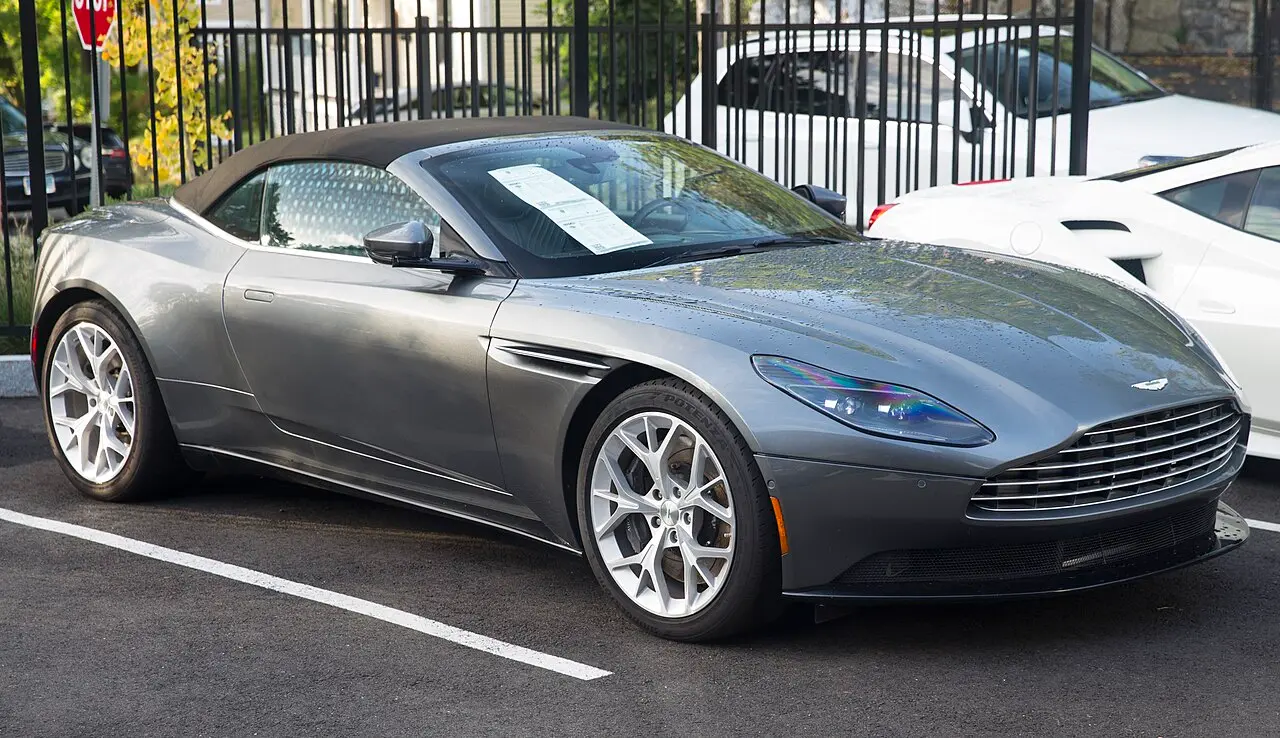
The official data lists 42 versions of the Aston Martin DB11 (2016–2024), in the European Union, the United Kingdom, the United States, and Canada. Each market publishes its own figures, measured on its own test procedure.
At a glance
Years in the data
2016–2024
Markets
European Union, United Kingdom, United States, Canada
Engines
4.0 L to 5.2 L
Power
375 kW (510 PS) to 470 kW (639 PS)
Fuels
Petrol
Lowest consumption (United Kingdom)
9.9 L/100 km (NEDC)
Lowest consumption (European Union)
11.0 L/100 km (WLTP)
Lowest consumption (Canada)
11.5 L/100 km (5-cycle)
New registrations in the EU
7,688
What is the Aston Martin DB11?
The DB11 is a front-engined grand touring car, offered as a coupe and a convertible. It succeeded the DB9 and sat at the heart of Aston Martin’s range, combining a two-door body with a focus on long-distance travel. Aston Martin was founded in 1913 by Lionel Martin and Robert Bamford.
The DB11 generation ran from 2016 to 2023. Its new bonded-aluminium structure and updated design introduced a fresh take on the familiar long-bonnet Aston Martin shape. The model was unveiled in 2016 as part of the company’s Second Century product plan.
Engines and power
DB11 versions used petrol engines. European Union and UK listings cover 4.0-litre and 5.2-litre units. The EU range runs from 375 kW (510 PS) to 470 kW (639 PS), and the UK listing shows the same output range.
The 5.2-litre V12 was offered from launch, and a 4.0-litre twin-turbo V8 joined the range in 2017. The two engines gave the DB11 distinct characters within the same grand touring body.
How economical is the Aston Martin DB11?
The lowest official EU figure is 11 L/100 km on WLTP. UK figures show a low of 9.9 L/100 km on NEDC. WLTP and NEDC use different test procedures, so these results are not directly comparable.
In the United States, the EPA’s lowest listed result is 11.8 L/100 km, with a combined rating of 20 MPG. Canada’s lowest is 11.5 L/100 km on the NRCan 5-cycle test. EPA, NRCan 5-cycle and European procedures differ, and results vary by engine and version.
Where was the DB11 sold?
Official DB11 figures are available for the European Union, the UK, the United States and Canada. EU figures span 2016–2024; UK, US and Canadian figures cover 2017–2023.
Questions and answers
When was the Aston Martin DB11 made?
The DB11 generation ran from 2016 to 2023. Official market figures extend through 2024 in the European Union and through 2023 in the UK, US and Canada.
Which engines were offered in the DB11?
The petrol range included a 4.0-litre twin-turbo V8 and a 5.2-litre V12.
What is the DB11’s lowest official fuel consumption?
The lowest listed figure is 9.9 L/100 km in UK NEDC results. Other markets use different procedures and report different minima.
Was the DB11 sold in North America?
Yes. It appears in US EPA and Canadian NRCan figures for 2017–2023.
New cars registered in the EU (plus Norway and Iceland), from the European Environment Agency. Figures on the NEDC procedure until 2020 and on WLTP from 2021; versions are grouped by engine and power, with their number of registrations.
Years and version
Engine
Power
Fuel
Consumption (combined)
CO₂
EU registrations
2023
4.0 L
393 kW (534 PS)
Petrol
11.3 L/100 km WLTP
256 g/km
75
2023
5.2 L
470 kW (639 PS)
Petrol
13.4 L/100 km WLTP
309 g/km
10
2022
4.0 L
394 kW (536 PS)
Petrol
11.2 L/100 km WLTP
256 g/km
82
2022
5.2 L
470 kW (639 PS)
Petrol
13.3 L/100 km WLTP
303 g/km
20
2022
4.0 L
375 kW (510 PS)
Petrol
11.2 L/100 km WLTP
254 g/km
19
2022
4.0 L
393 kW (534 PS)
Petrol
11.1 L/100 km WLTP
255 g/km
10
2021
4.0 L
375 kW (510 PS)
Petrol
11.0 L/100 km WLTP
256 g/km
170
2021
5.2 L
470 kW (639 PS)
Petrol
13.4 L/100 km WLTP
303 g/km
66
2020
4.0 L
375 kW (510 PS)
Petrol
–
230 g/km
814
2019–2020
5.2 L
470 kW (639 PS)
Petrol
–
265 g/km
612
2019
4.0 L
375 kW (510 PS)
Petrol
–
230 g/km
1,157
2019
5.2 L
448 kW (609 PS)
Petrol
–
265 g/km
54
2019
5.2 L
447 kW (608 PS)
Petrol
–
265 g/km
22
2018
4.0 L
375 kW (510 PS)
Petrol
–
230 g/km
1,298
2018
5.2 L
448 kW (609 PS)
Petrol
–
265 g/km
656
2018
3.9 L
375 kW (510 PS)
Petrol
–
230 g/km
46
2018
5.2 L
447 kW (608 PS)
Petrol
–
265 g/km
46
2018
5.2 L
470 kW (639 PS)
Petrol
–
267 g/km
18
2017
5.2 L
448 kW (609 PS)
Petrol
–
266 g/km
1,902
2016–2017
5.2 L
447 kW (608 PS)
Petrol
–
265 g/km
242
2017
4.0 L
375 kW (510 PS)
Petrol
–
230 g/km
84
2016
5.2 L
448 kW (609 PS)
Petrol
–
265 g/km
264
United Kingdom 11 versions
New cars on sale in the UK, from the Vehicle Certification Agency. NEDC figures until 2018 and WLTP figures after; years are the editions a version appeared in.
Years and version
Engine
Power
Fuel
Gearbox
Consumption (combined)
CO₂
2020–2023DB11 V8 RWD Automatic Convertible
4.0 L
375 kW (510 PS)
Petrol
8-speed automatic
11.3 L/100 km WLTP
257 g/km
2020–2023DB11 V8 RWD Automatic Coupe
4.0 L
375 kW (510 PS)
Petrol
8-speed automatic
11.2 L/100 km WLTP
254 g/km
2020–2023DB11 V12 AMR RWD Automatic Coupe · Coupe
5.2 L
470 kW (639 PS)
Petrol
8-speed automatic
13.4 L/100 km WLTP
303 g/km
2020–2021Coupe
4.0 L
375 kW (510 PS)
Petrol
8-speed automatic
10.8 L/100 km WLTP
244 g/km
2020–2021Convertible
4.0 L
375 kW (510 PS)
Petrol
8-speed automatic
11.6 L/100 km WLTP
263 g/km
2019Coupe
4.0 L
375 kW (510 PS)
Petrol
8-speed automatic
10.8 L/100 km WLTP
–
2019Convertible
4.0 L
375 kW (510 PS)
Petrol
8-speed automatic
11.6 L/100 km WLTP
–
2019Coupe
5.2 L
470 kW (639 PS)
Petrol
8-speed automatic
13.4 L/100 km WLTP
–
2018Coupé
4.0 L
–
Petrol
8-speed automatic
9.9 L/100 km NEDC
230 g/km
2018Convertible
4.0 L
–
Petrol
8-speed automatic
10.0 L/100 km NEDC
230 g/km
2017–2018Coupé
5.2 L
–
Petrol
8-speed automatic
11.4 L/100 km NEDC
265 g/km
United States 4 versions
Model years sold in the USA, from the EPA and the Department of Energy (fueleconomy.gov). MPG on the EPA test; litres per 100 km = 235.215 ÷ MPG.
Years and version
Engine
Fuel
Gearbox
Drive
Consumption (combined)
CO₂
2018–2023SIDI
4.0 L
Petrol
8-speed automatic
Rear-wheel drive
20 MPG (11.8 L/100 km) EPA
268 g/km
2022–2023
5.2 L
Petrol
8-speed automatic
Rear-wheel drive
17 MPG (13.8 L/100 km) EPA
324 g/km
2019–2021
5.2 L
Petrol
8-speed automatic
Rear-wheel drive
18 MPG (13.1 L/100 km) EPA
309 g/km
2017–2018
5.2 L
Petrol
8-speed automatic
Rear-wheel drive
17 MPG (13.8 L/100 km) EPA
309 g/km
Canada 4 versions
Model years sold in Canada, from Natural Resources Canada fuel consumption ratings (5-cycle test).
Years and version
Engine
Fuel
Gearbox
Consumption (combined)
CO₂
2018–2023Minicompact
4.0 L
Petrol
8-speed automatic
11.5 L/100 km 5-cycle
271 g/km
2022–2023Minicompact
5.2 L
Petrol
8-speed automatic
13.8 L/100 km 5-cycle
324 g/km
2019–2021Minicompact
5.2 L
Petrol
8-speed automatic
13.3 L/100 km 5-cycle
312 g/km
2017–2018Minicompact
5.2 L
Petrol
8-speed automatic
13.7 L/100 km 5-cycle
322 g/km
Versions outside these generations
European Union 1 version
New cars registered in the EU (plus Norway and Iceland), from the European Environment Agency. Figures on the NEDC procedure until 2020 and on WLTP from 2021; versions are grouped by engine and power, with their number of registrations.
Years and version
Engine
Power
Fuel
Consumption (combined)
CO₂
EU registrations
2024
4.0 L
394 kW (536 PS)
Petrol
11.3 L/100 km WLTP
256 g/km
21
Official figures are measured on standard test procedures and differ between markets. Your consumption depends on how, where and in what conditions you drive.